
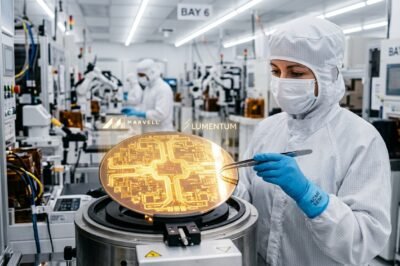
The global semiconductor landscape was rocked this morning by the announcement of a definitive agreement for Marvell Technology to acquire Lumentum Holdings in a transaction valued at a staggering $115 billion. This seismic move represents one of the largest acquisitions in the history of the technology sector, signaling a massive consolidation effort aimed squarely at dominating the burgeoning artificial intelligence infrastructure market. As generative AI models grow exponentially in complexity, the hardware requirements to support them have shifted from traditional compute-heavy architectures to specialized networking and optical interconnect solutions. By absorbing Lumentum, a leader in optical components and laser technology, Marvell is positioning itself as the primary architect for the next generation of AI-driven data centers. This deal is not merely a financial transaction; it is a strategic maneuver to control the flow of data at light speed, bridging the gap between electrical signals and optical transmission. Investors and industry analysts are viewing this as a direct challenge to established giants like Broadcom and Nvidia, as Marvell looks to own the entire connectivity stack. The implications for the global supply chain, cloud service providers, and the future of high-speed computing are profound, marking a new era where silicon and photonics become inseparable components of the AI revolution.
The Strategic Logic of the AI Infrastructure Supercycle
The primary driver behind this $115 billion acquisition is the unprecedented demand for bandwidth within modern data centers. AI training clusters, which often consist of tens of thousands of GPUs working in parallel, require massive amounts of data to be moved between nodes with near-zero latency. Traditional copper-based interconnects are reaching their physical limits in terms of distance and speed, leading to a massive pivot toward optical networking. Lumentum’s expertise in Vertical-Cavity Surface-Emitting Lasers (VCSELs) and Externally Modulated Lasers (EMLs) provides Marvell with the critical hardware needed to convert electrical pulses into light, enabling faster and more efficient data transmission across the vast distances of a hyperscale facility.
Marvell has spent the last several years pivoting away from its legacy storage business to focus on high-speed networking and custom compute. By integrating Lumentum’s photonic integrated circuits (PICs) with Marvell’s industry-leading Digital Signal Processors (DSPs) and Ethernet switches, the combined entity can offer a vertically integrated solution that reduces power consumption and total cost of ownership for cloud titans like Amazon Web Services, Microsoft Azure, and Google Cloud. This integration is crucial as data centers struggle with the immense power demands of AI, where every watt saved in data transmission can be redirected to computational power.
Analyzing the Financial Architecture of the $115 Billion Deal
Financing a $115 billion acquisition requires a complex mixture of cash, equity, and debt, reflecting the high-stakes environment of the current semiconductor market. According to details released by Reuters, Marvell will utilize a combination of its existing cash reserves and a significant new debt facility to fund the cash portion of the deal, while issuing new shares to Lumentum stockholders. This valuation represents a significant premium over Lumentum’s recent market capitalization, a testament to the perceived value of its intellectual property and market position. Analysts point out that while the debt load will be substantial, the projected cash flows from the combined entity’s dominant position in the optical-AI space should provide ample coverage for interest payments.
The deal is expected to be immediately accretive to Marvell’s non-GAAP earnings per share within the first full year after closing. Synergies are estimated to reach hundreds of millions of dollars annually, primarily through supply chain optimization and R&D consolidation. However, the market’s initial reaction has been a mix of awe and caution, as the sheer scale of the integration process poses significant execution risks. Successfully merging two distinct corporate cultures and product roadmaps while maintaining the rapid pace of innovation required in the AI sector will be a Herculean task for Marvell’s management team.
Synergies in Silicon Photonics and Co-Packaged Optics (CPO)
One of the most technically compelling aspects of this merger is the advancement of Co-Packaged Optics (CPO). Traditionally, optical transceivers are pluggable modules that sit at the edge of a switch chassis. As speeds move toward 1.6 Terabits per second and beyond, the electrical path from the switch chip to the pluggable module becomes a significant bottleneck and a source of power loss. CPO seeks to solve this by bringing the optical engines directly onto the same package as the silicon switch or processor. Lumentum’s laser technology is the missing piece of the puzzle for Marvell’s CPO roadmap, allowing for a more compact and energy-efficient architecture.
By owning the laser source and the silicon photonics platform, Marvell can optimize the performance of the entire link. This is particularly relevant for the development of 800G and 1.6T networking standards, which are becoming the baseline for AI back-end fabrics. The combination of Marvell’s PAM4 DSP technology with Lumentum’s high-bandwidth optical components creates a formidable moat that competitors will find difficult to bridge. This technical synergy ensures that Marvell remains at the forefront of the optical transition, providing the






































Leave a Reply