
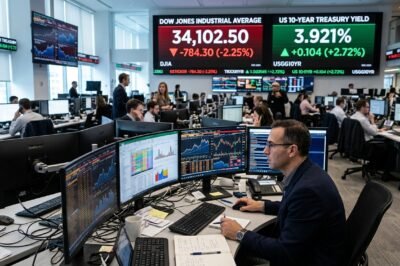
The financial markets are currently navigating a complex maze of political uncertainty and economic recalibration as the United States approaches the pivotal midterm elections. On Monday morning, investors woke up to a landscape defined by downward pressure on Dow Jones Industrial Average futures and a simultaneous climb in Treasury yields, a dual movement that signals a cautious, risk-averse stance among institutional traders. This movement is not merely a localized reaction to a single news cycle but rather the culmination of weeks of speculation regarding the future of fiscal policy, the potential for legislative gridlock, and the Federal Reserve’s unwavering commitment to taming inflation. The tension on Wall Street is palpable as the WSJ reports indicate that the traditional ‘pre-election rally’ is being replaced by a ‘wait-and-see’ approach, where the certainty of rising interest rates outweighs the speculative optimism of political shifts. As the 10-year Treasury yield edges closer to critical psychological levels, the cost of borrowing increases, putting an immediate damper on growth-oriented stocks and casting a shadow over the broader equity market. This analysis seeks to unpack the intricate relationship between Washington’s ballot boxes and New York’s trading floors, providing a comprehensive look at why the current economic climate is uniquely sensitive to the upcoming electoral outcomes and what it means for the global financial ecosystem.
The Anatomy of the Dow Futures Retreat
The decline in Dow futures represents more than just a red number on a screen; it is a quantitative reflection of the market’s discomfort with the unknown. Historically, the period leading up to midterms is marked by increased volatility, as investors attempt to price in various legislative scenarios. When futures for the Dow Jones Industrial Average fall, it often indicates that large-scale institutional players are hedging their bets, moving capital away from equities and into more defensive postures. This particular retreat is driven by the fear that a shift in congressional power could lead to a stalemate in fiscal policy, making it more difficult for the government to respond to a potential recession. Market participants are particularly concerned with how a divided government might impact spending bills, tax reform, and the debt ceiling.
Furthermore, the technical levels of the Dow are being tested. Traders are looking at the 30,000 to 32,000 range as a zone of significant support, and any slip below these markers could trigger automated sell orders, further exacerbating the downward trend. The current decline is also influenced by corporate earnings reports that have shown a mixed bag of results, with many companies issuing cautious guidance for the final quarter of the year. When combined with the political overhead, the incentive to stay long on equities diminishes, leading to the current futures slump. The interplay between sector-specific performance and the macro-political environment creates a high-stakes environment where even small shifts in polling data can lead to significant swings in futures pricing.
Understanding the Surge in Treasury Yields
As Dow futures descend, Treasury yields are moving in the opposite direction, a classic sign of the market’s focus on inflation and monetary policy. The 10-year Treasury note, often viewed as the benchmark for global borrowing costs, has seen its yield rise as investors dump bonds in anticipation of higher interest rates for longer periods. The logic is straightforward: if the Federal Reserve continues to hike rates to combat sticky inflation, older bonds with lower yields become less attractive, driving their prices down and their yields up. This surge in yields is a double-edged sword; while it reflects a robust attempt to stabilize the currency, it simultaneously increases the cost of mortgages, auto loans, and corporate debt.
The rise in yields also suggests that the bond market is pricing in a ‘higher for longer’ interest rate environment regardless of the election outcome. While some had hoped for a ‘pivot’ or a pause in rate hikes, the current trajectory of the 2-year and 10-year notes indicates that fixed-income investors are bracing for persistent inflationary pressures. This upward movement in yields directly competes with stocks for investor dollars. When a ‘risk-free’ government bond offers a 4% or 5% return, the relative attractiveness of the volatile stock market decreases, especially for pension funds and insurance companies that require stable, predictable returns. This ‘yield competition’ is a primary driver behind the current equity sell-off heading into the midterms.
Political Scenarios and Their Market Impacts
The upcoming midterm elections present several distinct scenarios that could drastically alter the market’s path in 2024 and beyond. The most discussed scenario is a ‘split government,’ where one party controls the White House and another controls at least one chamber of Congress. Historically, markets have actually performed well under gridlock because it prevents radical policy changes and provides a stable, if stagnant, regulatory environment. However, the current economic climate is different; gridlock could prevent necessary fiscal interventions if the economy enters a sharp downturn. Investors are weighing the benefits of a ‘check’ on executive power against the risks of legislative paralysis.
Another scenario involves a ‘sweep,’ where one party gains total control of both the House and the Senate. A Republican sweep might lead to expectations of tax cuts and deregulation, which typically boosts energy and financial stocks. Conversely, a Democratic hold might signal continued support for green energy initiatives and increased social spending, impacting the healthcare and technology sectors. The uncertainty of these outcomes leads to ‘positioning,’ where traders buy or sell specific sectors based on the latest polling data. This sector rotation is currently contributing to the overall instability of the Dow, as capital moves out of high-growth tech and into defensive staples or energy stocks that are perceived to be more resilient to political shifts.
The Inflation Factor and the Federal Reserve
While the elections are the immediate focus, the underlying driver of both Dow futures and Treasury yields remains the Federal Reserve’s battle with inflation. The Consumer Price Index (CPI) readings have remained stubbornly high, forcing the Fed to maintain an aggressive stance. The market is currently caught in a tug-of-war between the desire for political stability and the reality of a tightening monetary cycle. Even if the election produces a favorable result for markets, the Fed’s actions will likely have a more profound long-term impact on asset valuations. The rise in yields we see today is a direct response to the Fed’s ‘dot plot’ and public statements from FOMC members.
Moreover, the relationship between the labor market and inflation is under intense scrutiny. A ‘hot’ labor market, while good for workers, often signals to the Fed that the economy is not yet cooling enough to bring inflation back to its 2% target. This creates a ‘bad news is good news’ dynamic where strong economic data leads to stock market declines because it implies more aggressive rate hikes. As we head into the midterms, any economic data release becomes a potential catalyst for volatility, as it informs both voter sentiment and central bank policy simultaneously. The convergence of these factors makes the current period one of the most difficult to navigate for retail and institutional investors alike.
Historical Context: Midterms and Market Performance
Looking back at historical data, the fourth quarter of a midterm election year is usually one of the strongest periods for the stock market. Since 1950, the S&P 500 has often seen significant gains in the twelve months following a midterm election. However, the caveat this year is the unprecedented level of global debt and the speed of interest rate increases. Unlike previous cycles, we are dealing with a post-pandemic recovery that is being choked by supply chain issues and geopolitical tensions, such as the conflict in Ukraine. These external shocks mean that historical precedents may not be as reliable as they once were.
Statistics show that the Dow often experiences a ‘relief rally’ once the election results are finalized, simply because the uncertainty is removed. Markets hate uncertainty more than they hate bad news. Once the composition of Congress is known, corporations can begin to plan their capital expenditures and hiring strategies with more confidence. However, the rising Treasury yields act as a ‘governor’ on this potential rally. If yields continue to climb post-election, any stock market gain might be short-lived, as the fundamental valuation models (like the Discounted Cash Flow model) will require higher discount rates, effectively lowering the present value of future earnings. This historical context suggests a period of recovery is possible, but it is heavily conditioned on the stabilization of the bond market.
Conclusion: Navigating the Future Implications
The current synchronicity of falling Dow futures and rising Treasury yields heading into the midterms highlights a period of significant structural change in the financial markets. The ‘era of free money’ has officially ended, and we are entering a new phase where capital discipline and yield-sensitivity are paramount. For the average investor, the takeaway is clear: volatility is likely to remain elevated through the end of the year. The outcome of the elections will provide the ‘rules of the game’ for the next two years, but the Federal Reserve will remain the ultimate referee. The future implications suggest a shift toward ‘quality’ stocks with strong cash flows and low debt, as the cost of capital remains high.
As we move past the election cycle, the focus will likely shift back to corporate margins and the potential for a ‘soft landing’ versus a hard recession. If Treasury yields stabilize, we could see a return of confidence in the equity markets. However, if they continue to surge toward 5% or higher, the pressure on the Dow will likely persist, regardless of who wins control of Washington. In conclusion, while the midterms are a major milestone, they are just one piece of a much larger economic puzzle that includes global trade, energy security, and the persistent challenge of inflation. Investors should remain diversified and prepared for a market environment that prioritizes stability over speculative growth for the foreseeable future.







































Leave a Reply