
Bridging Traditional Craftsmanship and Higher Education
IMPHAL: Manipur’s rich heritage of traditional craftsmanship is set to receive renewed institutional attention, with Manipur University and the Ministry of Textiles exploring a specialised academic pathway to integrate traditional arts and crafts into higher education.
The proposed initiative seeks to establish a meaningful connection between generations of indigenous knowledge and contemporary academic, technical and entrepreneurial practices. By recognising traditional craftsmanship as a valuable field of education, research and innovation, the initiative aims to preserve cultural heritage while creating sustainable economic opportunities for artisan communities.
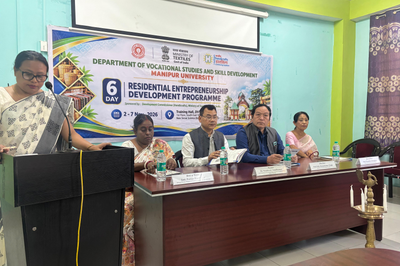
The proposal was highlighted by Ms. Pampa Karmakar, Assistant Director (Handicrafts), Handicrafts Service Centre (HSC), Porompat, during the inauguration of a six-day residential Entrepreneurship Development Programme at Manipur University on November 2, 2026.
Manipur possesses a diverse and vibrant tradition of handicrafts and handlooms, representing generations of artistic excellence and cultural inheritance. However, artisans across the State continue to face challenges arising from changing market dynamics, limited institutional support, financial constraints and disruptions caused by social disturbances.
Recognising these concerns, the Office of the Development Commissioner (Handicrafts), Ministry of Textiles, Government of India, has been promoting Entrepreneurship Development Programmes (EDPs) to strengthen the business capabilities of traditional craftspeople.
Proposed Academic Course to Recognise Traditional Knowledge
The proposed academic initiative at Manipur University reflects an emerging approach towards integrating traditional craftsmanship with structured higher education.
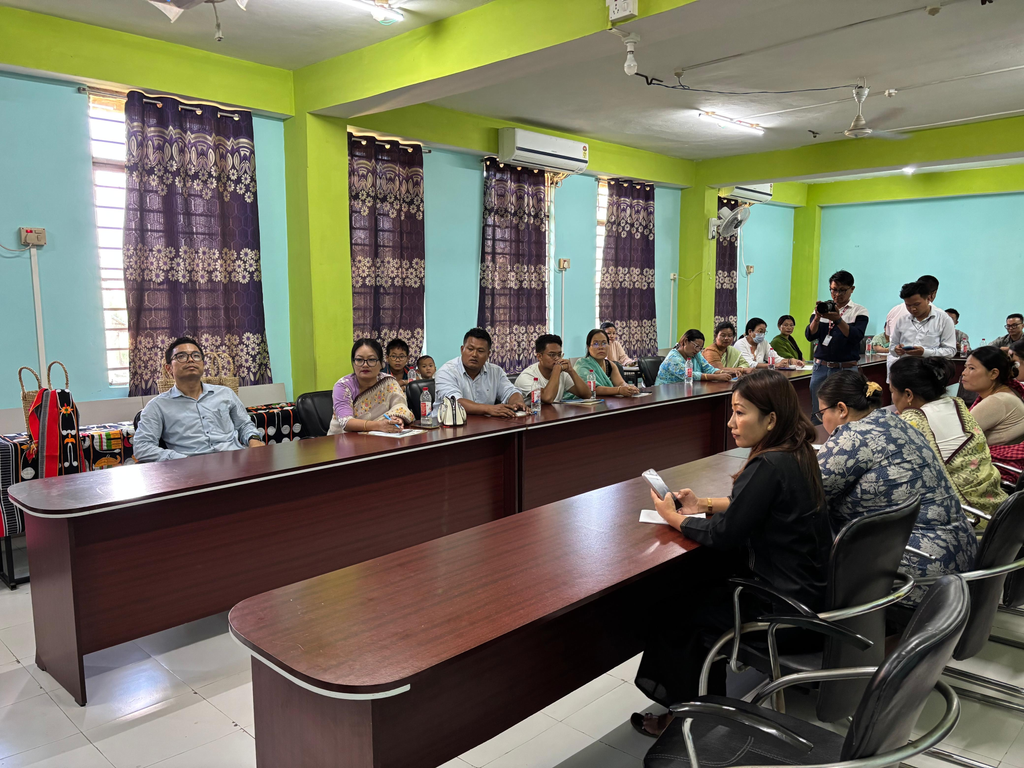
Ms. Karmakar indicated that the Ministry is interested in strengthening collaboration between universities and practising handicraft entrepreneurs. Such partnerships could provide opportunities for traditional artisans to contribute their practical knowledge while benefiting from academic research, technical expertise and institutional resources.
She proposed consultations with the university administration and faculty members to assess the academic, technical and infrastructural requirements for introducing a specialised course in traditional arts and crafts.
A structured questionnaire is expected to be shared with the University to obtain its views and suggestions. The responses could subsequently be placed before senior officials of the Ministry for further consideration.
Although the proposal remains at an exploratory stage, it represents an important step towards recognising traditional craftsmanship as a discipline capable of contributing to education, research, product innovation and entrepreneurship.
Six-Day Entrepreneurship Development Programme Begins
Alongside the proposed academic initiative, the Handicrafts Service Centre, Imphal, commenced a six-day residential Entrepreneurship Development Programme from November 2 to 7, 2026, at the Conference Hall of Manipur University.
The programme is being conducted under the National Handicrafts Development Programme (NHDP).
It is organised by the Department of Vocational Studies and Skill Development (DVSSD), Manipur University, with sponsorship from the Office of the Development Commissioner (Handicrafts), North Eastern Regional Office, Guwahati, Ministry of Textiles, in coordination with HSC Porompat.
Twenty registered artisans representing six Handicrafts Producer Companies are participating in the programme. The participating organisations include Heeri Konba Handloom & Handicraft, Loijing Loya Handicraft, Gyanis Handicraft, Kauna Eastern Company Limited, Aahenba and Citizen Welfare Handicraft Producer Companies.
The inaugural function was attended by Prof. R.K. Hemakumar Singh, Vice-Chancellor of Manipur University, as Chief Guest. Prof. Memcha Loitongbam, Dean, School of Social Sciences, and Ms. Pampa Karmakar attended as Guests of Honour. Dr. Nambram Amulkumar, Head of DVSSD, presided over the function.
Equipping Artisans with Contemporary Business Skills
The programme recognises that traditional artistic skills alone may not be sufficient to ensure commercial success in an increasingly competitive marketplace.
Artisans must also develop expertise in product quality, consumer preferences, costing, pricing, financial management, branding, packaging and marketing.
Accordingly, the training programme covers entrepreneurship and enterprise development, business planning, financial literacy, banking, GST, credit management, product design, digital marketing, e-commerce, export management and legal compliance for Producer Companies.
Practical sessions are designed to help participants identify market opportunities, improve production efficiency, manage financial resources and develop commercially sustainable enterprises.
Special emphasis is being placed on digital marketing and online business platforms, including IndiaHandmade and the Government e-Marketplace (GeM).
Participants are also being introduced to digital payments, product photography, export documentation and business planning, enabling them to apply the knowledge gained directly to their enterprises.
Addressing the participants, Vice-Chancellor Prof. R.K. Hemakumar Singh emphasised the importance of combining traditional craftsmanship with contemporary business knowledge.
He encouraged artisans to strengthen their understanding of enterprise management, financial procedures, GST, credit facilities, marketing and export opportunities. He also urged them to explore markets beyond their immediate geographical boundaries, including opportunities across India and overseas.
Referring to the national vision of Viksit Bharat 2047, he highlighted the importance of determination, continuous learning and individual initiative in achieving entrepreneurial success.
University–Artisan Collaboration for Innovation
Prof. Memcha Loitongbam highlighted the broader significance of entrepreneurship in economic and social development.
She observed that entrepreneurship extends beyond establishing businesses or making financial investments. It involves converting ideas into productive economic activities, generating employment and contributing to society.
She emphasised the importance of a supportive entrepreneurial ecosystem comprising financial resources, information technology, institutional guidance and market opportunities.
Manipur’s traditional skills and creative potential, she noted, must be supported through continuous knowledge enhancement, improved product quality and adaptation to changing consumer preferences.
Ms. Karmakar highlighted the complementary strengths of universities and practising artisans. While universities can contribute theoretical knowledge, research facilities and technical expertise, artisans possess invaluable practical experience acquired through generations of craftsmanship.
Such collaboration could facilitate product innovation, design development, preservation of traditional techniques and the creation of new entrepreneurial opportunities.
Dr. Kangjam Mukhara Devi, faculty member of DVSSD, also emphasised interactive learning that combines classroom knowledge with practical experience. She highlighted the need for stronger institutional support in finance, technology, marketing and business planning.
Manipur University as a Knowledge and Innovation Hub
Dr. Nambram Amulkumar highlighted the challenges faced by artisans in marketing, financial management, production efficiency and resource utilisation.
He drew attention to the University’s incubation facilities and technical infrastructure, including Computer Numerical Control (CNC) machines, which could potentially support product development and enterprise-related activities.
He assured participants that they could continue approaching the Department for technical guidance, knowledge-sharing and access to available facilities.
He also emphasised that financial assistance alone cannot ensure entrepreneurial success without proper planning, patience, resource management and sustained commitment.
The University has further announced another six-day Entrepreneurship Development Programme for handicraft artisans from November 16 to 21, 2026, indicating the possibility of continued institutional engagement with the artisan community.
Strengthening Producer Companies and Rebuilding Livelihoods
Handicrafts Producer Companies can play a significant role in improving the economic position of individual artisans by bringing them together under organised business structures.
Collective procurement of raw materials, coordinated production, quality management, branding and marketing can improve operational efficiency and bargaining capacity. Producer Companies can also facilitate larger orders, establish direct buyer relationships and create opportunities for participation in national and international markets.
The participation of six Producer Companies in the programme reflects the importance of strengthening collective entrepreneurship.
These initiatives assume particular significance in Manipur, where prolonged disturbances have affected the economic activities of numerous artisan families. Some craftspeople have experienced difficulties accessing raw materials, production facilities, transportation and markets, while artisans affected by community clashes have faced losses of houses, tools, materials and finished products.
Entrepreneurship development, institutional handholding, technical assistance and improved market access can contribute towards restoring livelihood opportunities and strengthening economic resilience.
The initiatives at Manipur University represent an encouraging effort to bring together traditional craftsmanship, higher education, government support, technology and entrepreneurship.
While the proposed academic course remains under exploration, the ongoing Entrepreneurship Development Programme provides an immediate platform for strengthening artisan enterprises.
The broader vision is to move beyond viewing artisans merely as producers and recognise them as entrepreneurs, innovators, employers and custodians of cultural heritage.
With sustained institutional collaboration, appropriate technical support and access to expanding markets, Manipur’s traditional crafts can gain renewed economic strength while retaining their cultural authenticity.






































Leave a Reply