
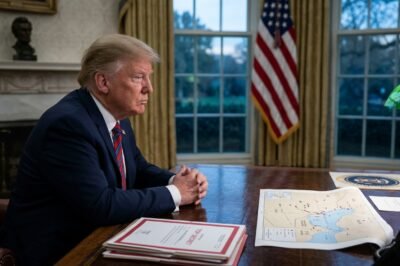
The political landscape of the United States underwent a seismic shift during the 2026 midterm elections, leaving the administration of Donald Trump in a state of unprecedented vulnerability. As the final ballots were tallied in key battleground states, the narrative of a resurgence for the incumbent party evaporated, replaced by a resurgent opposition that secured control over both the House of Representatives and the Senate. This electoral rebuke comes at a moment of extreme international peril, as the United States finds itself on the precipice of a full-scale kinetic conflict with Iran. The intersection of domestic political failure and a burgeoning foreign war has created a crucible for the White House, forcing a fundamental reassessment of a strategy that has hitherto relied on ‘maximum pressure’ and unilateral military brinkmanship. For the Trump administration, the loss is not merely a legislative hurdle; it is a clear signal from the American electorate that the appetite for another protracted conflict in the Middle East has reached an all-time low. As the dust settles on the 2026 midterms, the world watches with bated breath to see if the President will double down on his hawkish instincts or pivot toward a diplomatic off-ramp that now seems mandated by the people.
The 2026 Midterm Shift: A Mandate for De-escalation
The results of the 2026 midterms were a stark departure from the optimistic projections released by the Republican National Committee in the weeks leading up to the vote. Across the Rust Belt and the Sun Belt, voters turned out in record numbers to voice their disapproval of the administration’s aggressive foreign policy stances and the resulting economic instability. The loss of the Senate, in particular, represents a catastrophic blow to the administration’s ability to confirm military appointments and secure funding for ongoing operations in the Persian Gulf. Political analysts are pointing to a ‘war fatigue’ that has permeated the American consciousness, as the rhetoric surrounding the Iran conflict has increasingly mirrored the lead-up to the Iraq War in 2003.
In districts that were previously considered strongholds for the MAGA movement, there was a visible swing toward candidates who campaigned on a platform of ‘America First’—but with a twist that emphasized domestic rebuilding over foreign intervention. This internal schism within the conservative base has left the President with a fractured coalition. The new Congressional leadership has already signaled that it will use its subpoena power to investigate the intelligence used to justify the recent naval skirmishes in the Strait of Hormuz, further complicating the administration’s path forward. The mandate is clear: the American people are demanding a pivot away from the brink of war, leaving the President to navigate a path that satisfies his core supporters while acknowledging the reality of his diminished political capital.
The Geopolitical Stalemate: War with Iran at a Crossroads
The conflict with Iran has reached a dangerous stalemate, characterized by asymmetric warfare and a series of retaliatory strikes that have brought the two nations closer to the edge than ever before. Following the 2026 midterm results, the Iranian leadership in Tehran has adopted a posture of cautious observation, sensing that the U.S. executive branch is now internally constrained. The ‘Maximum Pressure’ campaign, which sought to cripple the Iranian economy to force a new nuclear agreement, has instead resulted in a hardened Iranian resolve and a series of provocative actions against international shipping and U.S. assets in the region. Without the backing of a unified Congress, the Trump administration’s threat of a ‘decisive military strike’ carries less weight on the international stage.
Military advisors within the Pentagon are reportedly divided on the next steps. Some argue for a strategic retreat to regroup and reassess, while others maintain that any sign of weakness following the election loss will only embolden Iranian-backed proxies in Lebanon, Iraq, and Yemen. The complexity of the battlefield is further exacerbated by the role of regional powers like Israel and Saudi Arabia, who have their own stakes in the outcome. However, with the new Congressional reality, the funding for any sustained military campaign is now under intense scrutiny. The 2026 midterms have effectively placed a ‘chokehold’ on the President’s ability to escalate the conflict without broad bipartisan support, which currently seems non-existent.
Economic Fallout: Global Markets and Oil Prices in Flux
The immediate reaction to the midterm results and the ongoing tensions in Iran was felt most acutely in the global financial markets. Oil prices, which had already been volatile, saw a sharp spike as traders weighed the possibility of a desperate administration taking military action to distract from domestic political failures. Brent crude surged past the $110 mark, sparking fears of a renewed inflationary cycle that could derail the fragile global economic recovery. For the Trump administration, the economic consequences of the Iran war are a double-edged sword; while high oil prices benefit domestic producers, they punish the average consumer at the pump—the very voters who just delivered a stinging rebuke to the President.
Furthermore, the uncertainty surrounding the U.S. political direction has led to a ‘flight to safety’ in the markets, with investors pouring capital into gold and treasury bonds. Financial analysts at major firms have warned that a prolonged period of legislative gridlock, combined with a potential military escalation, could lead to a ‘stagflation’ scenario reminiscent of the 1970s. The Business sector, usually a reliable ally for Republican administrations, has begun to voice concerns about the lack of a clear exit strategy in the Middle East. The 2026 midterms have highlighted the fact that geopolitical instability is no longer a localized issue but a direct threat to the American pocketbook.
Congressional Gridlock: The Legislative Hurdles for the Executive Branch
With the opposition now holding the gavels in the House and Senate, the Trump administration faces a legislative environment that is overtly hostile to its foreign policy agenda. The War Powers Resolution is expected to be the primary tool used by the new Congress to limit the President’s ability to engage in hostilities with Iran without a formal declaration of war. This legislative check on executive power has not been so prominently tested in decades. The upcoming budget cycle will also be a battleground, as the new majority seeks to redirect funds from the defense budget toward infrastructure and social programs that were central to their campaign promises.
This gridlock extends beyond just the military sphere. The administration’s ability to pass any significant domestic legislation is now effectively dead on arrival. This puts the President in a position where he may be tempted to use executive orders to bypass Congress, a move that would undoubtedly lead to a protracted legal battle reaching the Supreme Court. The 2026 midterms have transformed the final two years of the Trump term into a defensive struggle, where every move is checked by a legislative branch that views itself as having a mandate to stop the march toward war. The dynamic between the West Wing and Capitol Hill is expected to be the most contentious in modern American history.
The ‘The Hindu’ Perspective: Regional Stability and Indian Interests
The reporting from The Hindu highlights a critical dimension of this crisis: the impact on the Indo-Pacific and the Global South. For India, the escalation of a U.S.-Iran war is a nightmare scenario for energy security and regional stability. India’s strategic investments in the Chabahar port, intended as a gateway to Central Asia, are directly threatened by any conflict that destabilizes the Iranian plateau. The 2026 midterm results are being seen in New Delhi as a potential moderating influence on Washington’s policy. Indian diplomats have long called for a return to diplomacy, and the shift in the U.S. Congress provides a glimmer of hope that the ‘hawks’ in the administration will be sidelined.
Moreover, the instability in the Persian Gulf affects millions of Indian expatriates working in the region, whose remittances are a vital part of the Indian economy. The Hindu notes that the 2026 elections reflect a broader global trend where domestic populations are prioritizing economic stability over ideological wars. As the Trump administration weighs its next move, it must also consider the diplomatic pressure from its strategic partners like India, who are increasingly unwilling to be collateral damage in a conflict that serves few long-term interests. The global community is no longer looking to Washington for leadership in war, but for leadership in maintaining a stable international order.
Conclusion: Future Implications and the 2028 Horizon
The 2026 midterm elections will be remembered as the moment the American public hit the ‘reset’ button on a foreign policy that many felt had veered out of control. For President Trump, the loss is a definitive turning point that forces a choice between escalation and reconciliation. The next move in the Iran war will not just define his legacy, but will also set the stage for the 2028 presidential race. If the administration continues on its current path, it risks a total isolation from the legislative branch and a potentially catastrophic military engagement. Conversely, a pivot toward diplomacy could salvage the remaining years of the term and stabilize the global economy.
As we look toward the future, the implications of this electoral shift are profound. It signals a move toward a more restrained U.S. foreign policy and a reassertion of Congressional oversight in matters of war and peace. The 2026 midterms have demonstrated that even the most populist movements must eventually answer to the economic and social realities of the electorate. Whether the White House heeds this lesson or ignores it will determine the course of history for the remainder of the decade. One thing is certain: the era of unchecked executive action in the Middle East has met its match in the collective will of the American voter.
































Leave a Reply