
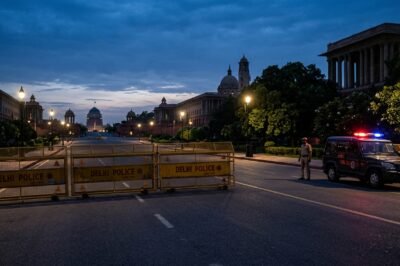
The heart of India’s democratic capital is currently the center of a profound legal and constitutional debate, as the Delhi Police defends its practice of issuing recurring 60-day prohibitive orders to prevent public gatherings and potential unrest. In a recent submission to the Supreme Court, law enforcement authorities justified these ‘ex-parte’ orders as essential preemptive strikes against chaos in sensitive zones, particularly around Parliament, diplomatic enclaves, and high-security government installations. This move comes at a time when the balance between state-mandated security and the fundamental right to peaceful assembly is being scrutinized under a microscopic lens. The implications of such long-term restrictions are not merely logistical; they strike at the very core of how a modern democracy manages dissent and maintains public order without stifling the voices of its citizenry. As the Supreme Court weighs the necessity of these measures against the potential for administrative overreach, the legal community and civil society groups are watching closely, recognizing that the outcome could redefine the boundaries of police power in the national capital for years to come.
For decades, Section 144 of the Code of Criminal Procedure (now replaced by the Bharatiya Nagarik Suraksha Sanhita) has been the go-to tool for administrators to maintain peace. However, the Delhi Police’s reliance on ‘ex-parte’ orders—those passed without hearing the parties affected—for extended 60-day periods has raised eyebrows. The police argue that the volatile nature of modern protests, often fueled by rapid social media mobilization, necessitates a standing order that covers the most sensitive areas of the city. They contend that the capital is a unique theater where localized disturbances can quickly escalate into national crises, requiring a ‘continuous state of vigilance.’ Yet, the Supreme Court has previously cautioned that such powers are intended for ‘emergency’ situations and should not become a permanent fixture of urban governance.
The Legal Architecture of Section 144 and Prohibitive Orders
The legal backbone of the current controversy lies in the transition from the old Code of Criminal Procedure (CrPC) to the new Bharatiya Nagarik Suraksha Sanhita (BNSS). Historically, Section 144 allowed a magistrate to issue orders to abstain from certain acts if such an order was likely to prevent obstruction, annoyance, or injury to any person lawfully employed, or danger to human life, health, or safety. The Delhi Police have utilized this power to create what critics call ‘perpetual protest-free zones.’ By issuing these orders ex-parte, the police bypass the usual requirement of notifying the public in advance, citing the urgency of maintaining the status quo in zones that house the Prime Minister’s Residence, the Rashtrapati Bhavan, and various international embassies.
The defense offered in the Supreme Court suggests that these 60-day windows are calculated based on intelligence assessments that highlight ongoing threats from various pressure groups and fringe elements. The police maintain that the repetitive nature of these orders is not an attempt to circumvent the law but a response to a repetitive cycle of threats. However, legal scholars argue that the ‘ex-parte’ nature of these orders should be the exception, not the rule. When an order is passed without a hearing, it places the burden of proof on the citizen to challenge it after the fact, which many argue is a reversal of democratic norms. The Supreme Court’s inquiry into whether these orders have become a ‘mechanical exercise’ is a direct challenge to the administrative habit of extending restrictions without fresh, specific evidence of a pending riot or disturbance.
The Concept of ‘Ex-Parte’ Necessity in Urban Policing
In the context of New Delhi, ‘ex-parte’ orders are justified by the police as a preventative necessity. The logic is simple: if the police were to wait for a specific threat to materialize before issuing a notice, the window for effective intervention might already be closed. They point to past incidents where sudden gatherings led to significant property damage and disruptions to the functioning of the central government. In their affidavit, the Delhi Police emphasized that the ‘geopolitical sensitivity’ of the capital makes it a target for various international and domestic actors looking to create a spectacle. Therefore, a standing 60-day prohibition serves as a deterrent and a legal framework that allows for immediate arrests and dispersals if a crowd forms.
However, this ‘prevention over cure’ approach has significant drawbacks. By categorizing vast swathes of the city as permanently sensitive, the administration effectively shrinks the public square. Critics argue that this leads to a ‘chilling effect’ on legitimate political expression. If a group wishes to protest a policy, they find themselves in a legal catch-22: they must apply for permission in a zone where gatherings are already prohibited by a standing order, and the denial of such permission is almost guaranteed based on the existence of that very order. This circular logic is what the Supreme Court is currently dissecting, looking for a way to ensure that ‘prohibitive orders’ do not become ‘prohibitive governance.’
Mapping the Restricted Zones: Impact on Daily Life and Commerce
The zones covered by these 60-day orders are not peripheral; they include the commercial and political nerve centers of the city. Areas like New Delhi District, which encompasses Connaught Place, Parliament Street, and the various Bhawans, are frequently under the shadow of these orders. While the police claim that these orders target ‘unlawful assemblies’ and not individual movement, the heavy presence of barricades and the constant threat of detention create an atmosphere of restriction. For businesses in these areas, the periodic tightening of security can lead to reduced footfall and logistical hurdles for employees and logistics providers.
Furthermore, the ambiguity of what constitutes an ‘assembly’ under these orders can lead to selective enforcement. While a group of tourists might be ignored, a group of students or activists carrying placards can be swiftly detained. This discrepancy is a central point of contention for human rights advocates. They argue that the 60-day orders provide a blanket cover for the police to act with high levels of discretion, often targeting specific ideologies or groups while allowing others to pass. The socioeconomic impact of turning the city’s heart into a fortress cannot be understated, as it alters the character of Delhi from a vibrant, inclusive capital to a controlled, bureaucratic citadel.
Judicial Precedents and the Supreme Court’s Evolving Stance
The Supreme Court of India has a storied history of protecting the right to protest, most notably in the Anuradha Bhasin v. Union of India case, where it ruled that indefinite suspension of fundamental rights (in that case, internet services) was unconstitutional. The court held that any restriction must satisfy the test of proportionality. Applying this to the Delhi Police’s 60-day orders, the court is now asking: Is the total ban on assembly in these zones proportional to the threat? Are there less restrictive means to achieve the same security goals? The police argument that the orders are reviewed and reissued every two months is seen by some justices as a technicality that avoids the spirit of the law.
Historical precedents like the Babulal Parate v. State of Maharashtra case also loom large. While the court has traditionally given the executive wide berth in matters of public order, the contemporary trend is toward greater judicial review of administrative actions. The justices have signaled that they are no longer willing to accept ‘vague apprehension’ as a ground for suspending civil liberties. The requirement for ‘concrete facts’ and ‘imminent danger’ is being reinforced. This shift suggests that the Delhi Police may soon have to provide more granular data to justify their standing orders, rather than relying on broad-brush statements about the city’s sensitivity.
The ‘Chilling Effect’ on Democratic Dissent
One of the most profound implications of recurring prohibitive orders is the erosion of the culture of protest. Protests are the safety valves of a democracy; they allow for the expression of grievances that might otherwise fester into more radical forms of resistance. When the capital city—the most visible stage for such expression—is consistently placed under prohibitive orders, it sends a message that dissent is a security threat rather than a democratic right. The ex-parte nature of these orders further isolates the administration from the public, as there is no dialogue or negotiation regarding where and how a protest can take place.
Scholars of political science point out that the ‘normalization’ of Section 144 in urban spaces changes the relationship between the citizen and the state. It fosters a sense of permanent emergency, where the exception becomes the rule. This environment is particularly difficult for marginalized groups who lack the resources to challenge these orders in high courts or the Supreme Court. For them, a 60-day order is a total shutdown of their ability to be heard by the powers that be. The ongoing litigation in the Supreme Court is therefore not just about a police procedure; it is about the visibility of the marginalized in the halls of power.
Future Implications: Towards a More Nuanced Security Protocol
As the Supreme Court nears a decision on the validity of these 60-day ex-parte orders, the path forward requires a more nuanced approach to urban security. Security experts suggest that instead of blanket prohibitions, the police should move toward a ‘risk-based’ model. This would involve specific orders for specific events, based on verifiable intelligence, rather than a standing order that covers months at a time. Digital tools and better crowd-management training could also allow the police to manage gatherings without needing to ban them entirely. This would satisfy the security needs of the capital while respecting the constitutional mandates of free speech and assembly.
Ultimately, the resolution of this case will set a precedent for other metropolitan areas in India. If the Supreme Court upholds the Delhi Police’s broad use of ex-parte orders, it could embolden other state governments to adopt similar tactics, leading to a nationwide contraction of the space for public assembly. Conversely, a ruling that demands higher transparency and narrower application would be a landmark victory for civil liberties. The eyes of the nation are on the apex court, waiting for a verdict that balances the scales between the heavy hand of the state and the essential freedoms of its people. The future of Delhi as a ‘living city’ of protest and politics hangs in the balance.

































Leave a Reply