
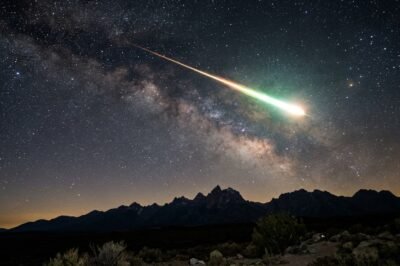
The Celestial Spectacle: A Night of Fire and Light
As the sun dips below the horizon tonight, the celestial stage is set for one of the most visually arresting displays in the astronomical calendar. The Taurid meteor shower, often referred to as the ‘Halloween Fireballs’ due to their timing and intensity, is reaching its peak, promising a spectacle that transcends the typical meteor shower experience. Unlike the rapid-fire bursts of the Perseids or the Geminids, the Taurids are known for their slow-moving, intensely bright meteors that can illuminate the ground below with an eerie, momentary glow. For seasoned astronomers and casual stargazers alike, tonight represents a rare window into the ancient history of our solar system, as Earth drifts through the debris trail of Comet 2P/Encke. This event is not just a visual treat; it is a significant moment for the burgeoning field of astrotourism and a reminder of the dynamic, often unpredictable nature of the cosmos. As urban sprawl continues to diminish our view of the heavens, the arrival of the Taurids offers a compelling reason to seek out dark skies and reconnect with the universe’s silent, fiery rhythm. This year’s display is particularly anticipated because the Taurid stream contains a higher proportion of larger particles than other showers, leading to the high-profile fireballs that make this event a headline-grabber.
Understanding the Taurid Stream: The Debris of Comet Encke
The Taurid meteor shower is unique because it is actually split into two distinct branches: the North Taurids and the South Taurids. Both originate from the debris of Comet 2P/Encke, a short-period comet that completes an orbit around the sun every 3.3 years. As the comet nears the sun, it sheds a trail of ice, dust, and rock. Over millennia, this debris has spread out into a wide stream that Earth takes several weeks to pass through. Tonight marks the convergence of these streams, providing a peak in activity that, while low in frequency, is high in impact. Unlike many other comets that produce fine dust, Encke has left behind substantial pebbles and small stones. When these larger fragments hit the Earth’s atmosphere at approximately 17 miles per second, they do not simply vanish; they burn with incredible intensity.
Scientists classify these intense flashes as fireballs—meteors that are brighter than the planet Venus. Because the Taurids enter the atmosphere at a relatively slow velocity compared to other meteor showers, they last longer in the sky. Observers often report seeing a ‘streak’ that lingers for several seconds, sometimes accompanied by a trail of smoke or a series of small explosions known as bolides. This slow burn allows the human eye to track the meteor across the constellations, providing a sense of motion and scale that is often lost in the blink-and-you-miss-it nature of other showers. The North Taurids are particularly noted for their peak this week, adding a layer of intensity to the already active South Taurid stream.
The Science of Fireballs: Rare and Radiant Displays
The chemistry behind these fireballs is a fascinating study in celestial physics. As a Taurid fragment enters the upper atmosphere, the air in front of it is compressed and heated to thousands of degrees. This heat vaporizes the meteor’s outer layers, creating a glowing envelope of plasma. The specific colors seen in a Taurid fireball—often vivid greens, yellows, or oranges—are indicators of the chemical composition of the comet’s debris. A green glow often suggests the presence of nickel, while yellow might indicate sodium. These colors are not just aesthetic; they are data points that tell us about the building blocks of the inner solar system. For researchers, capturing high-resolution spectra of these fireballs is essential for understanding the material that has been orbiting the sun for thousands of years.
Furthermore, the Taurid ‘swarm’ is a concept that gains traction every few years. Astronomers believe that Jupiter’s gravity occasionally herds the larger Taurid particles into a more concentrated pocket. When Earth passes through this swarm, the number of fireballs increases dramatically. While 2024 may not be a predicted ‘swarm’ year of the highest magnitude, the current positioning of the stream suggests a higher-than-average probability of witnessing significant bolide activity. This makes tonight’s peak a high-stakes event for astrophotographers who spend hours waiting for that one perfect, frame-filling explosion of light. The rarity of these events adds to their prestige, making the Taurids a favorite for those who value quality over quantity.
Global Impact and the Astrotourism Market
Beyond the scientific community, the Taurid meteor shower has a measurable impact on the global economy, specifically within the astrotourism sector. In recent years, there has been a significant surge in travelers seeking ‘dark sky’ destinations—remote areas with minimal light pollution. National parks in the United States, remote regions in the Chilean Andes, and the dark sky reserves of New Zealand are seeing record bookings during celestial events like the Taurid peak. This trend is driven by a growing public interest in space exploration and a psychological desire to escape the digital saturation of modern life. Travel agencies now offer specialized ‘meteor-watching’ packages, providing telescopes, warm amenities, and expert guides to interpret the night sky.
The financial implications extend into the equipment market as well. Sales of high-end telescopes, binoculars, and DSLR cameras with low-light capabilities see a spike in the fourth quarter, partly fueled by the string of astronomical events that occur late in the year. For the technology industry, the demand for better sensors that can capture the fleeting light of a fireball is a driver of innovation in consumer electronics. Local economies in rural areas also benefit from this influx of visitors, as hotels, campsites, and local eateries see a ‘second season’ of business after the traditional summer peak. The Taurid meteor shower, therefore, is not just an atmospheric event; it is a catalyst for economic activity that highlights the intersection of science and commerce.
Viewing Guide: Where and When to Look Tonight
To maximize your chances of seeing a Taurid fireball tonight, preparation is key. Unlike some showers that require looking in a specific direction, the Taurids radiate from the constellation Taurus, which will be high in the sky after midnight. However, fireballs can appear anywhere in the heavens. The best advice for observers is to find a location far from city lights, where the horizon is wide and unobstructed. You do not need a telescope or binoculars to see these meteors; in fact, the naked eye is superior for spotting fireballs because it provides a wider field of view. It takes about 20 to 30 minutes for your eyes to fully adjust to the dark, so avoid looking at your phone or any artificial light sources during this period.
Key Tips for Observers:
- Timing: The best viewing window is between midnight and 3:00 AM local time, when the radiant point is highest.
- Comfort: Bring a reclining chair or a blanket so you can look straight up without straining your neck.
- Location: Seek out Dark Sky Parks or rural areas away from streetlights.
- Patience: The Taurids are infrequent (5-10 per hour), but their brightness makes the wait worthwhile.
The presence of the moon is a critical factor in any meteor shower. Fortunately, tonight’s moon phase is conducive to viewing. As a waxing crescent, the moon will set early enough to leave the sky dark for the peak viewing hours after midnight. This lack of moonlight will make the fainter stars visible and provide a high-contrast backdrop for the brilliant fireballs. Even if you only see one or two meteors over an hour, the sheer intensity of a Taurid fireball is often enough to leave a lasting impression that outweighs the higher frequency of smaller showers.
Future Implications: Tracking the Taurid Legacy
As we look to the future, the study of the Taurid stream remains a high priority for planetary defense and astronomical research. Because the stream contains larger fragments than most, it is a living laboratory for understanding how debris behaves in the inner solar system. Some theorists even suggest that historical events, such as the Tunguska explosion in 1908, may have been caused by a fragment from the Taurid stream. While there is no immediate threat from tonight’s display, the continuous monitoring of these fireballs helps scientists refine their models of orbital mechanics and impact probabilities. Every fireball recorded tonight is a piece of a larger puzzle regarding the safety and evolution of our planet.
In conclusion, the Taurid meteor shower serves as a profound bridge between the scientific, the economic, and the existential. As fireballs streak across the sky tonight, they remind us of our place in a vast, moving system. The event underscores the importance of preserving dark skies—not just for the sake of astronomy, but for the preservation of human wonder. Whether you are a scientist collecting data, a photographer chasing a shot, or a family sitting on a porch, the Taurids offer a moment of universal connection. As technology advances and we become more adept at tracking these celestial visitors, the mystery of the ‘Halloween Fireballs’ continues to captivate the world, ensuring that the Taurid legacy will burn bright for generations to come.


































Leave a Reply