
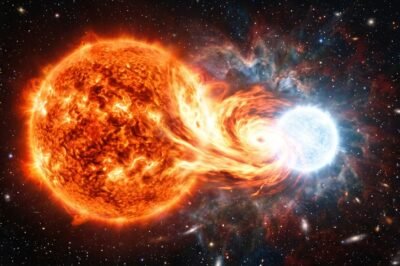
The universe is an arena of incomprehensible violence and majestic beauty, where the birth and death of stars dictate the chemical composition of the galaxies we inhabit. Recently, astronomers have documented a phenomenon that is as rare as it is significant: the merging of a massive, so-called puffy star with a much smaller companion star. This event, meticulously reported by Asharq Al-Awsat, marks a pivotal moment in our understanding of stellar evolution and binary system dynamics. For centuries, humanity looked at the stars as static lanterns in the night sky, but modern astrophysics reveals them to be dynamic engines of change. This merger is not just a collision; it is a complex gravitational dance that results in a singular, bloated entity that defies traditional stellar classifications. Such observations are critical because they provide a real-time window into processes that usually take millions of years to unfold, allowing scientists to test theories regarding common-envelope evolution and the eventual fate of stars like our own Sun, though on a much more dramatic scale. The observation of this specific merger allows us to peer into the thermal and gravitational mechanisms that govern the lifecycle of stars, offering a rare glimpse into the chaotic nature of the cosmos as it seeks equilibrium through destruction and rebirth.
The Celestial Ballet: Understanding Binary Star Dynamics
To understand the magnitude of this merger, one must first appreciate the prevalence of binary star systems in the Milky Way. Unlike our Sun, which is a solitary traveler, a significant majority of massive stars exist in pairs or multiple-star systems. These stars orbit a common center of mass, locked in a gravitational embrace that dictates their entire existence. Over eons, as one star exhausts its nuclear fuel and begins to swell, its outer layers can extend far enough to interact with its partner. This is precisely what led to the event observed by the international team of astronomers. The larger star, reaching its ‘puffy’ or red giant phase, began to lose its gravitational grip on its outermost plasma. The smaller, more compact companion star was essentially swallowed by this expanding envelope, leading to a phase known as common-envelope evolution. During this stage, the companion star orbits inside the outer layers of the larger star, creating immense friction that generates heat and causes the orbital distance between the two bodies to shrink rapidly.
As the smaller star plows through the dense gas of the puffy giant, it transfers kinetic energy into the envelope, causing it to glow with newfound intensity. This process is not instantaneous; it can take thousands of years for the orbits to decay, but the final merger is a spectacular outburst of energy. Astronomers noted that the light curve from this event showed a characteristic ‘red transient’ signature, a tell-tale sign of stellar cannibalism. This merger provides empirical data that helps refine mathematical models used to predict the outcomes of such collisions, which range from the formation of exotic stars to the potential creation of gravitational wave sources that can be detected across the universe.
The Anatomy of a Puffy Star: Red Giants and Their Expansion
The term ‘puffy star’ refers to a star in the late stages of its life, specifically those that have moved off the main sequence and expanded into red giants or supergiants. These stars are massive in volume but relatively low in density at their surfaces. The core of such a star has contracted and heated up, while the outer layers have expanded outward due to intense radiation pressure. This expansion creates a ‘puffy’ appearance where the star may be hundreds of times larger than its original size. In the case of the merger reported by Asharq Al-Awsat, the giant star had reached a critical point where its physical size overlapped with the orbital path of its companion. This expansion is a fundamental part of stellar aging, but when it happens in a binary system, it triggers a catastrophic interaction that completely alters the evolutionary trajectory of both stars.
The physical properties of these puffy stars make them ideal laboratories for studying fluid dynamics and thermal transport on a stellar scale. The sheer size of the envelope means that material is loosely bound, allowing for significant mass loss through stellar winds even before the merger occurs. When the smaller companion enters this environment, the interaction is less like a solid impact and more like a submarine moving through a thick, gaseous ocean. The energy released during this phase is massive, often rivaling the total energy output of the star over its entire previous life. This specific observation has allowed researchers to measure the temperature fluctuations and chemical signatures of the ejected material, providing clues about the internal makeup of the puffy star that were previously hidden from view.
Methodologies of Observation: How Astronomers Caught the Act
Detecting a stellar merger requires a combination of high-precision instrumentation and a fair bit of cosmic timing. Astronomers used a suite of ground-based and space-based telescopes to monitor the system over several months. By utilizing spectroscopy, they were able to break down the light from the merging pair into its component wavelengths. This revealed shifts in the chemical lines, indicating the presence of heavy elements being dredged up from the interior of the puffy star. Furthermore, photometric data—the measurement of the star’s brightness over time—showed a distinct pattern of brightening and dimming that aligned perfectly with the theoretical models of common-envelope friction. The use of infrared telescopes was particularly crucial, as the dust generated by the cooling gas of the merger often obscures visible light, making the event appear dimmer than it actually is.
International collaboration played a vital role in this discovery. Observations from the Very Large Telescope (VLT) in Chile were cross-referenced with data from orbiting satellites to ensure a comprehensive view of the event across the electromagnetic spectrum. This multi-messenger approach is the gold standard in modern astronomy, allowing scientists to piece together a narrative of the merger that includes temperature, velocity, and composition. The Asharq Al-Awsat report highlights how these global efforts are bridging the gap between theoretical physics and observable reality. By catching the merger in its ‘puffy’ state, astronomers have secured data that will be analyzed for decades, contributing to our knowledge of how binary systems eventually collapse into white dwarfs, neutron stars, or even black holes.
Chemical Consequences: The Enrichment of the Interstellar Medium
One of the most profound implications of a puffy star merging with a companion is the distribution of elements throughout the galaxy. During the merger, the intense heat and pressure can trigger unique nucleosynthesis processes, creating elements that are not typically produced in the standard lifecycle of a single star. As the outer envelope is blown off into space during the collision, these elements—including lithium, carbon, and nitrogen—are seeded into the interstellar medium. This material eventually collapses to form new stars and planets. In a very real sense, the violent merger observed by astronomers is a recycling plant for the cosmos, taking the ‘waste’ products of an old star and preparing them for the next generation of celestial bodies.
The study of these ejected materials helps astronomers understand the ‘chemical clock’ of our galaxy. By analyzing the ratios of isotopes in the wake of the merger, scientists can estimate the age of the stellar population in that region of space. Furthermore, the dust grains formed in the cooling remnants of the merger are of significant interest to astrochemists. These grains serve as catalysts for complex chemical reactions in space, potentially leading to the formation of organic molecules. The Asharq Al-Awsat coverage underscores the importance of these events not just as stellar curiosities, but as the foundational events that make life possible in the long term. Without the violent expulsion of material from merging and dying stars, the heavy elements required for planetary cores and biological life would remain trapped inside stellar interiors.
The Economic and Educational Impact of Astrophysical Discoveries
While the study of distant stars may seem disconnected from daily life, the economic and educational implications are vast. The technology developed for these observations—such as high-sensitivity CCD sensors and advanced data processing algorithms—often finds its way into commercial and medical applications. For instance, the same imaging techniques used to resolve the layers of a puffy star are applied in medical diagnostics and satellite telecommunications. Moreover, reports like the one in Asharq Al-Awsat serve as a powerful educational tool, inspiring the next generation of scientists, engineers, and data analysts. The ‘Space Economy’ is a rapidly growing sector, and fundamental research into stellar mergers fuels the innovation required to sustain that growth.
Investment in astronomical research also yields geopolitical prestige and fosters international cooperation. When nations collaborate on projects like the Very Large Telescope or the James Webb Space Telescope, they share costs and expertise, leading to discoveries that no single country could achieve alone. The observation of the puffy star merger is a testament to what humanity can accomplish when resources are pooled toward a common goal of understanding our place in the universe. In a world often divided by economic and political tensions, the shared pursuit of celestial knowledge provides a unifying narrative that emphasizes our common heritage as inhabitants of a single planet orbiting a fairly typical star in a vast, interconnected galaxy.
Future Horizons: Mapping the Graveyard of the Milky Way
Looking ahead, the observation of this puffy star merger is just the beginning of a new era in time-domain astronomy. With the advent of facilities like the Vera C. Rubin Observatory, astronomers will soon be able to scan the entire sky every few nights, identifying thousands of transient events like this merger in real-time. This will shift the field from observing individual ‘celebrity’ stars to performing large-scale statistical surveys of stellar death and interaction. We are moving toward a comprehensive map of the ‘stellar graveyard,’ where we can track the final moments of millions of binary systems. This will allow us to predict with much greater accuracy which systems are likely to produce supernovae or gravitational wave events, providing a roadmap for future deep-space exploration.
The future of this research also lies in the integration of artificial intelligence and machine learning to sift through the massive amounts of data generated by modern telescopes. By training algorithms to recognize the specific light patterns of a puffy star merger, astronomers can automate the discovery process, ensuring that no significant event goes unnoticed. As we continue to refine our tools and theories, the lessons learned from this specific event reported by Asharq Al-Awsat will serve as a cornerstone for our evolving understanding of the cosmos. The merger of a massive star with its companion is a reminder of the universe’s capacity for change, reminding us that even the stars themselves are subject to the relentless march of time and the transformative power of gravity. Through these observations, we gain not just knowledge of the distant past, but a glimpse into the inevitable future of our own solar neighborhood.






































Leave a Reply