
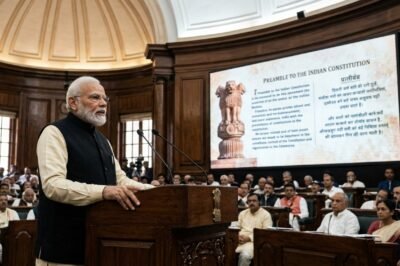
The observance of Constitution Day on November 26th marks a pivotal moment in the legislative and social history of the Republic of India, serving as a reminder of the day in 1949 when the Constituent Assembly formally adopted the document that would govern the world’s most populous democracy. In his recent address to the nation, Prime Minister Narendra Modi described the Indian Constitution as a ‘priceless heritage,’ emphasizing that democracy in India is not merely a political structure but a deeply ingrained cultural ethos that has survived millennia. The Prime Minister’s rhetoric focused on the resilience of the democratic spirit, highlighting how the Constitution has acted as a protective shield for the rights of the marginalized while providing a roadmap for the nation’s collective aspirations. As India traverses the ‘Amrit Kaal’—the lead-up to the centenary of its independence—the discourse surrounding the Constitution has shifted from a static legal framework to a dynamic instrument of social change and economic empowerment. This analysis explores the nuances of the Prime Minister’s speech, the historical weight of the day, and the implications for India’s future governance and global standing.
The Historical Foundation: From 1949 to the Modern Era
The genesis of the Indian Constitution was an exercise in unprecedented intellectual and social engineering. Under the chairmanship of Dr. B.R. Ambedkar, the Drafting Committee synthesized the best practices from various global constitutions while ensuring the final document remained uniquely Indian in its character. PM Modi’s reference to the ‘priceless heritage’ underscores the idea that the Constitution did not emerge from a vacuum but was a crystallization of ancient Indian democratic traditions, such as the ‘Sabhas’ and ‘Samitis’ mentioned in Vedic texts. This historical continuity is essential for the current administration’s narrative, which seeks to decolonize the Indian psyche and reclaim a sense of civilizational pride.
Over the past seven decades, the Constitution has been amended over a hundred times, reflecting its nature as a ‘living document.’ The Prime Minister noted that this adaptability is a sign of strength rather than weakness. It has allowed the nation to address emerging challenges, from the reorganization of states to the implementation of the Goods and Services Tax (GST) and the digital revolution. The celebration of Constitution Day, a tradition initiated by the Modi government in 2015, serves to bridge the gap between the complex legalities of the document and the common citizen, fostering a sense of ‘constitutional morality’ that Dr. Ambedkar frequently advocated for.
Deciphering PM Modi’s Address: The ‘Priceless Heritage’ Narrative
In his live updates and subsequent speeches, Prime Minister Modi focused heavily on the concept of ‘Jan Bhagidari’ or people’s participation. By calling democracy a ‘priceless heritage,’ he effectively framed the Constitution as an inheritance that every citizen is responsible for protecting. This shift in language is significant; it moves the responsibility of upholding democratic values from the ivory towers of the judiciary and the parliament to the doorstep of the ordinary Indian. The Prime Minister emphasized that the strength of the Constitution lies in its ability to empower the weakest members of society, a sentiment that aligns with his government’s ‘Antyodaya’ philosophy of serving the last person in the queue.
Furthermore, the Prime Minister’s address touched upon the balance between ‘Rights’ and ‘Duties.’ He argued that while the initial decades of the Republic were focused on establishing and securing fundamental rights, the coming decades must focus on fundamental duties. This narrative is intended to catalyze a national movement toward self-reliance and civic responsibility. Critics often debate this shift, fearing it might dilute the state’s accountability, but the government maintains that a rights-based approach is only sustainable when coupled with a duty-conscious citizenry. This ideological positioning is a cornerstone of the current administration’s governance model, aiming to create a more disciplined and goal-oriented society.
The Intersection of Executive Intent and Judicial Independence
The relationship between the executive and the judiciary remains a critical aspect of India’s constitutional health. During the Constitution Day celebrations, which often see the participation of the Chief Justice of India and other senior jurists, the dialogue usually centers on the ‘Basic Structure’ doctrine. This doctrine, established by the Kesavananda Bharati judgment, ensures that the parliament cannot alter the fundamental features of the Constitution. PM Modi’s remarks acknowledged the importance of judicial oversight while also emphasizing the need for all branches of government to work in harmony for the nation’s development.
There is a growing emphasis on making the legal system more accessible to the masses. The Prime Minister praised the efforts to translate court judgments into regional languages and the push for ‘Ease of Justice.’ This is seen as a direct extension of constitutional values, ensuring that the ‘Equality before Law’ promised in Article 14 is not hampered by linguistic or economic barriers. By integrating technology into the judicial process, the government aims to reduce the massive backlog of cases, which is often cited as the primary hurdle to the effective implementation of constitutional rights. The synergy between a proactive executive and a vigilant judiciary is presented as the essential formula for the stability of the Indian state.
Economic Sovereignty and Constitutional Stability
From a financial perspective, the Constitution provides the framework for India’s economic sovereignty. The distribution of powers between the Union and the States (the federal structure) is what enables a diverse economy to function as a single market. The Prime Minister’s focus on the ‘heritage of democracy’ also has significant implications for global investors. A nation that respects its constitutional mandates and ensures the rule of law is a much more attractive destination for Foreign Direct Investment (FDI). The stability of India’s democratic institutions acts as a hedge against the volatility seen in more authoritarian regimes, providing a ‘democratic premium’ to the Indian economy.
Moreover, the constitutional commitment to social justice translates into economic policies aimed at financial inclusion. Schemes like the Jan Dhan Yojana, which provided banking access to millions, are framed as the fulfillment of the Preamble’s promise of ‘Economic Justice.’ During his address, the Prime Minister linked the Constitution to the vision of a ‘Viksit Bharat’ (Developed India) by 2047. He argued that the constitutional framework provides the necessary stability to undertake bold economic reforms, such as land and labor law changes, which are essential for manufacturing growth. The alignment of constitutional values with economic development goals is a recurring theme in the government’s communication strategy.
India’s Democratic Stature on the Global Stage
In an era where democratic backsliding is a global concern, PM Modi used the occasion of Constitution Day to project India as the ‘Mother of Democracy.’ This branding is a vital part of India’s soft power strategy. By highlighting the ‘priceless heritage’ of the Constitution, the Prime Minister is signaling to the international community that India’s democratic roots are deep and resilient. This helps India position itself as a reliable partner in the ‘Global South’ and a democratic alternative to other regional powers. The address serves as a diplomatic signal that India’s growth is inextricably linked to its democratic identity.
The Prime Minister also noted that the Indian Constitution is a beacon of hope for many developing nations that are currently drafting or amending their own governance frameworks. The Indian model of managing a diverse, multi-religious, and multi-lingual population under a single secular constitution is seen as a unique achievement. By celebrating Constitution Day with such fervor, the government reinforces this global image, ensuring that India’s democratic credentials remain a central pillar of its foreign policy. This international dimension of the Constitution underscores the importance of domestic stability for global prestige.
Looking Forward: The Evolution of the Indian Republic
As India moves forward, the challenges to its constitutional fabric will likely evolve. Issues such as digital privacy, the ethics of Artificial Intelligence, and climate change will require new interpretations of constitutional principles. Prime Minister Modi’s vision for the future involves a ‘New India’ that is both modern and deeply rooted in its traditional values. The conclusion of his address served as a call to action for the youth of the country, whom he called the ‘ambassadors of the Constitution.’ He urged them to study the document not just as a legal text but as a guide for ethical living and national service.
The future implications of the current constitutional discourse suggest a move toward greater centralization in some aspects of governance (like ‘One Nation, One Election’) balanced by a push for grassroots empowerment in others. The success of the Indian Republic will depend on its ability to maintain this balance while upholding the core tenets of Liberty, Equality, and Fraternity. As the Prime Minister concluded, the Constitution is the greatest strength of every Indian, and its preservation is the collective duty of the nation. The journey from the colonial era to a self-assured republic is a testament to the power of the ‘priceless heritage’ that continues to guide India toward its destiny as a global leader.



































Leave a Reply