
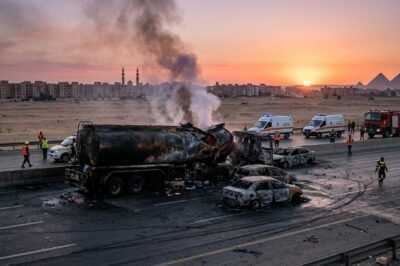
The early morning stillness of the Cairo-Alexandria desert road, a vital artery for Egypt’s commerce and transit, was catastrophically interrupted by a scene of unimaginable devastation. A fuel tanker, laden with highly flammable liquid, overturned on the Giza highway near Cairo, triggering a sequence of events that resulted in the tragic loss of at least 31 lives. This event is not merely a localized traffic accident but a profound national tragedy that has sent shockwaves through the Egyptian capital and beyond. As the flames engulfed several surrounding vehicles, the incident highlighted the precarious nature of road safety in a region characterized by rapid urban expansion and high-intensity logistics traffic. The sheer scale of the casualty list, which includes many who were simply commuting to work, underscores the urgent need for a systemic overhaul of how hazardous materials are transported across the nation’s burgeoning highway network. For many families in Giza and the surrounding governorates, what began as a routine journey ended in a nightmare, forcing the government and the public to confront the harsh realities of infrastructure vulnerabilities and the human cost of industrial transport accidents. The incident serves as a grim reminder that despite massive investments in the national road network, the interplay of human error, vehicle maintenance, and safety regulation remains a volatile mix that can lead to catastrophic failure.
The Anatomy of a Tragedy: What Happened in Giza?
The incident occurred during the early hours when visibility is often compromised by mist, yet traffic density remains high as freight movers and passenger buses compete for space on the Giza highway. Preliminary reports suggest that the fuel truck lost control after a tire blowout, causing it to veer across multiple lanes and overturn. The ensuing spill of thousands of liters of fuel created a lethal environment; within seconds, a spark ignited a massive fireball that trapped nearby passenger vehicles in a furnace of intense heat. Eyewitness accounts describe a scene of chaos where motorists had little time to react before the explosion occurred.
First responders arrived to find a landscape of scorched metal and asphalt. The intense heat of the chemical fire presented significant challenges for the Civil Defense forces, who struggled to suppress the flames while searching for survivors. Many of the 31 victims were found within their vehicles, unable to escape the rapid spread of the fire. The logistical difficulty of the rescue operation was compounded by the location of the crash, a high-speed section of the highway where the lack of immediate emergency access points delayed the arrival of heavy equipment needed to move the wreckage of the tanker and the charred remains of the cars caught in the blast radius.
Historical Context: Egypt’s Long Road Safety Struggle
To understand the gravity of this incident, one must examine the historical context of road safety in Egypt. For decades, the country has grappled with high rates of traffic-related fatalities, often attributed to a combination of aging vehicle fleets, inadequate road maintenance, and a general disregard for traffic laws. According to data from the Central Agency for Public Mobilization and Statistics (CAPMAS), Egypt has historically seen thousands of road deaths annually, though recent government initiatives have sought to curb these numbers. The Giza highway tragedy is particularly jarring because it occurred on a route that has been part of recent modernization efforts.
While the Egyptian government has reported a significant decrease in road accidents—noting a 25% drop in fatalities over the last five years due to the National Road Project—incidents involving heavy vehicles and hazardous materials continue to be a persistent threat. The density of Cairo’s outskirts, combined with the role of Giza as a transit hub for goods moving from the Mediterranean ports to the interior, creates a high-risk environment. Previous disasters, such as the Ramses Station train fire in 2019, had already prompted calls for stricter fuel transport regulations, yet the Giza highway explosion suggests that enforcement gaps remain wide and lethal.
Infrastructure and the National Road Project: Progress vs. Reality
Under the administration of President Abdel Fattah el-Sisi, Egypt has invested billions of dollars into the National Road Project, aimed at creating 7,000 kilometers of new roads and upgrading 10,000 kilometers of existing ones. The goal was to reduce congestion and improve safety. However, critics and transport experts argue that physical infrastructure is only one side of the coin. The Giza highway, while widened and resurfaced, still suffers from a lack of effective monitoring and speed enforcement. When a highway is improved, average speeds increase, and without corresponding increases in driver training and vehicle inspections, the severity of accidents can actually escalate.
Furthermore, the design of highway interchanges and the lack of dedicated lanes for heavy transport trucks have been cited as contributing factors in many high-speed collisions. In the Giza incident, the presence of multiple vehicle types—from microbuses to heavy tankers—sharing the same space at high speeds created a recipe for disaster. The government’s push for infrastructure-led growth must now be balanced with a more rigorous focus on the operational safety of the vehicles that use these roads. Without mandatory, high-frequency inspections for fuel tankers and heavy haulers, the multi-billion dollar road network remains a theater for avoidable tragedy.
Economic and Social Implications of the Transport Sector
The economic impact of road accidents in Egypt is staggering, with some estimates suggesting that they cost the country up to 3% of its annual GDP due to lost productivity, healthcare expenses, and property damage. This specific incident in Giza highlights the vulnerability of the logistics sector. Fuel transport is the lifeblood of the Egyptian economy, powering everything from industrial factories to the daily commutes of millions. A single catastrophic failure like the Giza explosion not only results in the loss of life but also causes significant disruptions to the supply chain and increases insurance premiums for the transport industry.
Socially, the cost is even higher. The loss of 31 lives in a single event leaves a permanent scar on the community. Many of the victims were likely the primary breadwinners for their families, meaning the ripple effects of this tragedy will be felt for generations. The public outcry following the DW.com report reflects a growing frustration among Egyptian citizens who feel that despite the visible improvements in the country’s





































Leave a Reply