
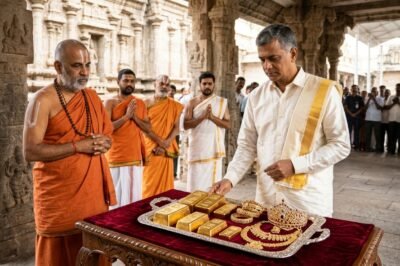
In the high-stakes world of Indian business and spirituality, few events capture the national imagination as intensely as a record-breaking donation to the Tirumala Venkateswara Temple. Recently, the headlines across major news outlets, including the Deccan Chronicle, have been set ablaze by the news of a staggering 121 kilograms of gold offered to the Lord of the Seven Hills. The man behind this monumental gesture is Vardhaman Jain, a figure whose name has suddenly become synonymous with both immense wealth and profound devotion. This act of unparalleled generosity, estimated to be worth nearly 100 crore rupees at current market prices, serves as a powerful testament to the deep-seated spiritual convictions that continue to drive India’s business elite. As the Tirumala Tirupati Devasthanams (TTD) receives this golden tribute, the narrative transcends simple financial statistics, touching upon the complex intersection of faith, legacy, and the cultural fabric of Southern India. For the millions of devotees who trek to the hills of Tirupati annually, such a donation is viewed as a supreme act of ‘Kainkaryam’ or divine service, yet for the economic analyst and the curious citizen, it invites a deeper investigation into the identity of the philanthropist who has redefined the scale of modern religious offerings. Who exactly is Vardhaman Jain, and what drives a private individual to commit such a vast fortune to a religious institution? This detailed analysis explores the background of the donor, the logistics of this historic offering, and what it signifies for the future of religious philanthropy in India.
The Magnanimous Offering: Breaking Down the 121KG Gold Donation
The sheer scale of the donation made by Vardhaman Jain is difficult to overstate. To put 121 kilograms of gold into perspective, one must consider that most high-profile donations to major temples rarely exceed a few kilograms of the precious metal at a time. The logistics of transporting, securing, and officially handing over such a massive quantity of gold require meticulous planning and coordination with the TTD authorities. This specific offering is intended to be used for the ‘Ananda Nilayam’—the iconic gold-plated gopuram (dome) that crowns the sanctum sanctorum of the temple. The process of gold-plating such a significant structure is a multi-year project that requires high-purity gold, and Jain’s contribution significantly accelerates the timeline for these spiritual renovations.
Furthermore, the financial valuation of this gift reflects the current bullish trend in the global gold market. With gold prices reaching historic highs, the 100-crore rupee valuation is a conservative estimate when considering the craftsmanship and the purity required for temple use. This donation places Vardhaman Jain in an elite tier of historical donors, reminiscent of the royal offerings made by the Vijayanagara emperors like Krishnadevaraya, who famously showered the deity with gold and jewels. In the modern era, while many industrialists provide recurring donations, a single lump-sum offering of this magnitude is a rare phenomenon that signals a unique level of personal commitment to the presiding deity of Tirumala.
Profiling Vardhaman Jain: The Business Leader Behind the Gesture
While the name Vardhaman Jain might not be a household staple in the same way as Ambani or Adani, within the business circles of Chennai and the broader South Indian industrial landscape, he is a well-respected figure. Jain is primarily known for his leadership roles in the pharmaceutical and healthcare sectors, where his strategic vision has led to the growth of significant enterprises. His background is rooted in the Jain community, a group historically known for their business acumen, ethical trade practices, and a strong emphasis on ‘Dan’ or charity. This specific donation, however, directed toward a prominent Hindu shrine, highlights the syncretic nature of Indian spirituality where business leaders often support institutions across various religious traditions.
Those close to Jain describe him as a low-profile individual who avoids the limelight of traditional media, preferring to let his philanthropic work speak for itself. His business philosophy is said to be deeply influenced by the concept of trusteeship—the idea that wealth is held in trust for the benefit of society. Before this record-breaking donation, Jain had been involved in various educational and medical charities in Tamil Nadu and Andhra Pradesh. The decision to make such a public and massive offering to TTD is seen by many as a culmination of a lifelong spiritual journey, a ‘Sankalpa’ or a solemn vow fulfilled after years of professional success. His story is one of quiet accumulation followed by spectacular distribution, reflecting a traditional Indian model of success.
Tirumala Tirupati Devasthanams: The World’s Richest Temple Trust
To understand the impact of Vardhaman Jain’s donation, one must understand the recipient: the Tirumala Tirupati Devasthanams (TTD). Managing what is often cited as the wealthiest religious institution in the world, the TTD oversees a vast empire of temples, social welfare programs, hospitals, and educational institutions. The gold reserves of the temple are already legendary, with thousands of kilograms deposited in various gold monetization schemes with the government of India. Donations like Jain’s are not just added to a vault; they are integral to the physical upkeep of the ancient structures and the funding of the ‘Annadanam’ (free meal) scheme that feeds nearly 100,000 pilgrims every single day.
The management of these funds is a subject of intense scrutiny and sophisticated administrative control. Every gram of gold donated by individuals like Jain is weighed, certified for purity, and documented under the watchful eyes of multiple committees and digital tracking systems. This transparency is what encourages High Net-Worth Individuals (HNIs) to channel their wealth through the TTD. The temple acts as a social stabilizer in the region, using the interest from its massive corpus to run universities and specialty hospitals that provide free or subsidized care to the poor. Thus, Jain’s 121kg of gold indirectly fuels a massive socio-economic engine that supports millions of lives beyond the spiritual realm.
The Economics of Faith: How Religious Offerings Impact Temple Infrastructure
The donation of gold serves a very specific architectural and religious purpose within the Vedic tradition. Gold is considered the most ‘Sattvic’ or pure metal, believed to attract and retain divine energy. By contributing gold for the ‘Ananda Nilayam’, Vardhaman Jain is participating in a tradition that spans over a thousand years. The maintenance of a gold-plated dome in a coastal-adjacent, hilly environment involves constant battle against the elements. The TTD periodically replaces or refurbishes the gold sheets, a process that requires hundreds of kilograms of the metal. Jain’s donation ensures that the temple’s external glory remains untarnished for the next generation of devotees.
From an economic standpoint, these massive religious offerings represent a significant circulation of wealth within the Indian economy. The procurement of the gold, the hiring of specialized goldsmiths and ‘Shilpis’ (traditional architects), and the associated administrative costs create a micro-economy centered around temple renovation. While some critics argue that such wealth could be better spent on direct secular charity, the counter-argument lies in the massive tourism and pilgrimage economy generated by the temple’s upkeep. A well-maintained and spiritually vibrant Tirumala attracts more pilgrims, which in turn supports thousands of local businesses, transport providers, and hospitality workers throughout the Rayalaseema region.
Comparing Corporate Philanthropy: Secular vs. Religious Giving in India
Vardhaman Jain’s act brings to the forefront the ongoing debate regarding the nature of philanthropy in India. In recent years, there has been a significant push toward CSR (Corporate Social Responsibility) which focuses on education, sanitation, and environment. However, ‘Religious Philanthropy’ remains a deeply rooted instinct among Indian industrialists. For many, donating to a temple is not an alternative to social work but a prerequisite for it—a way of expressing gratitude for the divine grace that allowed their businesses to flourish. Jain’s donation is reflective of a trend where HNWIs are increasingly comfortable making large-scale, transparent offerings to established religious trusts that have a proven track record of social service.
Unlike secular donations, which are often tied to specific KPIs (Key Performance Indicators) and quarterly reports, religious donations are often motivated by personal faith and family tradition. However, the scale of Jain’s 121kg gold offering bridges the gap between these two worlds. It is a ‘corporate-sized’ gift given with a ‘spiritual’ heart. This blend of traditional piety and modern financial capability is a hallmark of the new Indian billionaire class. They are as comfortable navigating global markets as they are performing ancient rituals on the hills of Tirumala. This duality is essential to understanding why figures like Jain choose to invest so heavily in religious infrastructure.
Future Implications: The Evolving Landscape of HNI Devotion
The massive donation by Vardhaman Jain is likely to set a new benchmark for other business leaders across India. As the country’s wealth grows, we can expect to see a surge in high-value religious offerings. This poses both an opportunity and a challenge for institutions like the TTD. On one hand, the influx of resources allows for unprecedented expansion of spiritual and social services. On the other hand, it requires even more robust systems of governance to ensure that these vast sums are managed ethically and in accordance with the donors’ wishes. The TTD has already begun implementing more digital tracking and blockchain-like transparency for its gold holdings, a move that will likely be accelerated by donations of this size.
Ultimately, the story of Vardhaman Jain and his 121kg of gold is more than just a news snippet about a wealthy man and a famous temple. It is a reflection of India’s enduring relationship with the divine and the unique ways in which the country’s economic success is being shared with its ancient institutions. As the gold is melted, rolled, and placed upon the dome of the Venkateswara Temple, it becomes a permanent part of the site’s history, ensuring that the name of Vardhaman Jain will be remembered alongside the great devotees of the past. The legacy of this donation will be seen in the gleaming golden roof of the temple for decades to come, serving as a silent, shining reminder of the power of faith in the modern age.



































Leave a Reply