
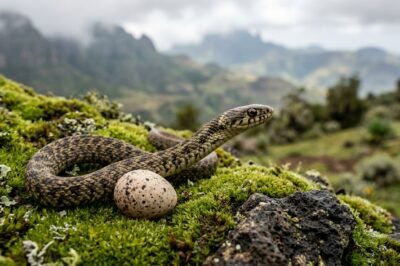
In the hidden crevices of the Ethiopian Highlands, a region long celebrated for its unique biodiversity and dramatic geological formations, a remarkable biological revelation has emerged. The discovery of a new snake species, equipped with a specialized anatomical feature colloquially dubbed an ‘egg peeler,’ has sent shockwaves through the global scientific community. This find is not merely a taxonomical addition to the records of the Horn of Africa; it represents a fascinating case study in evolutionary specialization. While the concept of egg-eating snakes is not entirely new to herpetology, the specific mechanism found in this Ethiopian specimen—an internal vertebral protrusion designed to systematically fracture eggshells from the inside—showcases an extraordinary level of physiological adaptation. This discovery highlights the intricate ways in which species evolve to exploit niche food sources, turning a seemingly difficult meal into a highly efficient source of nutrition.
The announcement, which originated from a dedicated team of researchers working in the remote Ethiopian wilderness, emphasizes the resilience and mystery of the natural world. In an era where global biodiversity is under constant threat from climate change and habitat loss, finding a previously unknown predator with such a complex and specialized survival kit offers a glimmer of hope for conservationists and scientists alike. This snake, a member of the Dasypeltis genus, has adapted to the point where its entire upper digestive tract has been modified into a biological tool. For financial observers and trend analysts, such discoveries often signal the untapped potential of regional biodiversity hubs, potentially leading to increased scientific funding and eco-tourism interest in the East African corridor. As we peel back the layers of this discovery, we find a story of survival, evolution, and the relentless drive of nature to perfect its designs.
The Discovery: Mapping Ethiopia’s Untouched Biodiversity
The discovery of this new species, now identified as part of the specialized group of egg-eating snakes, occurred during a systematic survey of the Ethiopian Plateau. This region, characterized by its high altitudes and fragmented ecosystems, has long been known as a hotspot for endemism. The researchers, led by an international coalition of herpetologists, were initially documenting the distribution of known reptiles when they encountered a specimen that exhibited unique morphological characteristics. This snake, although similar in appearance to other members of the Dasypeltis family, possessed a distinct coloration and, more importantly, a skeletal structure that had never been documented in this specific configuration.
Initial field observations were followed by rigorous laboratory analysis, including high-resolution CT scanning and genetic sequencing. These tests confirmed that the snake was indeed a distinct species. The find underscores the importance of continued investment in field biology, particularly in regions like Ethiopia where the terrain is challenging and many areas remain scientifically unexplored. From an environmental standpoint, the presence of such a specialized predator indicates a healthy and stable population of ground-nesting birds, as the snake’s survival is entirely dependent on the availability of eggs. This interdependency highlights the delicate balance of the Ethiopian ecosystem and the need for comprehensive protection of its remaining natural habitats.
Furthermore, the discovery has significant implications for our understanding of the Dasypeltis genus. Previously, it was thought that the primary evolutionary branches of this genus were well-documented. However, the unique ‘egg peeler’ mechanism found in this species suggests that the evolutionary tree is more complex than once believed. It provides evidence of a localized adaptation strategy that may have evolved over millions of years in isolation on the Ethiopian Plateau. This find adds another layer to the rich tapestry of African herpetology and reinforces the status of Ethiopia as a critical area for biological research and conservation efforts.
Anatomy of an ‘Egg Peeler’: How the Mechanism Works
The most striking feature of this new snake species is undoubtedly the ‘egg peeler’ located within its throat. To understand how this works, one must first look at the unique challenges of eating an egg for a limbless creature. Most snakes consume prey whole, but eggs present a unique problem: they are bulky, smooth, and protected by a hard shell. While other snakes might simply swallow an egg and wait for digestion, the Dasypeltis species has evolved a much more efficient method. The ‘egg peeler’ consists of elongated, specialized vertebrae that protrude into the esophagus. These are not teeth in the traditional sense, but sharp, bony projections that act like a saw or a lever once the egg is inside the snake’s neck.
When the snake swallows an egg, its highly flexible jaw allows it to encompass an object many times the size of its head. Once the egg reaches the mid-section of the throat, the snake contracts its powerful muscles, pressing the egg against the internal vertebral spines. These spines pierce the shell, causing it to collapse inward. The snake then expertly squeezes the contents of the egg—the yolk and white—into its stomach, while the crushed shell is compacted and eventually regurgitated as a small, neat pellet. This process is incredibly efficient, allowing the snake to extract every drop of nutrition while avoiding the ingestion of indigestible and potentially sharp shell fragments.
The mechanics of this internal cracking system are a marvel of biological engineering. The precision required to crack the shell without rupturing the esophagus requires a complex coordination of muscles and bone. Researchers believe that the specific shape and sharpness of the ‘peeler’ in the Ethiopian species are an adaptation to the specific types of eggs found in its habitat. These eggs might have thicker shells or different structural properties than those found in other regions, necessitating a more robust internal mechanism. This high level of specialization makes the snake a master of its niche, but it also makes it highly vulnerable to changes in its prey’s population, a common trait among evolutionary specialists.
Evolutionary Divergence: Comparing the New Species to Known Egg-Eaters
To truly appreciate the significance of the Ethiopian ‘egg peeler,’ it is necessary to compare it to its relatives in the Dasypeltis genus. Most egg-eating snakes found across Africa and parts of the Middle East share the basic ability to swallow eggs whole and use vertebral spines to crack them. However, the newly discovered species exhibits a refined version of this trait that appears to be more aggressive and structurally distinct. Preliminary comparisons suggest that the ‘egg peeler’ in this Ethiopian snake is longer and more curved, providing better leverage for cracking tougher shells. This suggests a divergent evolutionary path driven by the specific ecological pressures of the high-altitude Ethiopian environment.
Genetic analysis has revealed that this species diverged from its closest relatives several million years ago. During this time, the isolation of the Ethiopian Highlands acted as a laboratory for evolution. While other Dasypeltis species were adapting to the diverse prey of the African savannas, the Ethiopian species was fine-tuning its ability to thrive in a more restricted and specialized environment. This evolutionary divergence is a classic example of allopatric speciation, where geographical barriers lead to the development of new and distinct species. The presence of the ‘egg peeler’ is a phenotypic expression of this long history of isolation and adaptation.
Furthermore, the discovery challenges the notion that the evolution of egg-eating traits is a uniform process. By studying this new species, scientists can better understand the variations in vertebral structure across the entire genus. This could lead to a reclassification of several known species or the identification of even more cryptic species that have been overlooked in the past. The ‘egg peeler’ is not just a tool for survival; it is a biological marker that tells a story of millions of years of adaptation, environmental change, and the pursuit of ecological efficiency.
Ecological Impact: The Role of Specialized Predators in Ethiopian Highlands
In the grand scheme of the Ethiopian ecosystem, the new snake species plays a vital, albeit subtle, role. As a specialized predator, it acts as a natural regulator of bird populations. By consuming eggs, it prevents overpopulation of certain species, which in turn helps maintain the balance of the local flora and insect populations. Specialized predators like this are often considered ‘indicator species.’ Their presence and health can provide a snapshot of the overall health of the ecosystem. If the snake population is thriving, it suggests that the birds they prey upon are also healthy and that the habitat is providing enough resources for both.
The ecological impact also extends to the competition for resources. In the harsh environment of the highlands, food can be scarce. By specializing in a food source that many other predators cannot easily access—hard-shelled eggs—this snake reduces direct competition with other reptiles and small mammals. This niche partitioning allows for higher levels of biodiversity within the region. However, this specialization also comes with risks. If the populations of ground-nesting birds were to decline due to human activity or climate change, the ‘egg peeler’ would find itself without a food source, leading to a rapid decline in its population.
Moreover, the discovery of this snake highlights the importance of preserving ‘corridors’ of biodiversity in Ethiopia. The highlands are increasingly fragmented by agricultural expansion and infrastructure development. Ensuring that these specialized predators can move between habitats is crucial for their long-term survival. The ecological story of the Ethiopian egg-eating snake is a reminder that every species, no matter how small or specialized, plays a role in the intricate web of life. Protecting this snake means protecting the entire ecosystem that supports it, from the insects that feed the birds to the highland grasses that provide nesting cover.
Scientific Significance: Why This Discovery Challenges Reptilian Taxonomy
The discovery of a new snake with a built-in ‘egg peeler’ is more than just a headline; it is a significant event for reptilian taxonomy and evolutionary biology. For decades, the classification of African snakes has relied heavily on external characteristics like scale patterns and head shape. While these are important, this discovery emphasizes the need for internal anatomical studies to truly understand species diversity. The unique skeletal modifications found in this snake suggest that there may be many other ‘cryptic’ species hidden within known genera, distinguishable only by their internal structures or genetic makeup.
This find also provides new data for the study of morphological evolution. Scientists are particularly interested in how such a complex mechanism as the ‘egg peeler’ could have evolved. Did it happen in small, incremental steps, or was it the result of a more rapid evolutionary shift triggered by environmental changes? By comparing the Ethiopian snake to fossil records and other living species, researchers hope to map out the ‘evolutionary blueprint’ of this unique trait. This could have broader implications for our understanding of how vertebrates adapt their skeletal systems to meet specific functional needs, such as feeding or locomotion.
Additionally, the discovery highlights the role of modern technology in taxonomy. Without the use of CT scans and advanced imaging, the subtle but crucial differences in the snake’s vertebrae might have gone unnoticed. This signifies a shift in herpetology towards a more integrated approach, combining traditional field work with high-tech laboratory analysis. As we continue to explore the world’s remaining wilderness areas, these tools will be essential for documenting the full extent of Earth’s biodiversity. The Ethiopian egg-eater is a testament to the fact that even in well-studied groups of animals, there are still profound discoveries to be made.
Future Implications: Conservation and Continued Research
Looking ahead, the discovery of the Ethiopian ‘egg peeler’ snake opens up several new avenues for research and conservation. The immediate priority for scientists is to determine the full geographic range of the species and the size of its population. This data is essential for assessing its conservation status and developing strategies to protect its habitat. Given the rapid pace of development in Ethiopia, there is a sense of urgency to ensure that this unique evolutionary lineage is not lost before it can be fully understood. Conservation programs will need to work closely with local communities to balance the needs of human development with the preservation of critical wildlife habitats.
In the scientific realm, the discovery will likely spark a renewed interest in the herpetology of the Horn of Africa. Many researchers are now looking to conduct similar surveys in neighboring regions, hoping to find other undiscovered species with unique adaptations. There is also the potential for biochemical research; the process by which these snakes digest large quantities of egg yolk and white while regurgitating shells could offer insights into metabolic efficiency and digestive health. The ‘egg peeler’ mechanism itself might even inspire bio-mimetic designs in engineering, where efficient ways to pierce and compress materials are needed.
Ultimately, the story of this new snake species is a powerful reminder of the wonders that still await discovery in the natural world. It challenges our assumptions about what we know and underscores the importance of curiosity and exploration. As we move further into the 21st century, the preservation of biodiversity must remain a global priority. Discoveries like the Ethiopian ‘egg peeler’ snake enrich our understanding of life on Earth and provide a compelling case for the intrinsic value of every species. The future of herpetological research in Ethiopia looks bright, promising more insights into the extraordinary ways in which life adapts to the challenges of our ever-changing planet.





































Leave a Reply