
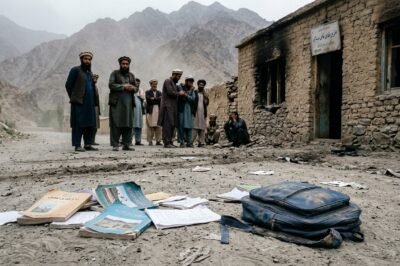
The quiet morning in the rugged terrain of eastern Afghanistan’s Kunar province was shattered by a devastating explosion that has once again cast a dark shadow over the nation’s fragile peace. Early reports from local officials and international news agencies, including Al Jazeera, confirm that at least six innocent students were killed in a blast that occurred immediately adjacent to their place of learning. This horrific incident underscores the persistent and lethal environment that Afghan civilians, particularly children, navigate daily in a landscape still littered with the remnants of decades of conflict and the resurgence of localized violence. As families mourn the loss of their young ones, the international community is forced to confront the reality that the security transition in Afghanistan remains deeply flawed and incomplete. The loss of these six lives is not merely a local tragedy; it is a profound indicator of the systemic failure to secure the most vulnerable segments of society in a post-conflict era that feels anything but peaceful for those on the ground.
The Incident in Kunar: A Detailed Account of the Tragedy
According to reports from provincial authorities in Kunar, the blast occurred during a peak hour when students were congregating near the school premises. While the exact nature of the explosive device is still under investigation by local security forces, preliminary assessments suggest either a remotely detonated improvised explosive device (IED) or the accidental triggering of unexploded ordnance (UXO) that had been abandoned in the area. Kunar province, characterized by its dense forests and mountainous borders with Pakistan, has historically been a flashpoint for military engagements, making it one of the most heavily mined and weapon-saturated regions in the country. The physical impact of the explosion was catastrophic, causing immediate fatalities and leaving several others with life-altering injuries, further straining the already dilapidated healthcare infrastructure in the region.
Witnesses described a scene of absolute chaos as parents rushed to the school to find their children amidst the smoke and debris. The local hospital in the provincial capital, Asadabad, was quickly overwhelmed as residents transported the wounded in private vehicles due to the lack of dedicated emergency services. This incident highlights the critical gap in emergency response capabilities within rural Afghanistan, where the distance between a tragedy and life-saving medical intervention can often be the difference between life and death. The emotional toll on the community is immeasurable, as the school, once seen as a beacon of hope for a generation seeking to move beyond the scars of war, has now become a site of mourning and trauma.
The Persistent Threat of Unexploded Ordnance and IEDs
The tragedy in Kunar serves as a grim reminder that Afghanistan remains one of the most contaminated countries in the world regarding landmines and explosive remnants of war (ERW). For decades, various factions have utilized IEDs as a primary weapon of choice, leaving behind a legacy of hidden killers that continue to claim lives long after the frontline battles have subsided. According to data from the United Nations Mine Action Service (UNMAS), thousands of Afghans are killed or maimed every year by these silent threats, with children accounting for a disproportionately high percentage of the victims due to their natural curiosity and tendency to play in open fields where these devices are often concealed.
The current administration in Kabul faces an uphill battle in demining operations. International funding for mine clearance has fluctuated significantly following the change in government, leaving many demining organizations with reduced budgets and limited access to high-risk zones. Furthermore, the technical expertise required to safely neutralize modern IEDs—which are often made with sophisticated triggers and non-metallic components—is in short supply. Without a sustained and well-funded national demining strategy, schools and public spaces in provinces like Kunar will remain hazardous zones, preventing the normalization of daily life and hindering the psychological recovery of the population.
Educational Institutions as Soft Targets in Volatile Regions
The targeting of educational institutions, whether intentional or incidental, represents a grave violation of international humanitarian standards and has long-term detrimental effects on a nation’s development. In the context of Afghanistan, schools have frequently been caught in the crossfire of ideological and territorial disputes. For the students of Kunar, the blast is a deterrent that may keep hundreds of other children away from classrooms out of fear for their safety. When education is compromised by violence, the economic and social trajectory of an entire generation is put at risk, creating a vacuum that can be exploited by extremist ideologies.
Furthermore, the security of schools in rural provinces is often neglected in favor of protecting urban centers and government installations. This geographic disparity in security resource allocation leaves rural students vulnerable to both active militant attacks and the passive threat of abandoned weaponry. Analyzing this from a sociological perspective, the repeated trauma associated with school-related violence leads to a decline in literacy rates and an increase in child labor, as families prioritize immediate survival over the perceived long-term benefits of an education that carries such high physical risks.
Regional Geopolitics and the Kunar-Nangarhar Security Corridor
Kunar province does not exist in a vacuum; it is a critical component of the eastern security corridor that includes Nangarhar and Nuristan. This region has long been a stronghold for various militant groups, including the local affiliate of the Islamic State (ISIS-K), which has historically clashed with the Taliban for territorial control. The presence of these competing factions creates a volatile security environment where civilian infrastructure is often collateral damage. The proximity to the porous border with Pakistan further complicates the security matrix, as it allows for the movement of materials and personnel involved in the manufacturing of explosives.
Market and geopolitical analysts suggest that instability in the Kunar region has direct implications for regional trade and infrastructure projects. The instability discourages foreign investment in mineral extraction and hydroelectric projects that Kunar is otherwise well-suited for. From a financial standpoint, the continued insecurity in the east prevents Afghanistan from integrating into regional trade networks that would connect Central Asia with South Asia. The cost of this instability is measured not only in lost lives but in billions of dollars of untapped economic potential and the continued reliance on international humanitarian aid rather than sustainable domestic growth.
Socio-Economic Impact and the Humanitarian Crisis
The death of six students is a micro-level tragedy that reflects the macro-level humanitarian crisis currently gripping Afghanistan. The country’s economy has been in a state of freefall, with high unemployment and soaring food prices. For the families in Kunar who lost their children, the economic impact is compounded by the loss of future earners and the immediate costs of funerals and medical care for the survivors. Humanitarian organizations operating in the region have noted that such incidents increase the prevalence of post-traumatic stress disorder (PTSD) among children, for which there are virtually no specialized mental health services available in the province.
International aid agencies are struggling to maintain operations amidst a complex political landscape. The blast in Kunar highlights the urgent need for ‘protection of civilians’ to be placed at the forefront of the international dialogue regarding Afghanistan. Financial implications also extend to the rising costs of security for NGOs operating in the area; as the risk of blasts increases, the insurance and operational overhead for delivering aid also rise, meaning less money actually reaches the people in need. The cyclical nature of violence and poverty is reinforced with every such explosion, making the path to self-sufficiency even more elusive for the Afghan people.
Conclusion: Assessing the Path Forward for Afghanistan
The loss of at least six students in Kunar is a call to action for both the de facto authorities in Kabul and the global community. It is a stark reminder that the ‘end’ of a war does not mean the end of its lethality. Moving forward, there must be a renewed emphasis on comprehensive mine clearance and the securing of educational environments as ‘zones of peace.’ The international community must find ways to support humanitarian demining and emergency medical services without necessarily navigating the complexities of political recognition, focusing instead on the fundamental right to life and safety for Afghan children.
If the security situation in provinces like Kunar continues to deteriorate or remains stagnant, the prospects for a stable and prosperous Afghanistan will continue to fade. The future implications of this incident will likely manifest in increased displacement, a further decline in educational enrollment, and a deepening of the humanitarian chasm that separates Afghanistan from the rest of the developing world. The blood of the students in Kunar demands more than just a momentary headline; it demands a strategic shift in how the world engages with the persistent dangers of a land still caught between its violent past and an uncertain future.




































Leave a Reply