
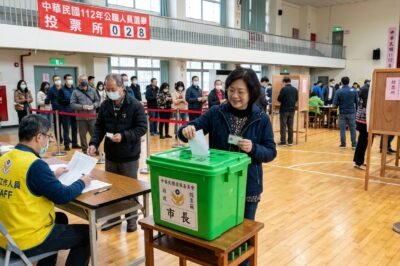
The dawn broke over Taipei with a sense of quiet intensity as millions of Taiwanese citizens prepared to exercise their democratic rights in what many analysts describe as the most consequential local elections in the island’s recent history. Often referred to as the ‘Nine-in-One’ elections, this massive democratic exercise involves the selection of mayors, county chiefs, and thousands of local representatives across the nation’s 22 cities and counties. While the ballots ostensibly focus on local issues like urban development, public transportation, and social welfare, the shadow of cross-strait relations and the broader geopolitical struggle between the United States and China looms large over the proceedings. For President Tsai Ing-wen and the ruling Democratic Progressive Party (DPP), these elections represent more than just local governance; they are a vital litmus test for the party’s narrative of democratic resilience and its stance against increasing pressure from Beijing. Conversely, for the opposition Kuomintang (KMT), this is a moment to prove their relevance by focusing on ‘bread-and-butter’ issues, arguing that the government has become overly preoccupied with international grandstanding at the expense of domestic stability and economic prosperity. As voters queued at school gymnasiums and community centers, the air was thick with the weight of a decision that would resonate far beyond the island’s shores, signaling the public’s appetite for the current administration’s trajectory as they look toward the pivotal 2024 presidential contest.
Understanding the Political Landscape: The Blue vs. Green Divide
Taiwan’s political ecosystem is traditionally defined by the binary struggle between the ‘Pan-Blue’ coalition, led by the Kuomintang (KMT), and the ‘Pan-Green’ coalition, led by the Democratic Progressive Party (DPP). This divide is deeply rooted in the island’s complex history, dating back to the retreat of the Nationalist government from mainland China in 1949 and the subsequent decades of martial law. Since the lifting of martial law in 1987 and the first direct presidential election in 1996, Taiwan has developed into one of the most vibrant and vocal democracies in Asia. In these local elections, the KMT typically holds an advantage in rural areas and among older demographics who favor the party’s historical emphasis on administrative efficiency and stable relations with the mainland. The DPP, meanwhile, has traditionally dominated in the south and among urban youth who identify strongly as Taiwanese rather than Chinese.
The current electoral cycle is particularly significant because it occurs at a time when the ‘status quo’ in the Taiwan Strait is being increasingly challenged. For the DPP, holding onto key mayoralties is essential to validate their ‘New Southbound Policy’ and their efforts to diversify Taiwan’s economic dependencies away from China. For the KMT, a strong showing would be a lifeline, potentially reversing years of electoral decline and proving that their message of pragmatic engagement with Beijing still resonates with a significant portion of the electorate who fear the economic consequences of prolonged tension. This section of the analysis underscores that while the positions are local, the ideologies behind the candidates are inextricably linked to the national identity debate that has defined Taiwan for a generation.
The Domestic Pulse: Livelihoods and Urban Management
At the heart of the 2022 local elections is a complex tapestry of domestic grievances and aspirations. While international media often frames Taiwan’s politics solely through the lens of its relationship with China, the average voter in Taichung or Kaohsiung is frequently more concerned with the skyrocketing cost of housing and the lingering economic effects of the COVID-19 pandemic. The ‘Nine-in-One’ format means that voters are not just choosing a mayor; they are deciding on the direction of their immediate communities, from waste management to school funding and healthcare infrastructure. The DPP, which has held the presidency since 2016, faces the natural ‘midterm’ fatigue that plagues many incumbent governments. Issues such as the reliability of the power grid, following several high-profile blackouts, and the rising inflation rates for essential goods have provided fertile ground for the opposition to critique the ruling party’s performance.
Furthermore, the handling of the pandemic remains a polarizing topic that has shifted from a point of pride to a point of contention. While Taiwan was initially praised for its ‘zero-COVID’ success, the transition to ‘living with the virus’ in 2022 saw a surge in cases that strained the healthcare system and impacted local businesses. The KMT has seized on these moments of perceived administrative failure, positioning their candidates as pragmatists who can deliver efficient governance without the ideological baggage often attributed to the DPP. This strategy aims to win over the middle-ground voters who may support Taiwan’s sovereignty in principle but are frustrated by the day-to-day challenges of living in an increasingly expensive urban environment. The effectiveness of this ‘livelihood first’ strategy is a key metric for determining the KMT’s future viability.
The Geopolitical Shadow: Framing the Vote as a Stand for Democracy
Despite the local nature of the positions at stake, the Democratic Progressive Party has made a concerted effort to frame these elections as a stand for democracy on the world stage. President Tsai Ing-wen has frequently stated that the world is watching how Taiwan votes, suggesting that a strong showing for the DPP would signal to Beijing and the international community that the Taiwanese people remain committed to their current path of autonomy and international engagement. This strategy seeks to elevate the local vote into a national referendum on the island’s identity and security. By emphasizing the ‘China threat,’ the DPP hopes to mobilize its base and appeal to younger voters who are generally more skeptical of closer ties with the mainland, especially following the crackdown on dissent in Hong Kong.
On the other side of the political aisle, the Kuomintang has criticized this approach as ‘fear-mongering’ designed to distract from local failures. The KMT argues that by turning every election into a geopolitical showdown, the DPP is neglecting its duty to maintain stable relations that ensure peace and economic exchange. The KMT’s traditional stance of the ‘1992 Consensus’—an agreement that both sides acknowledge there is one China but have different interpretations of what that means—is presented as a pragmatic tool to lower tensions and prevent accidental conflict. However, this position has become increasingly difficult to sell to a public that feels a growing sense of a distinct Taiwanese identity. The challenge for the KMT in these elections is to prove they can protect Taiwan’s interests while also being the party capable of de-escalating the risk of conflict, a delicate balancing act that requires nuanced communication.
Market Implications and the ‘Silicon Shield’
The global financial community watches Taiwan’s elections with a degree of scrutiny that few other local contests receive. This is primarily due to Taiwan’s indispensable role in the global technology supply chain. As the home of TSMC (Taiwan Semiconductor Manufacturing Company) and numerous other high-tech firms, any sign of political instability or a shift in the status quo can send ripples through global markets. Investors are particularly sensitive to how election results might influence Taiwan’s energy policy and its infrastructure development, both of which are critical for the energy-intensive semiconductor industry. A stable local government is seen as a prerequisite for the continued expansion of high-tech hubs in places like Hsinchu and Tainan, where land use and environmental regulations are managed at the local level.
Moreover, the concept of the ‘Silicon Shield’—the idea that Taiwan’s dominance in semiconductor manufacturing makes it too valuable for the world to allow it to be attacked—is a recurring theme in the political discourse. Local leaders play a significant role in facilitating the resources required for these industrial giants. Therefore, the election of mayors who are seen as business-friendly and capable of navigating the complexities of international trade and local environmental concerns is paramount for maintaining investor confidence. Market analysts often look for consistency in policy, and a major shift in the political landscape could lead to temporary volatility in the Taiwan Stock Exchange (TWSE) as investors recalibrate their expectations for the coming years and the potential for regulatory shifts regarding industrial expansion.
Key Battlegrounds: The Race for Taipei and Taoyuan
Taipei, the capital city, is the undisputed crown jewel of Taiwanese local elections. Traditionally, the mayoralty of Taipei has served as a stepping stone to the presidency, with former presidents like Lee Teng-hui, Chen Shui-bian, and Ma Ying-jeou all having served as the city’s chief executive. In the current cycle, the race is a three-way contest featuring the KMT’s Chiang Wan-an (the great-grandson of Chiang Kai-shek), the DPP’s Chen Shih-chung (the former health minister), and the independent-leaning Vivian Huang, supported by the Taiwan People’s Party (TPP). This triangular race is a microcosm of the national political landscape, representing the old guard, the current establishment, and a burgeoning third-force movement that seeks to disrupt the traditional two-party system.
Taoyuan is another critical battlefield that analysts are watching closely. As an industrial powerhouse and the gateway to the island via its international airport, Taoyuan’s political leanings have shifted in recent years, making it a ‘swing’ city. The DPP’s ability to hold onto this city after the departure of the popular outgoing mayor Cheng Wen-tsan is seen as a major test of the party’s organizational strength and its ability to transfer popularity from one candidate to another. A loss in Taoyuan would be a significant blow to the DPP’s momentum, while a victory for the KMT would signal a resurgence in the northern part of the island. These local contests are being analyzed not just for their immediate outcomes, but for what they reveal about the organizational health and voter outreach capabilities of the major parties as they head toward the 2024 general election.
The Third Force: Rise of the Taiwan People’s Party
One of the most interesting developments in this election cycle is the growing influence of the Taiwan People’s Party (TPP), led by Taipei Mayor Ko Wen-je. The TPP positions itself as a ‘rational’ and ‘pragmatic’ alternative to the ‘Blue vs. Green’ polarization that has defined Taiwanese politics for decades. By focusing on governance efficiency, fiscal discipline, and technocratic solutions, the TPP has successfully attracted a significant following among younger, urban voters who are disillusioned with both traditional parties. While the TPP may not win a majority of the seats, their role as a ‘spoiler’ or a ‘kingmaker’ in tight races cannot be overstated, as they draw votes away from both the DPP and the KMT.
The rise of a viable third party reflects a maturing democracy where the electorate is increasingly looking beyond the singular issue of national identity and cross-strait relations. The TPP’s performance in these local elections will determine if the party has the grassroots infrastructure to challenge the duopoly in the long term. If they manage to secure a significant number of city council seats or a major mayoralty, it will force both the DPP and the KMT to rethink their campaign strategies and potentially adopt more moderate, policy-focused platforms. This diversification of the political landscape adds a layer of unpredictability to the elections, suggesting that the future of Taiwanese politics may be increasingly coalition-based rather than dominated by a single party.
Implications for 2024 and the Democratic Future
As the final ballots are counted, the immediate aftermath will be a period of intense soul-searching for all parties involved. The results of the local elections will directly impact the internal power dynamics of the DPP and KMT. A poor showing for the DPP might lead to calls for a leadership shuffle and could complicate the presumed path of future candidates toward the 2024 presidential nomination. For the KMT, a victory would vindicate their strategy of focusing on domestic issues and provide a much-needed morale boost, but it would also trigger internal competition over who should lead the party in the next national contest. The ‘Nine-in-One’ results are essentially the starting gun for the 2024 race, defining the narrative and the momentum for the next fourteen months of political campaigning.
Ultimately, these elections reaffirm Taiwan’s status as a vibrant and functioning democracy in a region where democratic backsliding is a growing concern. The peaceful and orderly conduct of such a massive election, even under the shadow of external threats, is a powerful statement of the public’s commitment to their political system. Regardless of which party emerges victorious, the true winner is the democratic process itself. The high voter turnout and the vigorous debate over the island’s future demonstrate that the Taiwanese people are deeply invested in their right to self-determination. Moving forward, the challenge for the newly elected leaders will be to translate their campaign promises into tangible results, navigating the difficult waters of local grievances while keeping a steady eye on the horizon of international relations and economic stability. The world will continue to watch Taiwan, not just as a flashpoint of geopolitical tension, but as a model of how democratic values can survive and thrive under immense pressure.

































Leave a Reply