
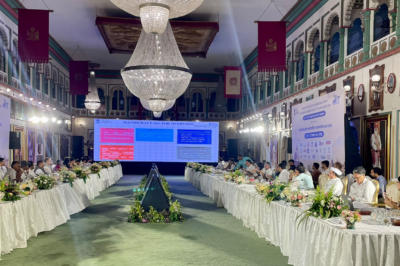
Standing Committee on Finance reviews artisan welfare, social security, craft revival and market opportunities in Rajasthan
Udaipur: India’s handicrafts represent far more than products created for commercial markets. Behind every handcrafted article is an artisan whose skill, knowledge and cultural identity have often been passed down through generations. Recognising this wider significance, the Standing Committee on Finance (2025–26), under the Chairpersonship of Shri Bhartruhari Mahtab, held detailed discussions on “Social Security for Informal Sector with special reference to the State of Rajasthan/Northern Region”, with particular attention to the development, welfare and social security of artisans and weavers.
Representatives of the Ministry of Textiles, Government of India, including officials from the Office of the Development Commissioner (Handicrafts) and the Office of the Development Commissioner (Handlooms), presented various initiatives undertaken for the development of these sectors. The presentations covered a wide range of issues, including artisan welfare, skill development, infrastructure, technology, marketing, livelihood generation and social-security measures.
From Craftsmanship to Sustainable Livelihoods
The presentation on handicrafts highlighted interventions being implemented under the National Handicrafts Development Programme (NHDP) and other development initiatives. The discussions recognised handicrafts not merely as an economic activity but as an important means of preserving traditional knowledge, cultural heritage, craftsmanship and age-old artistic traditions.
For millions of artisans, craftsmanship represents both a profession and a way of life. Traditional techniques are frequently transmitted from parent to child, master artisan to apprentice and one generation to the next. Strengthening the handicrafts sector, therefore, also requires strengthening the communities and individuals who keep these traditions alive.
Committee Examines Schemes from the Ground Level
Members of the Committee closely examined the presentations and interacted with senior officials representing the concerned departments. Discussions covered scheme implementation, financial assistance, artisan welfare, infrastructure, cluster development, marketing opportunities, social-security measures and the effectiveness of interventions at the grassroots level.
The interaction provided an opportunity to examine whether existing programmes are sufficiently aligned with the practical requirements of artisans and weavers. The Committee also suggested that appropriate improvements could be considered in the design and implementation of schemes to ensure that benefits reach intended beneficiaries more effectively.
Representing the Office of the Development Commissioner (Handicrafts), Ms. Seema Mishra, Director (Handicrafts), responded to and clarified various points raised by Committee Members. She was supported by the team led by Shri Virendra Kumar, Regional Director (Handicrafts), along with senior officers including Shri Rajat Verma, Shri Rabiveer Chowdhuri and Shri Mahindar Singh Meena.
Social Security for a Lifetime of Craftsmanship
One of the significant areas discussed was social-security support for eligible senior artisans. The Committee appreciated the provision of pension support for eligible award-winning artisans above 60 years of age.
For artisans who have spent decades preserving traditional crafts, such measures carry significance beyond financial assistance. Social-security support can provide greater dignity and a sense of security during the later years of life.
The discussions reinforced the importance of recognising artisans not merely for the products they create but also for the knowledge, cultural traditions and heritage they carry.
Focus on Endangered and Declining Crafts
The revival of endangered and declining traditional crafts was another important issue raised during the discussions.
When the number of practitioners of a traditional craft declines, the potential loss extends beyond an economic activity. Specialised techniques, cultural expressions and generations-old knowledge can also gradually disappear.
The discussions highlighted the importance of identifying endangered crafts and strengthening their revival through documentation of traditional knowledge, skill transmission to younger generations, design development, technology support, product diversification, market creation and sustained institutional handholding.
For a traditional craft to survive in the long term, revival efforts must also make it economically viable and culturally relevant. Creating sustainable livelihood opportunities can encourage younger generations to view craftsmanship as a viable profession.
Insurance and Social Security for Artisans
The Committee also raised issues relating to insurance coverage and social-security measures for artisans, particularly considering the vulnerabilities associated with informal-sector employment.
The discussions referred to initiatives such as the Pradhan Mantri Suraksha Bima Yojana (PMSBY) and Pradhan Mantri Jeevan Jyoti Bima Yojana (PMJJBY) as important areas for awareness and access among eligible artisan communities.
For artisan families, social-security mechanisms can provide an important safety net during difficult circumstances. The discussions therefore emphasised awareness, accessibility and effective last-mile facilitation to ensure that eligible beneficiaries are able to access available provisions.
Rajasthan’s Rich Craft Heritage
Rajasthan occupies a distinctive position in India’s handicrafts landscape. Across the state, generations of artisans have developed and preserved diverse traditions encompassing pottery, textiles, printing, embroidery, metalwork, leatherwork, painting and specialised crafts.
Several Rajasthan crafts have received Geographical Indication (GI) recognition. These include Blue Pottery of Jaipur, Molela Clay Work, Kathputlis of Rajasthan, Sanganeri Hand Block Printing, Bagru Hand Block Print, Thewa Art Work, Pokaran Pottery, Nathdwara Pichhwai Painting, Udaipur Koftgari Metal Craft, Bikaner Kashidakari Craft, Jodhpur Bandhej Craft, Bikaner Usta Kala Craft, Mojari Craft of Jodhpur and Ravan Hattha.
These traditions represent not only regional products but also the cultural identity of communities and an important foundation for artisan-led economic activity.
Expanding Market Opportunities
Market access emerged as another key component of sustainable artisan development. Marketing support, exhibitions, domestic and international events, buyer-seller meets, virtual platforms, publicity and brand promotion can help artisans connect traditional skills with contemporary consumers.
The discussions also highlighted the importance of understanding different market segments. Traditional, contemporary, premium, institutional, domestic and international markets may require different approaches to product design, pricing, packaging, branding and promotion.
Digital platforms, e-commerce, institutional buyers, exhibitions and tourism-linked markets can provide artisans and Producer Companies with opportunities to move beyond conventional local markets.
Producer Companies and Collective Strength
The formation and strengthening of Producer Companies was also recognised as an avenue for bringing artisans into more organised business structures.
Collective production, professional management, procurement, product development, branding and market access can enable artisans to participate more effectively across the value chain. Strong producer institutions can also create platforms for collective decision-making and enterprise development.
The future of handicrafts, therefore, involves not only preserving traditional skills but also creating institutional and commercial structures that enable those skills to generate sustainable livelihoods.
A Holistic Approach to Artisan Development
The discussions placed handicrafts within a broader framework of social security, livelihood generation and cultural preservation. Welfare-oriented interventions include eligible pension support, insurance-related measures, credit facilities, artisan identity cards and databases, awareness programmes, skill development and recognition through national-level handicraft awards.
The Committee’s observations underlined the importance of making development programmes increasingly practical, accessible, transparent and responsive to the actual requirements of artisans and weavers.
Improving last-mile delivery, strengthening awareness, facilitating access to financial and institutional support, expanding market opportunities and ensuring effective monitoring can contribute to more meaningful outcomes.
At the same time, greater attention to endangered crafts, insurance coverage, social security, market segmentation, digital marketing, contemporary design, technology adoption, branding and enterprise development can help traditional craftsmanship adapt to changing economic realities while retaining its cultural identity.
Preserving the Artisan, Preserving the Craft
The Study Visit provided a platform for interaction between Parliamentary representatives and implementing agencies and brought greater focus to the challenges and opportunities facing India’s informal artisan economy.
The discussions reaffirmed the importance of supporting artisans and weavers through a combination of craft revival, skill preservation, social security, insurance, access to finance, market development, enterprise support and sustainable livelihood opportunities.
The central message emerging from the discussions is that preserving a craft also means preserving the artisan who practises it. A traditional craft cannot survive merely as a museum object; it must remain a living, viable and dignified livelihood.
India’s handicraft heritage will endure when the hands that create it are supported, respected and empowered. Sustainable markets can strengthen artisans economically, social-security measures can provide dignity and confidence, and skill preservation can ensure that generations-old knowledge continues to reach the next generation.
When the artisan thrives, the craft survives. When the craft survives, India’s cultural heritage continues to live on.



































Leave a Reply