
The Sudden Escalation in the Red Sea Corridors
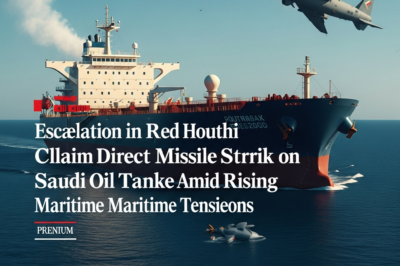
In a development that has sent shockwaves through global energy markets and maritime security circles, the Houthi movement in Yemen, also known as Ansar Allah, has officially claimed responsibility for a targeted missile attack on a Saudi Arabian oil tanker. This incident, reported initially by Al Jazeera and confirmed through Houthi military spokespersons, represents a significant uptick in the group’s campaign against international shipping. For months, the Bab el-Mandeb Strait and the Red Sea have become a volatile theater of conflict, but the direct targeting of a Saudi-flagged vessel adds a layer of complexity to an already fractured regional landscape. The Houthis have stated that their operations are a response to what they term as the ‘aggression’ of the Saudi-led coalition and a show of unwavering solidarity with the Palestinian people in Gaza. This latest strike is not merely a military maneuver; it is a geopolitical statement that highlights the vulnerability of the world’s most critical maritime chokepoints. As the smoke clears from the latest engagement, the international community is left to grapple with the implications of a non-state actor effectively challenging the naval dominance of regional powers and disrupting the flow of global commerce. The gravity of this situation cannot be overstated, as it threatens to reignite the dormant flames of the Yemeni civil war while simultaneously drawing global superpowers deeper into a localized conflict.
The Anatomy of the Attack: Tactical Details and Weaponry
The attack, which reportedly took place in the vicinity of the southern Red Sea, involved the deployment of advanced naval missiles. According to Houthi military spokesperson Yahya Saree, the operation was executed with precision, resulting in a direct hit on the vessel. While independent verification of the damage remains ongoing, the psychological impact of the claim has already been felt. Experts suggest that the Houthis have significantly upgraded their arsenal over the last decade, transitioning from repurposed Soviet-era hardware to sophisticated anti-ship ballistic missiles and suicide drones, many of which share striking similarities with Iranian designs. The use of such technology against a tanker carrying hundreds of thousands of barrels of crude oil raises immediate environmental and economic concerns. A major spill in the Red Sea would not only devastate the local marine ecosystem, including the unique coral reefs of the region, but would also cripple the desalination plants that provide fresh water to millions of people along the Saudi coast. The tactical shift toward targeting tankers specifically indicates a desire to exert maximum leverage over the global community by threatening the energy supply chains that fuel the world economy.
A Decade of Conflict: The Historical Context of Houthi-Saudi Hostility
To understand the current crisis, one must look back to the origins of the Yemeni Civil War in late 2014, when Houthi rebels seized the capital, Sanaa. This move prompted a massive military intervention by a Saudi-led coalition in 2015, aimed at restoring the internationally recognized government of President Abd-Rabbu Mansour Hadi. What followed was a protracted and devastating conflict that the United Nations labeled the world’s worst humanitarian crisis. Despite years of intensive aerial bombardment, the Houthis maintained their grip on much of northern Yemen, including the strategic port of Hudaydah. In recent years, a fragile truce had offered a glimmer of hope for a diplomatic resolution. However, the eruption of the war in Gaza in October 2023 served as a catalyst for the Houthis to pivot their military focus outward. By positioning themselves as the defenders of the Palestinian cause, the Houthis have successfully rebranded their local insurgency into a regional crusade. This transition allows them to domesticate support within Yemen while simultaneously challenging Saudi Arabia’s leadership role in the Islamic world. The attack on the Saudi tanker is, therefore, a continuation of a long-standing rivalry, now filtered through the lens of the broader Middle Eastern geopolitical realignment.
Global Energy Security and the Economic Fallout
The Red Sea is the gateway to the Suez Canal, through which approximately 12 percent of global trade and nearly 10 percent of the world’s seaborne oil passes. Any disruption here has an immediate and tangible effect on global markets. Following the news of the Houthi claim, Brent crude prices saw a noticeable uptick as traders factored in the increased risk premium of transporting oil through the region. Insurance companies have responded by dramatically increasing war-risk premiums for vessels navigating the Bab el-Mandeb, with some reports suggesting that insurance costs have risen by over 1,000 percent since the start of the Houthi campaign. Many of the world’s largest shipping giants, such as Maersk and Hapag-Lloyd, have already rerouted their fleets around the Cape of Good Hope in South Africa. This detour adds roughly 10 to 14 days to the journey and significantly increases fuel costs and carbon emissions. For Saudi Arabia, the world’s largest exporter of crude oil, the threat to its tankers is a direct challenge to its economic lifeline. The kingdom has invested billions in ‘Vision 2030’, a plan to diversify its economy, and a regional maritime war is the last thing its leadership wants. The economic fallout extends beyond oil; the delays in shipping affect everything from consumer electronics to grain supplies, contributing to global inflationary pressures.
The Role of Iran and the Question of Technical Support
A central theme in the discourse surrounding Houthi capabilities is the role of the Islamic Republic of Iran. While the Houthis maintain that their military decisions are made independently, Western intelligence agencies and United Nations experts have consistently pointed to the flow of Iranian technology and expertise into Yemen. The missiles used in recent attacks, such as the Quds series of cruise missiles and the Sammad series of drones, bear the hallmarks of Iranian engineering. Tehran has long been accused of using the Houthis as a proxy to exert pressure on Riyadh and Washington without engaging in a direct conventional war. This ‘gray zone’ warfare allows Iran to project power across the ‘Axis of Resistance,’ which includes Hezbollah in Lebanon and various militias in Iraq and Syria. The attack on the Saudi tanker serves Iranian interests by demonstrating that no maritime route is safe as long as sanctions persist and regional tensions remain high. However, the Houthis have also proven to be a highly adaptable and indigenous force, capable of innovating under the constraints of a blockade. This combination of external support and local ingenuity makes them a formidable adversary that cannot be easily deterred by traditional military means.
International Response: The Limits of Naval Deterrence
In response to the growing threat, the United States launched ‘Operation Prosperity Guardian,’ a multinational maritime task force intended to provide a protective umbrella for commercial shipping in the Red Sea. Despite the presence of advanced destroyers and carrier strike groups, the Houthis have not been deterred. The asymmetric nature of the conflict means that a relatively inexpensive Houthi drone or missile can force a multimillion-dollar interceptor missile to be fired in defense. This cost-imbalance is a strategic win for the rebels. Furthermore, the US and the UK have conducted several rounds of airstrikes on Houthi launch sites and command centers within Yemen. These strikes, while damaging to Houthi infrastructure, have failed to halt the attacks. Critics of the military approach argue that there is no purely military solution to the Houthi problem. The group has survived years of intensive bombing by the Saudi-led coalition and has built a resilient, decentralized military structure. The international community is divided on how to proceed, with some European nations hesitant to join the US-led strikes for fear of escalating the situation into a wider regional war. Meanwhile, China and Russia have remained largely on the sidelines, calling for restraint but refraining from condemning the Houthis with the same vigor as the West.
Future Outlook: A Region on the Brink
As we look toward the future, the prospect of a peaceful resolution seems increasingly remote. The Houthis have tethered their maritime campaign to the ceasefire in Gaza, a condition that remains elusive despite ongoing negotiations. This means that as long as the conflict in the Palestinian territories continues, the Red Sea will remain a danger zone. For Saudi Arabia, the situation is a delicate balancing act. Riyadh has been attempting to extricate itself from the Yemeni quagmire to focus on domestic development, even engaging in direct talks with Houthi officials in 2023. A return to full-scale war would be disastrous for the Kingdom’s regional ambitions. However, they cannot allow their primary export assets to be targeted with impunity. The global community must now decide whether to intensify military pressure on the Houthis or seek a broader diplomatic grand bargain that addresses the root causes of the conflict. The danger of a miscalculation is high. A single missile hit that causes a catastrophic oil spill or a significant loss of life could trigger a chain reaction that draws the Middle East into a conflict of unprecedented proportions. The Houthi claim of a strike on a Saudi tanker is more than just a headline; it is a warning that the old rules of maritime security no longer apply in an era of asymmetric warfare and shifting geopolitical alliances.




































Leave a Reply