
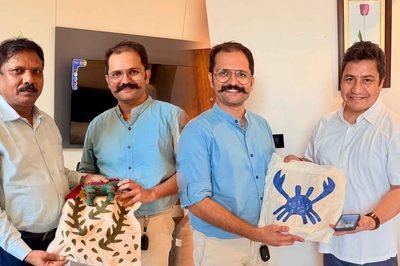
- From six villages near Jaipur, more than 100 women artisans are transforming textile waste into handcrafted products while building a collective, women-owned enterprise
Jaipur: A remarkable women-led enterprise has emerged from Ramsar Palawala village near Jaipur, bringing together traditional craftsmanship, sustainable production, women’s entrepreneurship and contemporary market opportunities.
M/s Unmukt Women Producer Company Limited, established in 2025, has come into focus during the recent identification of emerging artisan clusters by the Handicrafts Service Centre (HSC), Jaipur, under the Office of the Development Commissioner (Handicrafts). The enterprise offers an encouraging example of how grassroots artisan initiatives can evolve into market-oriented businesses while creating livelihood opportunities for women.
At the heart of Unmukt’s journey is the initiative of a young entrepreneur who took the lead in establishing the Producer Company and developing it as a business with a clear market orientation. During its establishment and development, the initiative received guidance and support from HSC Jaipur, reflecting the importance of institutional handholding in strengthening emerging artisan enterprises.
From Six Villages to a Collective Women-Owned Enterprise
Today, more than 100 women artisans from six villages around Jaipur are associated with Unmukt Women Producer Company.
What distinguishes the enterprise is the nature of their participation. The women are not merely engaged as workers in a production system; they are shareholders and directors of the Producer Company. This structure provides them with a greater sense of ownership and participation in the enterprise they are collectively building.
The model also creates opportunities for women to earn approximately ₹4,000–₹5,000 per month, while allowing them to work close to their homes and remain connected with their families and communities.
This combination of livelihood generation, local employment and collective ownership creates a bridge between traditional artisan skills and women-led enterprise development.
For rural women, such a model can provide an opportunity to participate in economic activity without requiring them to move away from their communities. At the same time, collective ownership creates a platform through which artisans can participate in the broader business process rather than remaining limited to production alone.
Turning Textile Waste into Creative Products
One of the most distinctive features of Unmukt is its focus on upcycling and sustainable craft production.
Surplus and discarded cotton fabric sourced from garment factories in Jaipur is transformed by the women artisans into attractive and functional handcrafted products. Instead of allowing usable textile material to remain waste, the enterprise converts it into products with additional creative and economic value.
The product range includes toys, bags, home textiles and accessories, with the products enhanced through traditional and contemporary craft techniques such as hand embroidery, block printing and eco-printing using natural dyes.
The emphasis on children’s toys is particularly noteworthy. By combining handmade craftsmanship with child-oriented product development, Unmukt is exploring a contemporary market while retaining the distinctive character of artisan-made products.
The approach demonstrates how textile waste can become a resource for creative production. Fabric that might otherwise be discarded can be redesigned, embellished and transformed into products capable of generating additional income for artisan communities.
In this sense, sustainability is not treated merely as an environmental concept. It becomes part of the enterprise’s production model and livelihood strategy.
Design, Innovation and Market Orientation
Unmukt has also developed a strong design-oriented approach, with more than 170 original designs across different product categories.
Design development is an important component of the enterprise because it allows traditional skills to respond to changing consumer preferences. The combination of embroidery, block printing, eco-printing and upcycled textiles creates opportunities for developing products that are both craft-based and contemporary.
The enterprise’s production capabilities also provide scope for undertaking wholesale orders, corporate gifting and export requirements.
Its market linkages have already expanded beyond its immediate geographical area, with buyers such as Choose Kind and Neela Jaipur associated with its products. The company’s products have also reached buyers in 10 different countries.
These developments indicate the potential of rural women-led enterprises to connect with wider domestic and international value chains when traditional skills are supported by design development, product diversification and market-oriented production.
From Artisans to Entrepreneurs
Perhaps the most significant aspect of Unmukt’s journey lies not simply in the products it creates, but in the changing role of the women who create them.
When an artisan becomes a shareholder, director and decision-maker, her role extends beyond contributing labour or technical skill to production. She becomes a stakeholder in the enterprise itself.
This collective ownership model can create a stronger connection between craftsmanship and entrepreneurship. It provides women with an opportunity to participate in decisions related to production, enterprise development and the future direction of their collective business.
The model also demonstrates how handicraft development can move beyond the conventional understanding of artisans as individual producers and towards more organised forms of enterprise.
By bringing artisans together under a Producer Company structure, Unmukt is creating a platform where traditional knowledge, collective ownership and business opportunities can interact.
HSC Jaipur: Identifying Potential and Creating Opportunities
The identification of Unmukt Women Producer Company by HSC Jaipur under the Office of the Development Commissioner (Handicrafts) highlights the importance of field-level identification of promising artisan initiatives.
Grassroots enterprises such as Unmukt can benefit from continued institutional support in areas including design development, product diversification, quality improvement, branding, packaging, digital marketing, market linkages and participation in exhibitions, along with access to appropriate Government schemes.
Such support can help emerging enterprises strengthen their production systems, improve their market readiness and develop stronger business capabilities.
Institutional handholding is particularly relevant for artisan-led enterprises that possess strong craftsmanship and community participation but may require additional support to navigate areas such as branding, market development, contemporary product design and business expansion.
A Sustainable Future Through Women’s Enterprise
Unmukt Women Producer Company brings together three important dimensions of contemporary handicraft development: women’s economic participation, sustainable production and market-oriented entrepreneurship.
Its journey demonstrates how textile waste can be transformed into useful handmade products, how traditional skills can be connected with contemporary design, and how women artisans can become owners and participants in the enterprises they help build.
From six villages around Jaipur, more than 100 women are contributing their skills, creativity and entrepreneurial spirit to an emerging enterprise with national and international aspirations.
The story of Unmukt is therefore not simply about converting discarded fabric into handcrafted products. It is about creating value at multiple levels—environmental, economic, social and cultural.
It is about turning skills into livelihoods, artisans into entrepreneurs, women into enterprise owners and a grassroots initiative into a promising model of sustainable craft development.
With continued institutional support, appropriate market linkages and professional handholding, such artisan-led initiatives can strengthen their businesses and move towards greater self-sustainability.
The experience of Unmukt also highlights a broader opportunity within India’s handicrafts ecosystem: traditional craftsmanship can remain relevant in contemporary markets when artisans are supported not only as skilled producers but also as entrepreneurs, owners and decision-makers.
Ultimately, sustainable handicraft development is about more than preserving products or techniques. It is about creating conditions in which the people who carry these skills forward can build dignified and sustainable livelihoods.
At Unmukt, discarded textiles are being given a new life, traditional skills are finding new markets, and women artisans are building an enterprise they can call their own.



































Leave a Reply