
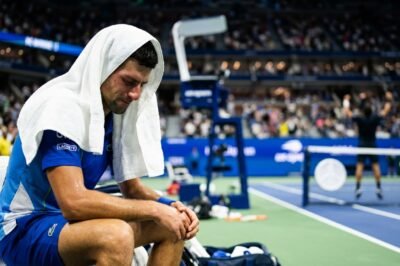
The night air at Arthur Ashe Stadium was thick with more than just the late summer humidity of New York City; it was heavy with the palpable sense of a monumental shift in the tectonic plates of professional tennis. As the clock struck midnight, the scoreboard told a story few had dared to predict: Novak Djokovic, the man who had defied time, physics, and the relentless march of younger generations for over two decades, stood at the baseline with a trembling hand. Across the net stood Mariano Navone, the Argentine powerhouse whose meteoric rise in 2026 had culminated in this third-round clash under the bright lights of the US Open. When the final forehand from Djokovic sailed long, hitting the back wall with a thud that echoed through the stunned silence of the twenty-four thousand spectators, the world watched in disbelief. It was not just the loss that captivated the audience, but the aftermath. For the first time in recent memory, the steely resolve of the twenty-four-time Grand Slam champion shattered completely. Djokovic, usually a master of composed post-match etiquette, slumped into his chair and buried his face in a towel, his shoulders heaving with uncontrollable sobs. This was not the frustrated outburst of a younger man, but the raw, vulnerable release of a legend realizing that his era might finally be drawing to a close. This analysis delves deep into the tactical collapse, the rise of a new threat, and the emotional weight of a night that will be remembered as the end of an epoch in sports history. To understand the magnitude of this defeat, one must look at the context of Djokovic’s 2026 season, which had already been marred by uncharacteristic exits in early rounds of major tournaments.
The Arthur Ashe Pressure Cooker: A Night of High Stakes
The atmosphere inside Arthur Ashe has always been unique, but on this particular Tuesday night, the energy felt different. It was a crowd that arrived expecting to witness another masterclass from the greatest of all time, yet as the match progressed, the cheers for the underdog grew louder. Mariano Navone, entering the tournament as the 15th seed, played with a fearless intensity that seemed to catch Djokovic off guard from the opening game. The first set was a grueling seventy-minute affair that saw Navone break Djokovic twice, using a devastating inside-out forehand that pushed the Serbian veteran well behind the baseline. Djokovic’s movements, while still fluid, lacked the explosive twitch response that had been his trademark for years. As the humidity peaked, the physical toll became evident. Djokovic was seen leaning on his racket between points, gasping for air, a sight that sent a ripple of concern through his coaching box. The stakes were not just about a spot in the fourth round; they were about the maintenance of a legacy that has stood unchallenged for years.
Mariano Navone: The Argentine Clay Specialist Who Conquered Hard Courts
Mariano Navone has long been recognized as a specialist on the red dirt of Europe and South America, but his transition to the hard courts of Flushing Meadows in 2026 has been nothing short of miraculous. His victory over Djokovic was the culmination of a year spent refining his serve and shortening his backswing to handle the faster pace of DecoTurf. In this match, Navone displayed a level of tactical maturity that mirrored his opponent’s prime. He targeted Djokovic’s backhand corner with relentless depth, forcing the champion into uncomfortable lunging positions. Navone’s ability to absorb the pace of Djokovic’s flat groundstrokes and redirect them with heavy topspin created a loop of frustration for the Serbian. By the third set, Navone was not just matching Djokovic’s consistency; he was outlasting him in the long rallies that used to be Djokovic’s bread and butter. The young Argentine’s mental fortitude was equally impressive, as he saved eight of the ten break points he faced, refusing to let the legend find a foothold back into the match.
Statistical Breakdown: Where the Legend Faltered
A deep dive into the match statistics reveals a harrowing picture for Djokovic fans. The most glaring figure was the 48 unforced errors committed by the Serbian, a number nearly double his seasonal average. Even more telling was the success rate on his second serve, which hovered at a lowly 38 percent throughout the final two sets. Navone exploited this weakness by stepping inside the baseline and attacking the return, putting immediate pressure on Djokovic’s service games. Furthermore, the average rally length in points won by Navone was 9.5 shots, compared to only 4.2 for Djokovic. This indicates that whenever the point went long, the advantage shifted heavily toward the younger, more energetic Navone. Djokovic also struggled at the net, winning only 12 of 25 approaches, many of which were forced by Navone’s clever short-slice shots that drew the veteran forward into no-man’s land. These numbers do not just represent a bad day at the office; they suggest a physical decline in the ability to maintain peak performance over five sets against elite competition.
The Moment the Mask Slipped: Analyzing Djokovic’s Emotional Outburst
Perhaps the most striking image from the night was not any specific winner or ace, but the sight of Djokovic during the changeover in the fourth set. The cameras caught a close-up of his eyes, which were already brimming with tears as he spoke to himself in Serbian. The pressure of maintaining his status at the age of 39, coupled with the realization that his body was no longer responding to his mental commands, seemed to break the psychological dam. In the post-match press conference, a red-eyed Djokovic was candid about his feelings. He spoke of the ‘immense weight’ of expectation and the ‘loneliness’ of being at the top for so long. The breakdown in tears on the court was a rare moment of humanity from a player often described as an ‘iron man’ or a ‘cyborg.’ It resonated with fans and critics alike, serving as a reminder that even the greatest athletes are susceptible to the psychological strain of their own ambitions.
Age vs. Agility: Is 2026 the Final Chapter for the GOAT?
The question that now looms over the tennis world is whether we are witnessing the final chapter of Novak Djokovic’s career. At 39, he is already the oldest player to have held the number one ranking in the modern era, but the loss to Navone highlights the narrowing gap between his floor and the ceiling of the next generation. Tennis is a sport of margins, and those margins are shrinking for Djokovic. His recovery time between matches has increased, and his susceptibility to minor injuries has become a recurring theme. While his tactical mind remains the sharpest in the game, his legs can no longer always carry out the brilliant strategies he devises. Comparing his 2026 performance to his dominant 2023 season shows a significant drop in baseline speed and defensive coverage. If the US Open was meant to be his grand stand, the tears may suggest he knows the curtain is falling.
The Ripple Effect: How This Reshapes the ATP Rankings and Grand Slam Race
Djokovic’s early exit has massive implications for the ATP rankings and the race for the most Grand Slam titles in history. With Carlos Alcaraz and Jannik Sinner already established as the new power duo, and now the emergence of players like Mariano Navone, the path to a 25th Grand Slam title for Djokovic looks increasingly blocked. This loss will likely see him drop out of the top five for the first time in nearly a decade, depending on other results. For the tournament itself, the draw has blown wide open, giving Navone a legitimate chance to reach a maiden Grand Slam final. The ‘Big Three’ era, which began its sunset with Federer’s retirement and Nadal’s injury struggles, now feels closer than ever to its final twilight. The sport is in a state of transition, and this match in New York will be cited by historians as a pivotal moment of transition. In conclusion, the 2026 US Open will be remembered not just for who won, but for the raw emotion displayed by its most decorated champion. Novak Djokovic’s tears were a testament to his passion and the agonizing realization of his own sporting mortality. As Mariano Navone moves forward, the shadow of the legend he defeated will linger over the court, a reminder of the greatness that once was and the inevitable evolution of the game. Whether Djokovic returns for one last run in 2027 or chooses to hang up his rackets, his legacy is secure, but the night in New York proved that even gods of the court must eventually face their human limitations.




































Leave a Reply