
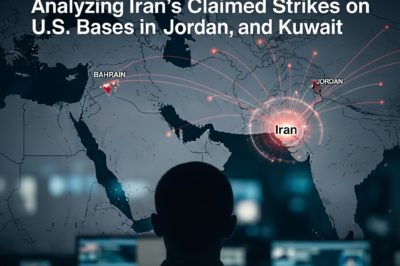
The geopolitical landscape of West Asia has been thrust into an unprecedented state of volatility following the recent announcement from the Iranian military regarding alleged strikes on U.S. military installations across Bahrain, Jordan, and Kuwait. This development, as reported by major outlets including The Hindu, represents a staggering escalation in a region already simmering with tension. For decades, the confrontation between the Islamic Republic of Iran and the United States has largely been characterized by a sophisticated dance of deterrence, economic sanctions, and proxy engagements. However, the move toward direct kinetic action—or at least the official claim of such action—marks a departure from the historical status quo and signals a potential shift into an all-out regional conflict. The international community is now forced to grapple with the implications of a direct military confrontation that could disrupt global energy markets, redefine regional alliances, and lead to a humanitarian crisis of immense proportions.
The Direct Confrontation: Breakdown of the Alleged Attacks
According to reports emerging from Tehran, the Iranian military has targeted several key installations that serve as the backbone of American military presence in the Middle East. The claims specify that ballistic missiles or high-precision drones were utilized to penetrate the air defense umbrellas of bases in Bahrain, Jordan, and Kuwait. While U.S. Central Command (CENTCOM) has traditionally been quick to refute or clarify the extent of such incidents, the mere assertion of these strikes by the Iranian Revolutionary Guard Corps (IRGC) serves a dual purpose: it acts as a domestic show of strength and a signal to the ‘Axis of Resistance’ that the era of strategic patience may be concluding. The technical details of these alleged strikes are critical. If Iranian munitions successfully bypassed the Patriot missile batteries or the Integrated Air and Missile Defense (IAMD) systems deployed in these host nations, it would suggest a significant leap in Iranian electronic warfare capabilities or a coordinated saturation attack designed to overwhelm local defenses. The psychological impact on the host nations—Bahrain, Jordan, and Kuwait—cannot be overstated, as they now find themselves physically caught in the crossfire of a superpower struggle.
Strategic Significance of the Targeted Bases
To understand the gravity of these claims, one must look at the strategic importance of the locations mentioned. Bahrain is home to the U.S. Naval Forces Central Command and the United States Fifth Fleet. This installation is the nerve center for maritime security across the Persian Gulf, the Red Sea, and the Arabian Sea. Any threat to Bahrain is a direct threat to the free flow of global commerce through the Strait of Hormuz. In Jordan, the U.S. maintains a presence at several locations, including the strategic ‘Tower 22’ and various airbases that have been instrumental in the campaign against ISIS. Jordan has long been a bedrock of stability and a key intermediary in the Israeli-Palestinian conflict; dragging it into a direct military confrontation with Iran would destabilize one of the few remaining ‘quiet’ borders in the region. Kuwait, meanwhile, hosts Camp Arifjan and Camp Buehring, which serve as massive logistical hubs for U.S. Army Central (ARCENT). These bases are not merely outposts; they are the literal engines of American power projection in the hemisphere. An attack on these sites is not just a tactical maneuver; it is a direct challenge to the architecture of the post-Cold War security order in the Middle East.
The Geopolitical Domino Effect: Iran vs. the United States
The escalation follows months of heightened tension catalyzed by the ongoing conflict in the Gaza Strip. Iran has consistently messaged that it would not remain a bystander if its regional allies were pushed to the brink. The ‘Axis of Resistance,’ comprising Hezbollah in Lebanon, the Houthi movement in Yemen, and various militias in Iraq and Syria, has been activated in a multi-front pressure campaign against U.S. and Israeli interests. However, the transition from proxy-led harassment to direct Iranian military involvement suggests that Tehran perceives a window of opportunity or, conversely, a terminal threat that necessitates a high-stakes gamble. The United States, for its part, finds itself in a precarious position. The Biden administration has sought to prevent a wider regional war while simultaneously maintaining its ‘ironclad’ support for regional security. A direct strike on U.S. personnel and assets necessitates a response under the doctrine of self-defense, yet any retaliatory strike on Iranian soil could trigger a cycle of escalation that leads to the very regional war Washington seeks to avoid. This ‘escalation ladder’ is currently missing several rungs, making the descent into chaos much faster than diplomats can manage.
Regional Reactions and Internal Dynamics in Host Nations
The internal political climates of Bahrain, Jordan, and Kuwait are now under extreme pressure. Bahrain, with its complex internal demographics and proximity to Iran, has always walked a tightrope. A direct strike on its soil forces the monarchy to align even more closely with the West, potentially agitating internal factions. Jordan faces a different challenge: a population deeply sympathetic to the Palestinian cause and increasingly wary of being a launchpad for Western military operations. The Jordanian government must balance its vital security partnership with the U.S. against the risk of domestic civil unrest. Kuwait, historically a mediator and a proponent of diplomatic solutions, finds its policy of neutrality shattered. The Gulf Cooperation Council (GCC) as a whole is likely to convene emergency sessions to determine a unified stance. There is a palpable fear among the Gulf monarchies that their multi-billion dollar ‘Vision’ projects and economic diversification plans could be reduced to rubble in a matter of weeks if the region becomes a primary battleground for a global conflict.
Economic and Global Market Implications
The economic fallout of these alleged strikes was felt almost immediately in the commodities markets. Brent Crude prices have shown extreme sensitivity to the news, as traders price in the ‘war premium.’ The Persian Gulf remains the world’s most vital energy artery. If the Iranian military continues to target bases in the vicinity of oil production facilities and shipping lanes, the cost of insurance for tankers will skyrocket, leading to higher fuel prices globally. This comes at a time when the global economy is already struggling with inflationary pressures and supply chain disruptions. Furthermore, the potential closure of the Strait of Hormuz—a perennial threat often voiced by Tehran—would effectively choke off 20% of the world’s oil supply. The ripple effects would be felt from the gas stations of the American Midwest to the factories of East Asia. The ‘West Asia war’ is not a localized event; it is a global economic earthquake that threatens to undo years of post-pandemic recovery.
The Role of Technology and Modern Warfare
This conflict is also a testing ground for 21st-century warfare. Iran’s reliance on ‘asymmetric’ technologies, such as loitering munitions (suicide drones) and precision-guided ballistic missiles, has proven to be a cost-effective way to challenge superior conventional forces. The U.S. military’s reliance on expensive interceptors like the SM-6 or the Patriot PAC-3 creates a ‘cost-exchange’ ratio that favors the attacker. For every $20,000 drone Iran launches, the U.S. might spend $2 million to shoot it down. Over time, this attrition of resources is unsustainable. Additionally, the role of cyber warfare cannot be ignored. Reports suggest that alongside the physical strikes, there has been a significant uptick in state-sponsored hacking attempts targeting the infrastructure of the host nations. The blurring of lines between kinetic strikes and digital sabotage makes it increasingly difficult for international law to define the boundaries of ‘act of war,’ leaving diplomats in a gray zone of uncertainty.
Conclusion: The Path Forward
As the smoke clears—literally and figuratively—the path forward remains shrouded in uncertainty. The claim by Iran’s military that it has attacked U.S. bases in Bahrain, Jordan, and Kuwait has fundamentally altered the security calculus of the Middle East. Whether these claims are fully verified or part of a broader psychological warfare campaign, the intent is clear: Iran is willing to risk direct confrontation to alter the regional balance of power. The U.S. must now decide between a path of massive retaliation, which risks a third major conflict in the region this century, or a path of complex diplomacy that requires engagement with an increasingly emboldened Tehran. For the residents of the Middle East, the prospect of a peaceful and prosperous decade has been replaced by the familiar and haunting specter of war. The coming days will be some of the most critical in modern history, as the world watches to see if cooler heads will prevail or if the flames of conflict will consume the entire region.




































Leave a Reply