
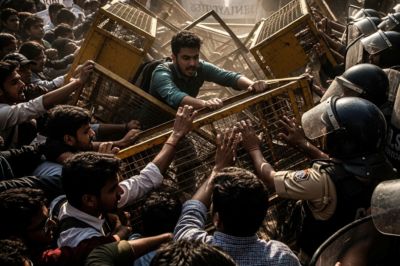
The capital city of Ranchi witnessed scenes of unprecedented chaos and administrative tension today as thousands of students and job aspirants took to the streets in a massive show of defiance against the current state government. The protest, which began as a localized gathering at the historic Morabadi Ground, quickly escalated into a full-scale march towards the Jharkhand Legislative Assembly. As the sea of protestors surged forward, the air was thick with slogans demanding justice, employment transparency, and the immediate rectification of what they term a ‘failed recruitment system.’ This movement represents a significant boiling point in the ongoing friction between the youth of Jharkhand and the administrative machinery, highlighting a deep-seated disillusionment with the way competitive examinations and state-level hiring processes have been handled over the last several years. The visuals of students scaling police barricades and facing off against security forces have sent ripples across the nation, placing the Hemant Soren-led government under intense scrutiny during a critical political junction.
The Spark that Ignited the Fire: Understanding the Jharkhand Student Protests
The origins of today’s massive unrest are not found in a single event but are the culmination of years of frustration regarding the Jharkhand Staff Selection Commission (JSSC) and the Jharkhand Public Service Commission (JPSC). For nearly a decade, the youth of the state have complained about a cycle of delayed notifications, paper leaks, and legal entanglements that have stalled the recruitment of thousands of government positions. The specific trigger for the current ‘Assembly Gherao’ (siege) was the recent mishandling of the JSSC Combined Graduate Level (CGL) examination. After years of waiting, the exam was finally conducted, only to be cancelled following widespread allegations of paper leaks. For many students who had spent their family’s life savings on coaching and stayed in cramped hostels in Ranchi, this was the final straw. The protest is not just about one exam; it is about the structural integrity of the state’s hiring process. The protestors argue that the lack of a robust anti-leak mechanism and the perceived apathy of the authorities have robbed an entire generation of their career prospects. This context is essential to understand why the students were willing to risk legal action and physical injury to make their voices heard today.
A Breakdown of the March: From Morabadi to the Assembly Gates
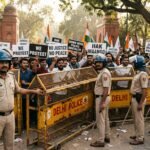
The day began early with students trickling into the Morabadi Ground from various districts across Jharkhand, including Hazaribagh, Dhanbad, and Jamshedpur. By noon, the gathering had swelled into a massive crowd of over 10,000 individuals. Organized by various student unions and independent aspirant groups, the march was intended to be a peaceful demonstration to submit a memorandum of demands to the Speaker of the Assembly. However, the atmosphere grew increasingly volatile as the protestors encountered the first layer of police cordons. Despite the heavy presence of the Jharkhand Armed Police (JAP) and local police units, the sheer volume of the crowd made it difficult to maintain order. Near the Sahid Maidan area, the first major confrontation occurred. Protestors were seen physically pushing against iron barricades, eventually toppling them to continue their march. The security forces, caught between the need to maintain order and the instruction to avoid excessive force against students, struggled to redirect the flow. As the march neared the prohibited zones around the Assembly building, the intensity reached its peak. The police utilized water cannons and tear gas in an attempt to disperse the leading edge of the protest, but the aspirants stood their ground, often sitting on the road in a peaceful sit-in when they could not move forward, creating a complete logistical deadlock in the heart of Ranchi.
The Core Grievances: Paper Leaks, Delayed Exams, and Job Insecurity
At the heart of this movement are several specific demands that the students insist are non-negotiable. Firstly, they are demanding a high-level, independent investigation into the recent JSSC-CGL paper leak, preferably conducted by the Central Bureau of Investigation (CBI), as they lack faith in the local Special Investigation Teams (SITs). Secondly, the protestors are calling for the immediate implementation of a strict anti-paper leak law that includes life imprisonment and heavy fines for those found guilty of compromising the sanctity of exams. Furthermore, there is a deep demand for a clear and transparent ‘Recruitment Calendar.’ Currently, aspirants complain that they prepare for years without knowing when the next exam will be held or if the results will ever be published. The socio-economic impact of these delays cannot be overstated. Jharkhand is a state with a high percentage of tribal and marginalized communities who see government jobs as the primary vehicle for social mobility. When these exams are cancelled or delayed by four to five years, it pushes families further into poverty and leaves the youth in a state of perpetual limbo. The protestors are also demanding that the state government fulfill its pre-election promise of providing five lakh jobs per year, a figure that the opposition has repeatedly used to highlight the government’s perceived failures.
Political Fallout: How the Ruling Coalition and Opposition are Navigating the Crisis
The timing of these protests is particularly sensitive given the upcoming state elections. The ruling Jharkhand Mukti Morcha (JMM) and Congress coalition find themselves in a defensive position. While government spokespersons have stated that they are working to address the students’ concerns and that ‘vested interests’ are manipulating the youth, the visual reality of thousands of angry students tells a different story. Chief Minister Hemant Soren has previously emphasized his government’s commitment to the locals through the ‘1932 Khatian’ based domicile policy, but students argue that identity politics means little if there are no actual jobs to be had. On the other side of the aisle, the Bharatiya Janata Party (BJP) and the All Jharkhand Students Union (AJSU) have seized the opportunity to corner the government. Senior BJP leaders have been vocal in their support of the students, accusing the JMM-led government of ‘killing the dreams’ of the state’s youth. However, the student unions have been careful to maintain a non-partisan stance, at least publicly, stating that their fight is for their future and not for any political party’s gain. Nevertheless, the political temperature in Ranchi has reached a boiling point, with the assembly session being frequently disrupted by debates over the protest and the law and order situation.
Security Response and the Use of Force: A City Under Siege
In response to the march, the Ranchi district administration had imposed Section 144 of the CrPC in several areas, prohibiting the assembly of five or more people. More than 2,000 security personnel were deployed, and drones were used to monitor the movement of the crowd from above. Despite these measures, the ‘Chalo Assembly’ call was so effective that the administration had to close several major arterial roads, leading to massive traffic jams that affected the entire city. When the protestors reached the final barrier near the Jagannath Temple, the situation turned into a standoff. Reports indicate that several students were injured in the scuffle, and a few police personnel also sustained minor injuries. The use of force has been widely condemned by civil society groups, who argue that the government should have sent a high-level ministerial delegation to talk to the students at Morabadi rather than meeting them with batons and water cannons. The administration, however, maintains that the force used was ‘proportional’ and necessary to prevent the protestors from storming the high-security Assembly zone while the session was in progress. The heavy-handedness of the police has only served to further galvanize the student community, with social media being flooded with videos of the confrontation, drawing support from students across India.
The Road Ahead: Potential Solutions for Jharkhand’s Education and Employment Crisis
As the sun sets on a day of intense protest, the question remains: what happens next? The government has indicated a willingness to meet with a small delegation of student leaders, but the protestors are demanding a public commitment from the Chief Minister himself. To resolve this crisis, several long-term structural reforms are needed. Firstly, the JSSC and JPSC need to be completely overhauled with the appointment of officials who have a track record of integrity and administrative efficiency. There needs to be a digital revolution in how exams are conducted, moving away from vulnerable paper-based systems to more secure, encrypted online formats where possible. Secondly, the state must address the legal loopholes that allow exam-related litigation to drag on for years in the courts. A dedicated tribunal for recruitment-related disputes could be a viable solution. Most importantly, there needs to be a restoration of trust. The youth of Jharkhand need to believe that their hard work will be rewarded in a fair and transparent manner. If the government fails to address these core issues, today’s march may just be the beginning of a much larger, more sustained movement that could redefine the political landscape of Jharkhand for years to come. The resilience shown by the students today is a clear indication that they are no longer willing to accept excuses for administrative failure.


































Leave a Reply