
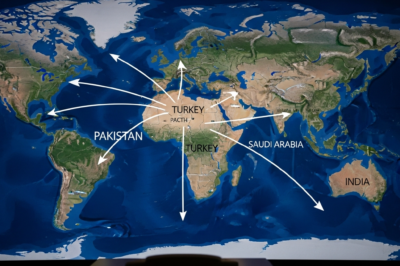
The geopolitical landscape of South Asia and the Middle East is witnessing a seismic shift as the Ministry of External Affairs (MEA) in New Delhi begins a rigorous assessment of the newly formed defense trilateral between Pakistan, Türkiye, and Saudi Arabia. This convergence of military and strategic interests among three major Islamic nations has sent ripples through the international community, particularly within the corridors of power in India. The announcement, which follows a high-level meeting in Rawalpindi, signifies more than just a routine military agreement; it represents a potential realignment of power dynamics that could influence regional stability, defense procurement, and diplomatic maneuvers for decades to come. As India continues to assert its role as a global leader and a net security provider in the Indian Ocean Region, the MEA’s official stance emphasizes a policy of ‘calculated watchfulness,’ ensuring that India’s national security interests remain uncompromised amidst these developing alliances.
The Genesis of the Trilateral Defense Framework
The roots of this new defense pact can be traced back to the second meeting of the Pakistan-Türkiye-Saudi Arabia Trilateral Defense Collaboration, held recently at the General Headquarters in Rawalpindi. This meeting was not a sudden occurrence but the culmination of years of bilateral defense cooperation that has now transitioned into a more structured trilateral format. Historically, Pakistan and Saudi Arabia have shared a ‘special relationship’ characterized by economic aid in exchange for military expertise. Similarly, the defense ties between Ankara and Islamabad have flourished, particularly in the realms of naval engineering and unmanned aerial vehicles (UAVs). However, the inclusion of Saudi Arabia into this specific defense technology and equipment-sharing axis marks a departure from traditional frameworks. The focus of the trilateral is reported to be on ‘defense equipment, research and development, and joint production,’ suggesting a long-term commitment to self-reliance and the creation of a shared military-industrial complex that operates independently of Western or Russian influence.
India’s Measured Reaction and the MEA’s Diplomatic Calculus
When questioned about the implications of this trilateral pact, MEA spokesperson Randhir Jaiswal maintained a tone of diplomatic caution, stating that India is ‘carefully monitoring’ the situation. This phrasing is significant in the world of international relations; it implies that while India is not currently viewing the pact as an immediate existential threat, it recognizes the potential for this alliance to alter the tactical balance on its western border. India’s primary concern lies in the potential transfer of advanced Turkish drone technology or Saudi-funded military hardware to Pakistan. The MEA’s assessment involves analyzing whether this pact is purely defensive or if it incorporates elements of intelligence sharing and offensive capability enhancement. India’s diplomatic strategy has recently focused on de-hyphenating its relations with the Arab world from its relations with Pakistan. This pact tests that strategy, as Saudi Arabia remains a critical energy partner and a key component of India’s ‘Link West’ policy and the proposed India-Middle East-Europe Economic Corridor (IMEC).
The Turkish Factor: Drones, Defense Exports, and Geopolitical Ambitions
Türkiye’s role in this trilateral is perhaps the most disruptive. Under President Recep Tayyip Erdoğan, Turkey has aggressively expanded its defense industry, with the Bayraktar TB2 drone becoming a symbol of Turkish military ingenuity. Turkey’s willingness to export high-end military tech with fewer ‘end-use’ restrictions than Western nations makes it an attractive partner for Pakistan. For India, Turkey’s stance on the Kashmir issue has often been a point of friction, and Ankara’s deepening military integration with Islamabad adds another layer of complexity. Turkey is also involved in the MILGEM project, providing corvettes to the Pakistan Navy, which directly impacts the naval balance in the North Arabian Sea. By leading the R&D aspect of this trilateral, Turkey seeks to cement its position as a regional hegemon, using its defense exports as a tool of statecraft to build a bloc of like-minded nations that can challenge existing power structures.
Saudi Arabia’s Strategic Diversification: Balancing India and Pakistan
Saudi Arabia’s participation in this pact is a masterclass in strategic hedging. Under Crown Prince Mohammed bin Salman, the Kingdom is pursuing the ‘Vision 2030’ initiative, which includes the localization of defense spending. By partnering with Turkey (for tech) and Pakistan (for manpower and operational experience), Riyadh aims to build its own indigenous defense industry. However, Saudi Arabia must tread carefully. India is one of Saudi Arabia’s largest trading partners and a massive consumer of its oil. Furthermore, India and Saudi Arabia have recently increased their own military-to-military cooperation, including joint naval exercises. Riyadh’s involvement in the trilateral with Pakistan and Turkey likely stems from a desire to diversify its security providers beyond the United States, rather than a move intended to antagonize New Delhi. The MEA’s challenge is to ensure that Saudi Arabia’s defense investments in Pakistan do not translate into a qualitative military edge for Islamabad that could be used against India.
Ramifications for Regional Security and the Balance of Power
The long-term ramifications of this pact extend beyond the three participating nations. A strengthened Pakistan-Turkey-Saudi axis could create a new pole in the Islamic world, potentially challenging the traditional leadership of the OIC (Organization of Islamic Cooperation) or creating a sub-group that focuses on hard security. For India, the primary risk is the ‘collateral enhancement’ of Pakistan’s military capabilities. If Turkey and Saudi Arabia provide the funding and technology for Pakistan to modernize its air force and naval assets, India may be forced to accelerate its own defense acquisitions, potentially leading to a localized arms race. Moreover, this trilateral could influence the situation in Afghanistan, where all three nations have vested interests. The MEA is likely looking at how this alliance might influence the security of the maritime trade routes in the Indian Ocean, especially with Turkey’s growing naval presence and Pakistan’s hosting of Chinese-funded ports like Gwadar.
Conclusion: Navigating a Complex Geopolitical Maze
In conclusion, the MEA’s assessment of the Pakistan-Türkiye-Saudi defense pact highlights a period of intense diplomatic and strategic recalibration for India. While the trilateral reflects the individual national interests of the participants—Turkey’s desire for export markets, Saudi Arabia’s need for tech localization, and Pakistan’s search for security partners—its collective impact cannot be ignored by New Delhi. India’s response will likely be multi-faceted: strengthening its own domestic defense manufacturing under ‘Aatmanirbhar Bharat,’ deepening its strategic partnerships with the UAE and Israel to counter-balance the trilateral, and maintaining a high-level diplomatic dialogue with Riyadh to protect its economic and energy interests. As the world moves toward a more multi-polar order, such fluid alliances will become more common. For India, the key to navigating this complex maze lies in maintaining its strategic autonomy while ensuring that no regional combination can destabilize the hard-earned peace and economic growth of the South Asian subcontinent. The coming months will be crucial as the MEA translates its ‘monitoring’ into a concrete policy response that safeguards India’s sovereignty and regional stature.





































Leave a Reply