
The Scale of the Disaster: A Region in Crisis
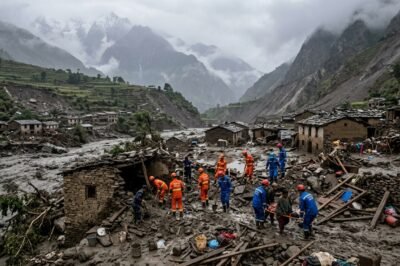
The sheer scale of the devastation across the Himalayan corridor has reached a tragic milestone, as officials confirm that the combined death toll from recent flooding and landslides in Nepal and the bordering regions of China has now surpassed 600 individuals. This unfolding humanitarian crisis, triggered by unprecedented monsoon intensity, has transformed scenic mountain landscapes into zones of wreckage and despair. For the families residing in the shadows of the world’s highest peaks, the annual monsoon has shifted from a life-giving necessity for agriculture into a recurring harbinger of destruction. The current situation represents one of the deadliest environmental events in the region over the last decade, demanding an immediate and sustained international response. As rescue teams from both Kathmandu and Beijing restart their operations after a brief pause due to inclement weather, the focus is not only on recovery but on the survival of thousands still stranded in remote, high-altitude villages. The international community watches closely as two nations, often divided by complex geopolitics, find common ground in the face of a shared catastrophe that threatens the stability of the entire Hindu Kush-Himalaya range.
Breaking Down the Statistics: The Human and Economic Cost
The numbers emerging from the flood-affected zones are staggering. Of the 600 confirmed fatalities, over 400 have been reported within Nepal alone, with the remaining casualties spanning across the Tibet Autonomous Region of China. In addition to those confirmed dead, more than 250 people remain missing, buried under the debris of massive landslides that have leveled entire hamlets. The statistics reveal a grim reality: the majority of the victims are from marginalized mountain communities with limited access to early warning systems or sturdy infrastructure. Economically, the impact is estimated to be in the hundreds of millions of dollars. Over 15,000 homes have been completely destroyed, and another 30,000 have suffered significant structural damage. Vital transport arteries, including the Araniko Highway that links Nepal and China, have seen multiple sections washed away, paralyzing trade and the movement of essential goods. The loss of livestock and the destruction of standing crops like rice and maize have also jeopardized the food security of hundreds of thousands of people, promising a long and difficult winter ahead for the survivors.
Cross-Border Cooperation: Resuming Joint Rescue Operations
In a significant display of bilateral cooperation, Nepal and China have formally resumed joint rescue and search operations along their shared border. The operations had been temporarily suspended due to heavy cloud cover and the risk of further landslides, but as the weather cleared slightly, helicopters and ground teams were redeployed. Chinese People’s Liberation Army (PLA) units have been working alongside the Nepal Army to clear debris from blocked river channels that pose a risk of secondary flooding. This cooperation is vital because many of the affected rivers, such as the Koshi and Gandaki, are transboundary in nature. A landslide on the Chinese side can create an artificial dam, which, if it bursts, would send a wall of water into Nepalese territory. The resumption of these efforts involves high-tech drone surveillance to map the shifting terrain and the deployment of specialized search-and-rescue dogs. This joint initiative not only serves a practical humanitarian purpose but also strengthens the diplomatic ties between the two nations as they navigate the logistical complexities of the high-altitude terrain.
The Role of Climate Change: A Himalayan Warning
The intensity of this year’s monsoon cannot be discussed without addressing the underlying driver: global climate change. The Himalayan region is warming at a rate significantly higher than the global average, leading to the rapid melting of glaciers and the formation of unstable glacial lakes. This phenomenon, known as Glacial Lake Outburst Floods (GLOFS), has become a primary concern for climatologists. When coupled with heavy, concentrated rainfall, the soil on steep mountain slopes becomes saturated beyond its holding capacity, leading to the catastrophic landslides that have contributed to the high death toll. Environmental experts argue that these events are no longer ‘natural’ disasters in the traditional sense but are exacerbated by human-induced atmospheric changes. The shift in monsoon patterns—where months’ worth of rain falls in just a few days—has outpaced the adaptive capacity of local infrastructure. This crisis serves as a stark warning that without significant global intervention to reduce carbon emissions, the frequency and severity of such flooding events will only increase, potentially making large swaths of the Himalayas uninhabitable.
Infrastructural Vulnerability and the Need for Resilient Planning
One of the most painful lessons of the current flood crisis is the sheer vulnerability of the region’s infrastructure. Many of the roads and bridges that were washed away were built using traditional methods that did not account for the extreme water volumes seen this year. In many areas, poorly planned ‘dozer roads’—roads cut into hillsides without proper engineering or drainage—acted as conduits for landslides. The destruction of several hydropower plants has also plunged large portions of Nepal into darkness, hindering rescue efforts and local communication. Moving forward, there is an urgent need for ‘climate-proof’ infrastructure. This includes building bridges with higher clearances, implementing better drainage systems in mountain towns, and strictly regulating construction on floodplains. The cost of rebuilding will be immense, and it requires a shift in philosophy from rapid development to sustainable, resilient growth. International financial institutions and partner nations like China will need to play a pivotal role in funding these more expensive, but necessary, engineering projects to ensure that the next monsoon does not bring a repeat of this year’s tragedy.
Humanitarian Response: Challenges in the High Altitude
Providing aid to the survivors of the Nepal-China floods is a logistical nightmare. Many of the hardest-hit areas are accessible only by foot or helicopter, and the rugged terrain makes the delivery of heavy equipment nearly impossible. Humanitarian agencies are reporting a critical shortage of clean drinking water, leading to fears of waterborne disease outbreaks such as cholera and dysentery. Temporary shelters are overflowing, and there is a desperate need for blankets, medicine, and hygiene kits. The psychological toll on survivors, many of whom have lost their entire families and livelihoods, is also profound. Non-governmental organizations (NGOs) are working to set up field hospitals, but the sheer number of injured is taxing the available resources. Furthermore, the politicization of aid can sometimes slow down the response, though both governments have currently prioritized the humanitarian imperative. The focus must remain on the most vulnerable populations—children, the elderly, and the displaced—who are facing the elements with little more than the clothes on their backs.
Geopolitical Implications and Future Regional Stability
The disaster has highlighted the interconnectedness of South and East Asian security. Disaster diplomacy has become a key feature of the relationship between Kathmandu and Beijing, with China utilizing its superior engineering and logistics capabilities to assist its neighbor. However, this also occurs within a broader geopolitical context where regional powers vie for influence. For Nepal, balancing the assistance from China with its traditional ties to India is a delicate act. Long-term, the shared threat of environmental disaster may force a more permanent regional framework for disaster management. If the death toll continues to rise and the frequency of these events increases, it could lead to large-scale climate migration, which would have significant implications for regional stability. The current crisis is a test of whether regional neighbors can move beyond border disputes and historical grievances to create a unified front against a changing climate that respects no national boundaries.
Conclusion: Looking Toward a Sustainable Future
As the death toll from the floods in Nepal and China surpasses 600, the immediate priority remains the recovery of the missing and the provision of aid to the living. However, the tragedy must also serve as a turning point for how the world views the Himalayan region. We can no longer afford to treat these events as isolated incidents; they are part of a systemic environmental collapse that requires a global response. The resilience of the people in this region is legendary, but resilience has its limits. Future implications involve a radical rethink of mountain development, a commitment to transboundary water management, and a massive investment in early warning technologies. As the waters recede and the scars on the landscape become visible, the true measure of success will not be how quickly we rebuild the roads, but how well we protect the people who live along them. The path forward is difficult, but the alternative is a cycle of loss that the region can no longer sustain.




































Leave a Reply