
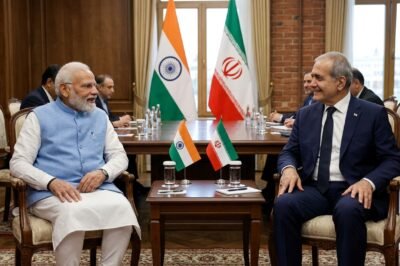
Geopolitics is often described as a high-stakes chess game where every move on the board has cascading effects across continents. Recently, the diplomatic corridors of Washington and New Delhi have been buzzing with tension following the high-profile meeting between Indian Prime Minister Narendra Modi and the newly elected Iranian President Masoud Pezeshkian. This encounter took place on the sidelines of the 16th BRICS Summit in Kazan, Russia—a location that itself adds a layer of complexity to the narrative. As India seeks to solidify its presence in Central Asia through strategic partnerships and infrastructure projects like the Chabahar Port, the United States has once again reiterated its stern stance on dealings with Tehran. The reaction from the US State Department was swift, serving as a reminder that while India and America share a ‘Comprehensive Global Strategic Partnership,’ their views on Iran remain fundamentally divergent. This analysis delves deep into the nuances of this diplomatic friction, exploring whether New Delhi’s quest for ‘strategic autonomy’ can withstand the pressure of Western sanctions and how this meeting reshapes the power dynamics in the Global South. The stakes are particularly high as the world watches whether the US will follow through on its warnings or allow its ‘indispensable’ ally in the Indo-Pacific some leeway. This meeting is not merely a bilateral discussion but a statement of intent in an increasingly multipolar world. ## The Kazan Encounter: A Diplomatic Tightrope The meeting between Prime Minister Modi and President Pezeshkian marked their first face-to-face interaction since Pezeshkian assumed office. During the discussions, both leaders emphasized the historical and civilizational ties that bind India and Iran. They focused on enhancing bilateral cooperation in diverse sectors, with a significant emphasis on the International North-South Transport Corridor (INSTC) and the long-term development of the Chabahar Port. For India, Iran is not just a neighbor across the Arabian Sea but a vital gateway to Afghanistan and the resource-rich Central Asian republics, bypassing the logistical hurdles posed by Pakistan. However, for the United States, any engagement that strengthens Iran’s economy is viewed through the lens of its ‘maximum pressure’ policy. The US reaction emphasizes that entities or countries considering business deals with Iran must be aware of the potential risks they are opening themselves up to, including the risk of sanctions. This creates a challenging environment for Indian policymakers who must balance their energy needs and connectivity goals with the necessity of maintaining a robust relationship with Washington. The optics of the meeting, occurring in Russia—a country currently at odds with the West—further complicated the message sent to the international community. ## Washington’s Firm Warning: The Sanctions Regime Explained Shortly after reports of the Modi-Pezeshkian meeting surfaced, the US State Department issued a clear warning. Spokesperson Vedant Patel, when questioned about the bilateral engagements, noted that the US continues to enforce its sanctions related to Iran. The core of the American argument rests on the Countering America’s Adversaries Through Sanctions Act (CAATSA) and other executive orders designed to isolate Tehran financially and diplomatically. Washington’s concern is that increased trade and investment in Iran provide the regime with the liquidity necessary to fund regional proxies and advance its nuclear program. While the US has previously granted limited waivers for the Chabahar project—recognizing its importance for the reconstruction of Afghanistan—this leniency is not a blank check. The warning serves as a prophylactic measure to deter other nations from following India’s lead in seeking long-term economic commitments with Tehran. The US maintains that anyone considering business deals with Iran should be aware of the potential risk that they are opening themselves up to sanctions. This rhetorical stance is designed to create a ‘chilling effect,’ making international banks and corporations hesitant to facilitate trade, even if the Indian government provides political backing. ## The Chabahar Factor: India’s Strategic Gateway and Economic Stakes At the heart of the India-Iran relationship is the Chabahar Port, located in the Sistan-Baluchestan province. Earlier this year, India signed a 10-year contract to operate the Shahid Beheshti terminal at the port, committing to an investment of approximately $120 million, with an additional $250 million in credit lines for infrastructure improvement. This port is the linchpin of India’s ‘Connect Central Asia’ policy. It allows India to export goods to the Commonwealth of Independent States (CIS) and Europe more efficiently than the traditional Suez Canal route. From a statistical perspective, the INSTC is expected to reduce carriage costs by 30% and transit time by 40%. For New Delhi, Chabahar is not merely a commercial venture; it is a strategic counterweight to China’s influence in the region, particularly the Gwadar Port in Pakistan. However, the shadow of US sanctions looms large over the project’s operationalization. While India argues that the port serves humanitarian purposes and stabilizes the regional economy, the US remains skeptical of any long-term revenue stream flowing to the Iranian government. The tension between India’s logistical necessity and America’s geopolitical strategy creates a recurring friction point that requires constant high-level diplomatic management. ## Balancing Act: India’s ‘Strategic Autonomy’ in a Polarized World India has long prided itself on its policy of ‘strategic autonomy,’ which allows it to maintain independent relationships with rival power centers. This policy is currently being tested as never before. On one hand, India is a member of the Quad (alongside the US, Japan, and Australia), aimed at ensuring a free and open Indo-Pacific—essentially a containment strategy against China. On the other hand, India is an active participant in BRICS and the Shanghai Cooperation Organisation (SCO), where it sits at the table with Russia, China, and Iran. The meeting in Kazan highlights India’s refusal to be siloed into a Western-led bloc. Indian diplomats argue that their engagement with Iran is consistent with their national interests and does not necessarily undermine their partnership with the US. They point out that a stable, economically integrated Iran is less likely to engage in disruptive regional behavior. However, the US perspective is that global stability requires a unified front against what it terms ‘state sponsors of terrorism.’ This fundamental disagreement on the ‘Iran problem’ remains the most significant hurdle in the US-India bilateral relationship, often overshadowed by cooperation in defense and technology but always present under the surface. ## The Broader Middle East Equation: Conflict, Trade, and Energy The Modi-Pezeshkian meeting took place against the backdrop of heightened tensions in the Middle East, specifically the ongoing conflict involving Israel, Hamas, and Hezbollah. India has a delicate role to play here as well. Prime Minister Modi has expressed solidarity with Israel following the October 7 attacks but has also consistently called for a two-state solution and sent humanitarian aid to Palestine. Iran, conversely, is a primary backer of the ‘Axis of Resistance.’ By engaging with Pezeshkian, Modi is attempting to position India as a neutral mediator or at least a stable interlocutor that can talk to all sides. Furthermore, energy security remains a critical driver. While India stopped importing Iranian oil in 2019 under pressure from the Trump administration, it remains interested in the potential for future energy cooperation if sanctions are eased. The dialogue in Kazan also touched upon the safety of maritime trade routes, which have been disrupted by Houthi rebels in the Red Sea—an group supported by Tehran. India’s message to Iran is likely one of de-escalation, emphasizing that regional instability hurts global trade, which in turn affects India’s economic growth targets. ## Global Reactions and Potential Sanction Risks for New Delhi The international community is closely watching how Washington responds to India’s deepening ties with Iran. European nations, many of whom were disappointed by the US withdrawal from the JCPOA (Iran Nuclear Deal), are observing whether India can successfully carve out a sanctions-exempt niche. If the US were to impose secondary sanctions on Indian companies involved in Iran, it could trigger a diplomatic crisis between Washington and New Delhi. However, most analysts believe such an extreme step is unlikely given India’s role as a buffer against China. Instead, the US is expected to use bureaucratic delays and financial warnings to slow down the pace of India-Iran cooperation. On the other hand, the BRICS nations view the Modi-Pezeshkian meeting as a sign of the emerging multipolar world where the US dollar and US sanctions no longer hold absolute sway. The push for using local currencies for trade—a topic discussed at the summit—is a direct response to the weaponization of the global financial system. For India, the challenge is to reap the benefits of this multipolarity without alienating the Western markets that are essential for its technology and defense sectors. ## Conclusion: Future Implications and the Path Ahead The meeting between PM Modi and President Pezeshkian is a testament to India’s commitment to its own geopolitical roadmap, regardless of external pressures. While the US warning serves as a necessary posturing for Washington’s domestic and international audience, the reality on the ground is more nuanced. The future of US-India relations will likely depend on how effectively both sides can manage their ‘principled disagreements’ on Iran. For India, the success of the Chabahar Port and the INSTC is non-negotiable for its long-term growth. For the US, maintaining the integrity of its sanctions regime is a matter of national security. As the two nations navigate this complex landscape, the Modi-Pezeshkian summit will be remembered as a pivotal moment when New Delhi asserted its right to engage with a pariah state in the eyes of the West, for the sake of regional connectivity and economic sovereignty. The coming months will reveal whether the US will prioritize its strategic partnership with India over its desire to isolate Iran, or if a new era of diplomatic friction is on the horizon. The global order is shifting, and the dialogue in Kazan is a clear indicator that middle powers like India are increasingly setting their own terms of engagement.
The India-Iran-USA Triad: Deciphering the Geopolitical Fallout of the Modi-Pezeshkian Meeting
Posted by
Stories





-

Hunkkaar Teaser Analysis: Aneet Padda’s Gritty Transformation and the Evolving Landscape of Indian Thrillers
-

Mithila Palkar: The Relatable Queen of Indian Web Series and Her Meteoric Rise
-

Wamiqa Gabbi: The Meteoric Rise of Indian Web Series’ Most Versatile Leading Lady
-

Triptii Dimri Biography: The Evolution of India’s Newest Cinematic Sensation and Web Series Star
-

Wamiqa Gabbi: The Rise of India’s New Digital Icon and the Future of OTT Stardom
-

Mithila Palkar: The Unstoppable Evolution of India’s Digital Darling and Her Journey to the Silver Screen
-

Mithila Palkar: The Comprehensive Journey of India’s Web Series Sensation and Digital Pioneer
-

Mithila Palkar: The Relatable Queen of Indian Web Series and Her Inspiring Journey to Stardom
-

Sobhita Dhulipala Biography: The Meteoric Rise of India’s Most Versatile Web Series Star
-

Mithila Palkar: The Unstoppable Journey of India’s Digital Darling and Web Series Queen
-

Triptii Dimri: The Complete Biography of India’s Newest Cinematic Sensation and Web Series Icon
-

Wamiqa Gabbi: The Ethereal Rise of India’s Most Versatile Web Series Star
-

Sobhita Dhulipala: The Unstoppable Rise of India’s Most Versatile Web Series Icon
-

Wamiqa Gabbi: The Meteoric Rise of the New Queen of Indian Web Series and Her Unstoppable Journey to Stardom
-

Triptii Dimri: The Meteoric Rise of India’s New Cinema Sweetheart and Web Series Icon
-

Wamiqa Gabbi: The Versatile Queen of Indian OTT and Her Phenomenal Rise to Stardom
-

Tripti Dimri Biography: The Rise of India’s New National Crush and Her Journey from Laila Majnu to OTT Stardom
-

Wamiqa Gabbi Biography: The Meteoric Rise of India’s Newest OTT Sensation and Versatile Powerhouse
-

Wamiqa Gabbi Biography: The Meteoric Rise of the Digital Queen of Indian Web Series
-

The Rise of Wamiqa Gabbi: A Deep Dive into the Journey of India’s Most Versatile OTT Sensation
-

The Meteoric Rise of Triptii Dimri: Biography, Acting Prowess, and the Journey of India’s Newest Cinema Sensation

Launching Soon: The Future of News with Our E-Newspaper
In the ever-evolving landscape of media and technology, we are thrilled to announce the upcoming launch of our innovative e-newspaper, set to redefine the way news is consumed in the digital age. Embracing the convenience and accessibility that the digital world offers, our e-newspaper aims to deliver real-time news updates, insightful articles, and interactive features directly to your devices. With a commitment to journalistic integrity and a passion for storytelling, we are dedicated to keeping you informed, engaged, and connected, no matter where you are. Stay tuned for the launch of our e-newspaper, where the future of news awaits at your fingertips.
Recent News
- Netanyahu Orders West Bank Closure Following Attack on Israelis Ahead of Elections

- Jio Platforms and OYO Parent Company IPOs Move Forward Amid Market Interest

- Financial Stability Key to Achieving Price Stability, Says RBI Governor Shaktikanta Das
- First Batch of 60 Indians Rescued from Cambodia Cybercrime Centers Return Home: A Deep Dive into the Human Trafficking Crisis

- Pune Porsche Crash: Juvenile Justice Board Remands Minor to Observation Home Until June 5
- US stocks jump after biggest wipeout for Dow Jones in over a year

Politics
- Netanyahu Orders West Bank Closure Following Attack on Israelis Ahead of Elections
- Court Convicts Medha Patkar in Defamation Case: A Deep Dive into the Legal Battle with Delhi LG V K Saxena
- In Abhijeet Dipke’s Message To “Cockroaches”, Pause In Protests And A “Real Leaders” Reveal – NDTV

- The Ethics and Optics of Military Justice: Analyzing Trump’s Decision to Bar Livestreaming the Fort Hood Gunman Execution

- Delhi’s Political Pressure Cooker: Analyzing the Anti-CEC Protests and Security Gridlock

- Anti-CEC protests LIVE: CJP leaders Das, Ranka booked for unauthorised entry at Jantar Mantar – The Hindu

Categories
- Art & Culture 106
- Auto 85
- Beauty 15
- Blog 307
- Books 7
- Business 370
- Celebrities 217
- Crime Files 139
- Democracy 308
- Education 84
- Entertainment 154
- Environment 133
- epaper 1
- Fashion 37
- Food 59
- Gadgets 89
- Guide 150
- Handicrafts 14
- Health 281
- Healthy Living 108
- History 5
- incidents 169
- Lifestyle 41
- Music 7
- Photography 15
- Politics 460
- Science & Technology 160
- Sports 283
- Tech 142
- Television 4
- Travel 68
- Travel & Tourism 30
- Trends 57
- Weather 9
- Web Series 97
- Workout 4
- World 665
Leave a Reply