
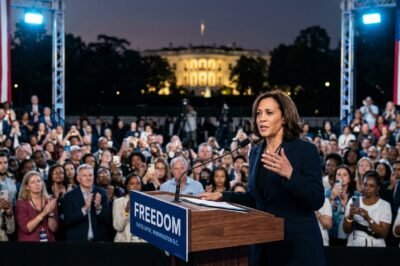
Standing on the hallowed and historically charged grounds of the Ellipse, Vice President Kamala Harris delivered a powerful and calculated closing argument to the American people just days before the 2024 Presidential Election. With the White House looming majestically behind her—a symbolic reminder of the stakes at hand—Harris sought to distill a complex, often vitriolic campaign into a singular, clear-eyed choice for the future of the nation. The atmosphere was electric, filled with a palpable sense of urgency that transcended standard political theater. As thousands gathered to hear her final pitch, Harris did not just address the crowd; she spoke to the millions of undecided voters in swing states who hold the keys to the Oval Office. This was a moment designed to contrast her vision of institutional stability and progressive growth against the backdrop of the site where, nearly four years ago, a different rhetoric led to one of the darkest chapters in American democracy. By choosing this location, Harris framed her candidacy not just as a policy alternative, but as a moral and structural necessity for the preservation of the republic, bridging the gap between her role as a prosecutor and her potential role as the first female President of the United States. The weight of the moment was evident in her cadence, as she pivoted from a critique of her opponent to a detailed blueprint for what she termed the ‘Opportunity Economy,’ aiming to capture the hearts of the middle class and the minds of fiscal conservatives alike.
The Symbolism of the Ellipse: A Site of Historical Contrast
The choice of the Ellipse as the venue for this closing argument was far from accidental. By standing in the same location where Donald Trump spoke on January 6, 2021, Harris effectively turned the site into a living contrast. Her speech was designed to reclaim the space, transforming it from a symbol of insurrection into a platform for democratic transition. This strategic move allowed her to highlight the ‘chaos’ and ‘division’ she associates with the previous administration without needing to rely solely on verbal attacks. The visual narrative spoke for itself, positioning her as the steady hand against the backdrop of the very seat of power she seeks to occupy.
During this segment of her address, Harris emphasized that the strength of American democracy lies not in the power of an individual, but in the integrity of its institutions and the participation of its citizens. She meticulously detailed the importance of the peaceful transfer of power, framing the upcoming election as a referendum on the American character. By invoking the history of the site, she bridged the gap between historical precedent and future aspirations, arguing that the nation is at a crossroads where one path leads back to grievance and the other leads forward to a unified national purpose.
Economic Blueprints and the Opportunity Economy
A significant portion of Harris’s address was dedicated to the ‘Opportunity Economy,’ a phrase that has become the cornerstone of her financial platform. Recognizing that inflation and the cost of living remain the primary concerns for the average voter, Harris outlined a series of targeted economic interventions. She spoke extensively about her plans to lower the costs of essential goods, expand the child tax credit, and provide federal assistance for first-time homebuyers. These policies are designed to resonate with the ‘exhausted middle’—voters who feel squeezed by global economic shifts and are looking for tangible relief rather than ideological warfare.
Harris also addressed the corporate sector, balancing her populist appeals with a commitment to maintaining American competitiveness on the global stage. She proposed incentives for clean energy manufacturing and domestic technology production, arguing that the next century of economic dominance will be won through innovation and investment in the American workforce. By articulating a vision that combines social safety nets with capitalistic drive, she sought to reassure both labor unions and moderate business leaders that her administration would foster a stable environment for growth, contrasting this with the unpredictability of tariff-heavy trade policies proposed by her opponent.
Defending Democratic Norms and Reproductive Rights
In what was perhaps the most impassioned segment of her speech, Harris turned her focus to civil liberties and the protection of fundamental rights. She argued that the current political climate has put long-standing freedoms at risk, specifically citing the reversal of Roe v. Wade and the subsequent legislative battles over reproductive healthcare. Harris framed reproductive rights not just as a social issue, but as a fundamental matter of personal autonomy and economic freedom, connecting the ability to plan a family directly to the ability to participate fully in the economy.
Furthermore, she discussed the broader implications of judicial appointments and the importance of a non-partisan Department of Justice. Harris warned that the erosion of democratic norms could lead to a system where the rule of law is secondary to political loyalty. Her rhetoric focused on the idea that ‘freedom’ is a hard-won prize that requires constant vigilance. By positioning herself as the protector of the Constitution, she aimed to consolidate the support of suburban women and younger voters, demographics that have shown high levels of engagement regarding social justice and institutional integrity.
Strategic Implications for Swing State Voters
With the election effectively being decided in a handful of battleground states, Harris’s speech was precision-engineered for audiences in Pennsylvania, Michigan, and Wisconsin. Her messaging skipped over the deep-blue enclaves to speak directly to the concerns of the Rust Belt and the Sun Belt. She touched upon the importance of the manufacturing sector, the dignity of work, and the need for a balanced approach to energy production—recognizing that while climate change is a priority, energy independence and job security are immediate concerns for voters in these regions.
Political analysts note that this closing argument was less about mobilizing the base and more about persuading the ‘persuadable.’ By adopting a tone that was both presidential and accessible, Harris sought to lower the ‘risk profile’ of her candidacy for those who may have reservations about the current administration but are equally wary of returning to the style of the previous one. The speech functioned as a final reassurance that her leadership would prioritize pragmatic solutions over partisan performance, a message that is critical in the final 72 hours of a razor-thin race.
Market Reactions and Global Financial Outlook
The financial markets have been closely monitoring the closing arguments of both candidates, looking for signals of future fiscal policy. Harris’s emphasis on stability and incremental reform provided a counterpoint to the more disruptive economic proposals seen elsewhere. Investors generally favor predictability, and Harris’s detailed outline of tax policies and federal spending priorities offered a roadmap that the markets could digest. Following the speech, analysts pointed to the potential for a ‘stability rally’ if the election results are clear and uncontested, as her platform suggests a continuation of current growth trajectories with added focus on social infrastructure.
Global markets also reacted to her comments on international alliances and trade. By reinforcing her commitment to NATO and traditional diplomatic partnerships, Harris signaled a ‘business as usual’ approach to foreign policy that contrasts with isolationist trends. This has significant implications for global supply chains and international trade agreements, as a Harris victory would likely mean a more collaborative approach to addressing China’s economic influence and managing the transition to a green global economy. The intersection of domestic policy and international standing was a recurring theme, suggesting that her administration would view economic strength as a primary tool of national security.
Conclusion: The Road to Election Day and Future Implications
As the echoes of her speech fade at the Ellipse, the focus shifts entirely to the ballot box. Harris’s closing argument was a masterclass in political positioning, attempting to weave together the disparate threads of economic anxiety, democratic preservation, and social progress into a cohesive national narrative. The success of this speech will ultimately be measured by its ability to turn out the vote and sway the remaining undecideds in the critical final hours. If successful, her approach could redefine the Democratic platform for a generation, moving away from identity-focused rhetoric toward a more inclusive, economy-first strategy that centers on the ‘Opportunity Economy.’
Looking ahead, the implications of this moment are profound. A victory for Harris would signal a mandate for the institutionalist path, confirming that a majority of Americans prefer steady, predictable governance over radical disruption. Conversely, if the message fails to resonate, it may lead to a period of deep introspection within the party regarding how to communicate with the working class. Regardless of the outcome, Harris’s address at the Ellipse stands as a definitive marker of her political identity—a prosecutor-turned-leader who views the defense of democracy and the promotion of the middle class as two sides of the same coin. As the nation moves toward Election Day, this closing argument serves as the final, high-stakes pitch in one of the most consequential elections in American history.



































Leave a Reply