
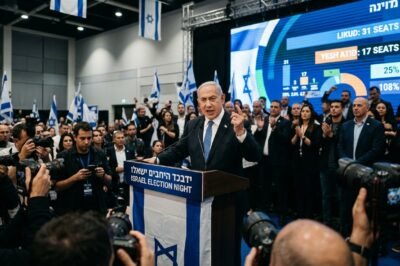
The political landscape of Israel has once again been cast into a state of high-stakes flux as the latest exit polls and early vote counts suggest a familiar yet precarious outcome for the nation’s longest-serving leader. Benjamin Netanyahu, the veteran politician whose career has been defined by both unparalleled electoral success and polarizing legal challenges, finds his right-wing and religious bloc in a commanding lead. However, as the dust settles on the fifth election in less than four years, the narrow margins indicate that the path to a stable, 61-seat majority in the 120-seat Knesset remains frustratingly elusive. This development marks yet another chapter in Israel’s ongoing political saga, a period characterized by deep societal divisions and a persistent deadlock that has tested the resilience of its democratic institutions. The atmosphere in Jerusalem and Tel Aviv remains electric, with supporters of the Likud party celebrating a perceived victory while analysts warn that the final decimal points of the vote tally could still shift the balance of power significantly. For a nation weary of the ballot box, the prospect of a sixth election looms as a shadow over the current celebrations, highlighting the systemic challenges of a proportional representation system that empowers smaller fringe parties and complicates the formation of a cohesive executive branch.
The current results reflect a deeply polarized electorate, where the central question remains the fitness of Netanyahu to lead while under indictment for corruption. Despite these legal hurdles, his base remains fiercely loyal, viewing him as a uniquely capable defender of Israel’s security and economic interests. The lead maintained by his bloc is largely attributed to the surge of the Religious Zionism party, an ultra-nationalist faction that has moved from the fringes of Israeli politics to a position of significant influence. This shift represents a broader trend in Israeli society toward more conservative and nationalist sentiments, a movement that has increasingly sidelined the traditional center-left parties that once dominated the nation’s political landscape. As the counting continues, the focus remains on the ‘threshold parties’—those smaller factions hovering near the 3.25 percent mark required to enter the Knesset. Their failure or success in crossing this bar will ultimately decide if Netanyahu can finally break the stalemate that has paralyzed the country’s governance for years.
The Mathematical Reality: Analyzing the Exit Poll Data
As the initial exit polls were released by Israel’s major television networks, the numbers painted a picture of a right-wing resurgence. Netanyahu’s Likud party is projected to remain the largest single faction, but the real story lies in the aggregate strength of his natural allies. The bloc, comprising Likud, the ultra-Orthodox parties Shas and United Torah Judaism, and the Religious Zionism alliance, is currently hovering between 59 and 62 seats. This razor-thin margin is the difference between a triumphant return to power for Netanyahu and another period of grueling coalition negotiations or, worse, a continued caretaker government under Yair Lapid. The volatility of these numbers cannot be overstated; in previous cycles, shifts of just a few thousand votes have completely altered the political trajectory of the country.
The implications of a 60-60 split are particularly dire for the Israeli public, which has expressed significant fatigue with the electoral process. Such a result would likely lead to a period of intense political horse-trading, where individual members of the Knesset are courted with lucrative ministry positions and policy concessions to defect from their blocs. Historically, Netanyahu has been a master of this ‘retail politics,’ but the current ideological divides are more rigid than in the past. The ‘Anyone But Bibi’ camp, led by the incumbent Prime Minister Yair Lapid, remains committed to preventing Netanyahu’s return, arguing that his leadership poses a fundamental threat to the rule of law and the independence of the judiciary.
The Rise of Far-Right Influence and Its Consequences
Perhaps the most significant development of this election cycle is the meteoric rise of the Religious Zionism party, led by Bezalel Smotrich and the provocative Itamar Ben-Gvir. Exit polls suggest they could become the third-largest party in the Knesset, giving them unprecedented leverage in any Netanyahu-led government. Ben-Gvir, who has been a lightning rod for controversy due to his past extremist rhetoric and legal run-ins, has successfully tapped into the frustrations of younger, right-wing voters who feel that the state has been too soft on security issues. This surge has caused concern not only among secular Israelis but also among international observers and allies, particularly the United States.
Key implications of a strong Religious Zionism presence include:
- Judicial Reform: A push to weaken the Supreme Court’s power to strike down legislation, potentially clearing the way for Netanyahu to bypass his legal troubles.
- Security Policy: Demands for more aggressive military responses in the West Bank and Gaza, and a hardline stance on internal civil unrest.
- Settlement Expansion: Increased funding and legal recognition for outposts in disputed territories, which could further complicate future peace negotiations.
- Societal Tension: Potential friction over the role of religion in public life, including issues related to LGBTQ+ rights and gender-segregated public spaces.
The inclusion of such elements in a senior governing capacity would represent a significant departure from the more pragmatic center-right governments of the past. It would likely lead to friction with the Biden administration, which has expressed a preference for maintaining the status quo on settlement activity and ensuring the protection of democratic norms in Israel.
Market Reactions and Economic Stability Concerns
From a financial perspective, the Israeli markets have reacted with a mix of cautious optimism and underlying anxiety. Historically, the Tel Aviv Stock Exchange (TASE) prefers a decisive outcome—regardless of the winner—over continued uncertainty. However, the prospect of a government dominated by populist and ultra-religious factions presents a unique set of challenges for the economy. The Israeli Shekel has shown volatility in early trading, reflecting investor uncertainty about future fiscal policy and the potential for increased government spending on sectarian interests. Analysts at major financial institutions in Tel Aviv have noted that while Netanyahu is traditionally viewed as a market-friendly neoliberal, his dependence on the ultra-Orthodox parties could lead to significant budgetary allocations for non-productive sectors of the economy.
Furthermore, Israel’s high-tech sector, which is the engine of the nation’s GDP, relies heavily on international investment and a stable geopolitical environment. There are concerns within the tech community that a shift toward more extreme nationalist policies could damage Israel’s ‘Start-up Nation’ brand and deter foreign venture capital. The cost of living remains a top priority for voters, with inflation and housing prices reaching record highs. Any new government will face immediate pressure to implement structural reforms to increase competition and lower costs, tasks that require a stable and long-term legislative outlook—something that has been missing for years.
Foreign Policy and International Relations
On the international stage, the stakes of the election results are equally high. The Abraham Accords, which normalized relations between Israel and several Arab nations, are a centerpiece of Netanyahu’s legacy. While these agreements are generally popular across the political spectrum, the rhetoric of a potential far-right government could strain these new alliances. Moderate Arab states like the UAE and Bahrain will be watching closely to see if a Netanyahu-led coalition pursues policies that could spark renewed violence or instability in the region. The relationship with the United States is also at a critical juncture; while the security bond remains ironclad, the ideological gap between a Ben-Gvir-influenced cabinet and the current Democratic administration in Washington could lead to public disagreements on human rights and Palestinian issues.
Additionally, the looming threat of Iran’s nuclear program remains the most pressing security concern for any Israeli leader. Netanyahu has long been a vocal critic of the Iran nuclear deal and has advocated for a maximum pressure campaign. A stable right-wing government would likely double down on this stance, potentially increasing the risk of regional escalation. Conversely, if the results remain deadlocked and Yair Lapid remains at the helm of a caretaker government, the approach might be more coordinated with the international community, focusing on diplomatic pressure backed by a credible military threat.
The Potential for a Sixth Election
Despite the current lead for the Netanyahu bloc, the specter of a ‘hung Knesset’ is very real. If the final vote count, including the ‘double envelopes’ from soldiers and diplomats, moves the right-wing bloc below 61 seats, the country will enter a period of constitutional uncertainty. Under Israeli law, if no candidate can form a coalition within a designated timeframe, the Knesset is dissolved and new elections are called. This ‘doomsday scenario’ for Israeli democracy would further erode public trust and delay much-needed legislative action on healthcare, education, and infrastructure. The financial cost of another election cycle is also a significant burden on the national treasury, diverting funds from essential services to campaign advertisements and polling stations.
The role of the Arab parties is also crucial in this context. Their participation rate in this election was higher than expected, and their refusal to join any Netanyahu-led government makes them the ultimate obstacle to his majority. However, the internal divisions within the Arab factions have also made it difficult for them to provide a coherent alternative for the center-left bloc. This fragmentation on both sides of the aisle is what has led to the current impasse, where the two major camps are effectively neutralizing each other’s ability to govern.
Future Implications: A Nation Divided
Looking ahead, the primary implication of these results is that Israel remains a deeply fractured society with no clear consensus on its future direction. Whether Netanyahu manages to scrape together a majority or the country slides into a sixth election, the underlying tensions will persist. The judicial system, the military, and the media are all being pulled into the political fray, threatening the institutional stability that has been a hallmark of the state since its inception. A Netanyahu victory would likely trigger a massive push for judicial reform, which his critics label as a ‘regime change,’ while his supporters see it as a necessary correction to an activist court.
In the short term, the world must prepare for a period of intense negotiation and potential instability. The final results will be scrutinized not just for the seat counts, but for what they reveal about the changing identity of the Israeli electorate. The move toward the right is undeniable, but the resistance to Netanyahu’s personal leadership is equally persistent. As the final ballots are tallied, the question is no longer just about who will lead, but about whether the current political system can survive another round of stalemate without suffering permanent damage. The coming days will be decisive, as party leaders meet with the President to recommend a candidate for the premiership, setting the stage for what will undoubtedly be a tumultuous few weeks in Jerusalem.






































Leave a Reply