
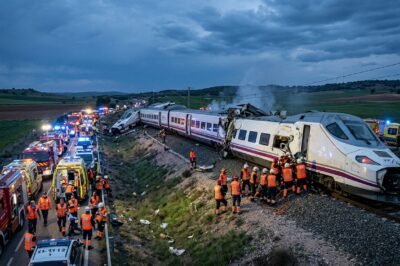
The peaceful evening in the heart of the Toledo province was abruptly and violently interrupted on Tuesday as two high-speed trains collided near the municipality of Oropesa, resulting in what officials are now calling one of the deadliest rail disasters in modern Spanish history. As the sun dipped below the horizon, the initial reports of a minor derailment were quickly replaced by a harrowing reality that has sent shockwaves across the Iberian Peninsula and the European Union at large. With the confirmed death toll rising to 64 individuals, including several children and international travelers, the scale of the devastation is only beginning to be fully realized by the emergency crews who have been working tirelessly through the night under the glare of floodlights. The air, once filled with the scent of dry earth and summer heat, became heavy with the smell of scorched metal and the sounds of specialized heavy machinery cutting through the mangled remains of the Talgo carriages. This catastrophe does not merely represent a failure of steel and speed but stands as a profound moment of national grief, forcing a sudden and painful introspection into the very infrastructure that defines Spain’s modern connectivity and technological pride. As families gather at local community centers awaiting news of their loved ones, the nation stands in a state of suspended animation, paralyzed by the sheer magnitude of a loss that feels as avoidable as it is tragic. The local hospital systems in Toledo and Madrid have been pushed to their absolute limits, triaging hundreds of injured passengers while forensic teams begin the grim task of identifying those who did not survive the impact. This event marks a dark milestone in European rail travel, prompting an immediate and rigorous investigation into the safety protocols that were supposed to prevent such a collision.
Anatomy of a Catastrophe: The Sequence of Events
The collision occurred at approximately 8:42 PM local time, involving a regional high-speed train traveling from Madrid and a long-distance express service heading toward the Portuguese border. Preliminary data suggests that the two trains were operating on a shared track segment due to ongoing maintenance on the secondary line, a common practice that usually relies on sophisticated signaling systems to maintain safe separation distances. However, witnesses describe a scene of pure chaos as the front engines of both trains impacted at high velocity, leading to a massive kinetic energy discharge that crumpled several passenger cars like accordion pleats. The force of the impact was so significant that the lead locomotive was tossed nearly thirty meters from the tracks, landing in a nearby olive grove, while the trailing carriages piled on top of one another in a vertical wreckage that made initial rescue efforts incredibly perilous for first responders.
Technical investigators from the Spanish Ministry of Transport are currently examining the black boxes of both trains to determine why the automated braking systems failed to engage. In modern rail operations, the ERTMS (European Rail Traffic Management System) is designed to automatically slow or stop trains if they exceed speed limits or enter occupied track segments. The failure of this digital fail-safe is the primary focus of the early investigation. There are also reports from local residents of a bright flash and a sudden loss of power in the area just moments before the collision, leading to speculation about a possible electrical fault or power surge that might have blinded the signaling infrastructure. Until the data is fully extracted and analyzed, the question of whether this was a mechanical failure, a software glitch, or human error remains the most pressing concern for the public and the government alike.
Emergency Mobilization and the Struggle for Survival
Within minutes of the impact, the first emergency calls flooded the 112 dispatch centers, and the response was nothing short of massive. Over 500 personnel from the Military Emergencies Unit (UME), the National Police, and local fire brigades were deployed to the site. The rugged terrain of the Toledo countryside provided a significant challenge, as many of the mangled carriages were positioned on an elevated embankment, making it difficult to stabilize the wreckage before rescuers could enter. Heavy-duty cranes had to be trucked in from Madrid to lift the steel beams that pinned survivors underneath. Throughout the night, the sound of hydraulic shears echoed across the fields as rescuers worked in shifts to reach those trapped inside the ‘quiet’ carriages of the high-speed service, which bore the brunt of the secondary impact force.
Medical teams established a field hospital on-site to stabilize the most critically injured before they were airlifted via a fleet of twelve helicopters to major trauma centers. The logistical coordination required to manage 64 fatalities and over 120 injuries in such a remote location tested the limits of Spain’s emergency preparedness. Volunteering doctors and nurses from across the region drove to the site, offering their services in the triage tents. The psychological toll on the first responders has also been highlighted, as they encountered scenes of immense trauma. The regional government of Castilla-La Mancha has since declared three days of official mourning, and psychological support units have been deployed to assist the families of the victims who are currently being housed in a makeshift center in the city of Toledo.
Investigating Technical Failures: A Crisis of Infrastructure
Spain’s rail network is often cited as a global benchmark for high-speed connectivity, but this incident has cast a long shadow over the reputation of ADIF, the state-owned infrastructure manager. The investigation is exploring several critical vulnerabilities, starting with the integration of older track segments with newer high-speed rolling stock. While the AVE lines are generally isolated, the Toledo corridor features several points where high-speed trains must transition onto mixed-use tracks. It is at these transition points that the risk of collision is statistically higher, and critics are now pointing to years of warnings regarding the need for more robust physical separation in these zones. The scrutiny is also falling on the maintenance schedules of the signaling boxes located at the Oropesa junction, which had reportedly undergone a routine inspection just two weeks prior.
Furthermore, the investigation is looking into the communications between the central control room in Madrid and the train conductors. Initial transcripts indicate that there may have been a confusion regarding the ‘proceed’ signal on the single-track stretch. If the signaling was green for both trains, it would point to a catastrophic failure of the centralized computer systems. This has broader implications for rail safety across Europe, as the ERTMS system is used in multiple countries. If a fundamental flaw is discovered in how the system handles track maintenance overrides, it could necessitate an immediate audit of thousands of kilometers of rail lines across the continent, potentially causing massive disruptions to European travel and commerce for months to come.
Socio-Economic Impact and the Future of Spanish Tourism
Beyond the immediate tragedy, the economic ramifications of the Toledo collision are expected to be substantial. Spain’s economy is heavily reliant on its transport infrastructure to support a thriving tourism industry, which accounts for a significant portion of the national GDP. The Toledo province, known for its historical landmarks and high-speed links to Madrid, serves as a vital artery for domestic and international travelers. A loss of confidence in the safety of the rail network could lead to a decline in ticket sales and a shift toward air or road travel, neither of which is as environmentally sustainable or efficient. Shares in Renfe and ADIF’s partner contractors saw a sharp decline in early trading following the news, as investors braced for the costs of litigation, reparations, and the inevitable multi-billion euro infrastructure overhaul that will likely follow the final report.
Additionally, the legal fallout is expected to be unprecedented. Law firms specializing in transport disasters are already coordinating with the families of the victims to file a class-action lawsuit against the state railway operators. The compensation claims alone could reach hundreds of millions of euros, further straining the national budget. There is also the matter of international relations; with several of the deceased being foreign nationals, the Spanish government is under pressure to provide a transparent and rapid explanation to the embassies involved. The reputational damage to ‘Brand Spain’ as a leader in civil engineering and high-speed transit cannot be overstated, and the path to recovery will require not only the physical rebuilding of the tracks but a total restoration of public trust.
Political Accountability and National Security Reform
The political atmosphere in Madrid has become incredibly charged as opposition leaders call for the resignation of the Minister of Transport. A special session of the Spanish Parliament has been convened to discuss the disaster, with many lawmakers demanding a full independent audit of the entire high-speed rail network. The Prime Minister, who visited the crash site earlier today, has promised that ‘no stone will be left unturned’ in the pursuit of the truth, yet the public demand for immediate accountability remains high. This incident has reignited the debate over the balance between rapid infrastructure expansion and the rigorous maintenance of existing systems. For years, the focus has been on building more kilometers of high-speed track than any other European nation, but this tragedy suggests that the operational safety budget may have been sidelined in favor of political optics.
There are also calls for a complete overhaul of how rail accidents are investigated in Spain. Currently, the commission responsible for investigating rail accidents (CIAF) is under the umbrella of the Ministry of Transport, leading to concerns about potential conflicts of interest. Reformers are pushing for a truly independent body, similar to the aviation safety boards in the United States or the United Kingdom, to ensure that the findings are not influenced by political pressure to protect state-owned enterprises. As the national flags fly at half-mast, the legislative focus is shifting toward a comprehensive Rail Safety Act that would mandate the installation of secondary, redundant safety systems on all mixed-use tracks, regardless of the cost.
Conclusion: Honoring the Victims Through Systemic Change
As Spain begins the long process of mourning the 64 lives lost in Toledo, the focus must eventually shift from grief to action. The victims of this collision deserve more than just a monument; they deserve a rail system that is incapable of repeating such a failure. The coming months will be defined by rigorous technical analysis and difficult political decisions. The international rail community is watching Spain closely, knowing that the lessons learned from the Oropesa collision will shape the safety standards of the 21st century. Safety must never be sacrificed for speed, and the connectivity of a nation must not come at the cost of its citizens’ lives. As the wreckage is cleared and the tracks are eventually repaired, the memory of this tragedy will remain a somber reminder of the responsibility inherent in high-speed travel. Only through a transparent, thorough investigation and a commitment to systemic reform can Spain hope to move forward from this dark chapter and ensure that its trains are once again symbols of progress rather than conduits of catastrophe.
- Confirmed fatalities: 64
- Total passengers involved: 312
- Location: Oropesa-Talavera segment, Toledo
- Primary investigation focus: ERTMS signaling failure
- National mourning period: 3 Days




































Leave a Reply