
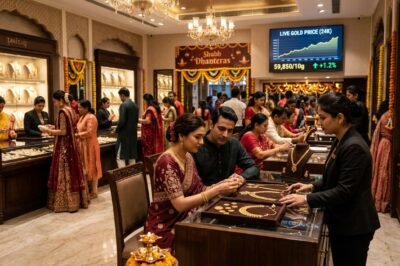
As the first light of dawn breaks over the horizon on the auspicious occasion of Dhanteras, the streets of India’s major jewelry hubs are already buzzing with an electric mix of devotion and economic calculation. This year, the festival of wealth and prosperity arrives amidst a historic financial phenomenon: gold prices have surged to unprecedented record highs, shattering previous psychological barriers and testing the resolve of even the most dedicated investors. For the average Indian household, the purchase of the yellow metal during Dhanteras is more than a mere transaction; it is a sacred ritual believed to invite the goddess Lakshmi into the home for the coming year. However, with 24-carat gold prices hovering around the astronomical mark of 78,000 to 80,000 Indian Rupees per 10 grams, the glitter of the metal is accompanied by a sharp pinch to the pocket. This intersection of deep-rooted cultural tradition and a volatile global economic landscape creates a fascinating case study in market resilience and consumer psychology. Analysts and retailers alike are watching closely as the nation balances its spiritual yearning for gold with the pragmatic realities of a high-inflation environment, marking this Dhanteras as one of the most significant in recent financial history.
The cultural significance of gold in India cannot be overstated. As the world’s second-largest consumer of the metal, India’s demand cycles often dictate global price movements. This year, the confluence of a shortened supply chain, a recently reduced import duty that was quickly offset by rising international rates, and a domestic appetite that refuses to dim despite the costs, has created a perfect storm. The narrative of gold during this festive season is not just about the price on the ticker but about the enduring trust the Indian public places in bullion as the ultimate safe haven. While other asset classes like equities and real estate have seen their share of volatility, gold remains the bedrock of Indian savings, a tangible symbol of security that transcends generations. As we dive into the specifics of this price surge, we see a complex tapestry of global geopolitics, monetary policy, and domestic demand patterns that define the current bull run.
The Statistical Surge: A Deep Dive into Record Prices
To understand the magnitude of the current situation, one must look at the hard data. Over the last twelve months, gold prices in India have seen a staggering appreciation of nearly 25-30%. For 24-carat gold, the price has consistently stayed above the 75,000 mark for several weeks, recently touching the 79,000 levels in several metropolitan cities. This is a far cry from the prices seen during Dhanteras just two years ago, where the metal was trading in the low 50,000s. The rapid escalation has been driven by a combination of a weakening Indian Rupee against the US Dollar and a surge in international spot prices. Market statistics indicate that despite the high prices, the volume of silver has also hit a milestone, with silver prices crossing the psychological barrier of 1,00,000 INR per kilogram for the first time in domestic markets.
Furthermore, the premium on physical gold has reached new heights. In previous years, jewelers often offered significant discounts on making charges to lure customers during the festive week. However, with the base price of the metal so high, retailers are finding it difficult to offer deep concessions. Instead, we are seeing a shift in transaction values. While the weight of gold sold in grams may see a marginal decline of 10-15% compared to the previous year, the total turnover in terms of value is expected to rise by over 20%. This data points to a market that is consolidating; the wealthier segments of society are continuing their large-scale purchases, while the middle class is shifting toward smaller, high-purity items like 1-gram and 2-gram gold coins to keep the tradition alive.
Global Geopolitical Drivers and the Safe Haven Appeal
The primary catalyst for the international rally in gold prices, which directly impacts the Indian market, is the prevailing sense of global uncertainty. Geopolitical tensions in the Middle East have acted as a massive tailwind for precious metals. Whenever the threat of conflict looms over oil-producing regions or major trade routes, investors worldwide flee toward safe-haven assets. Gold, having no counterparty risk and a history of maintaining value over millennia, is the natural beneficiary of this fear. The ongoing friction between major powers and the localized conflicts in Eastern Europe and Western Asia have ensured that the ‘risk-off’ sentiment remains dominant in the global financial markets.
Moreover, central banks across the globe have been on a gold-buying spree. From the People’s Bank of China to the Reserve Bank of India, monetary authorities have been diversifying their foreign exchange reserves away from the US Dollar. By increasing their gold holdings, these institutions are signaling a lack of long-term confidence in fiat currencies amidst high global debt levels. This institutional demand creates a floor for gold prices, ensuring that even if retail demand fluctuates, the overall price remains buoyant. For the Indian consumer, this means that the prices they see at the local jeweler are a direct reflection of the global race for security and the diminishing trust in traditional currency regimes.
The US Federal Reserve and Monetary Policy Impact
One cannot discuss gold prices without looking at the United States Federal Reserve. Gold is denominated in US Dollars on the international stage, meaning there is an inverse relationship between the strength of the dollar and the price of gold. Recently, the expectation of interest rate cuts by the Fed has provided a significant boost to gold. Lower interest rates reduce the opportunity cost of holding non-yielding assets like gold. When savings accounts and bonds offer lower returns, the relative attractiveness of gold increases, prompting institutional investors to rotate their portfolios into bullion.
In the Indian context, the situation is compounded by the Rupee’s performance. As the US Fed manages its inflation targets, any volatility in the USD/INR exchange rate adds another layer of cost for Indian importers. Since India imports the vast majority of its gold, a weaker Rupee makes every ounce of gold more expensive to bring into the country. Even when international gold prices see a minor correction, the domestic price often stays high because of the currency depreciation. This dual pressure of global price hikes and currency weakness has created the current record-high environment that shoppers are navigating this Dhanteras.
Retail Dynamics and the Evolution of Consumer Behavior
The Indian retail jewelry sector has had to pivot rapidly to accommodate the new price reality. Major players like Tanishq, Malabar Gold & Diamonds, and Joyalukkas have reported a significant shift in how consumers are approaching their festive shopping. There is a noticeable trend toward ‘lightweight’ jewelry. Designers are now focusing on creating pieces that look heavy and ornate but use less gold through innovative hollow-casting and 3D printing techniques. This allows consumers to maintain the aesthetic of grand wedding jewelry while staying within a manageable budget. Retailers are also reporting a 40% increase in pre-booking orders, as savvy customers tried to lock in prices weeks before the Dhanteras peak.
Another fascinating development is the rise of the organized recycling market. Many consumers are bringing in their old gold jewelry to be exchanged for new designs. By trading in old gold, shoppers only have to pay the making charges and the difference in weight, effectively shielding themselves from the full brunt of the record-high prices. This ‘old-for-new’ trend has become a cornerstone of the retail strategy this year, helping to sustain footfall in stores that might otherwise have been empty due to the high entry price. It reflects a circular economy within the gold sector that is unique to the Indian market, where gold is never truly ‘spent’ but merely transformed.
The Rise of Digital Gold and Sovereign Gold Bonds
While physical gold remains the king of Dhanteras, the digital revolution has finally made a significant dent in the market. Digital gold platforms, which allow users to buy as little as one rupee worth of gold, have seen a massive surge in users aged 18 to 35. This demographic, while still respecting the tradition of Dhanteras, prefers the convenience of purchasing gold via mobile apps like PhonePe, Google Pay, or dedicated platforms like MMTC-PAMP. The ease of storage, lack of making charges, and the ability to sell back the metal instantly make digital gold a highly attractive proposition for the urban millennial.
Furthermore, the popularity of Sovereign Gold Bonds (SGBs) has changed the investment landscape. Although the government has slowed down the frequency of new issuances, the secondary market for SGBs remains active. Investors are beginning to realize that if the goal is purely financial gain, SGBs offer the benefit of an annual interest rate on top of the capital appreciation of gold, without the worries of theft or purity. However, for Dhanteras, the physical touch of gold still holds a sentimental value that digital bytes cannot replace. We are seeing a hybrid model emerge where families buy a small physical coin for the ‘puja’ and invest a larger sum into digital formats to maximize their financial returns.
Future Outlook: Will the Bull Run Continue into 2025?
As we look beyond the festive season, the big question for investors is whether gold has reached its peak or if there is more room for growth. Most market analysts remain bullish. With the wedding season following closely on the heels of Diwali, the domestic demand in India is expected to remain robust through the first quarter of 2025. Internationally, as long as geopolitical tensions remain unresolved and central banks continue to diversify their reserves, the upward pressure on gold is likely to persist. Some aggressive forecasts even suggest that gold could test the 85,000 to 90,000 INR level by late 2025 if the global economic climate worsens.
In conclusion, this Dhanteras marks a pivotal moment for the Indian gold market. It is a testament to the metal’s enduring power that even at record-high prices, the queues outside jewelry stores remain long. Gold continues to be the ultimate bridge between India’s glorious past and its aspiring future. While the high prices may change ‘how’ Indians buy gold—shifting from heavy necklaces to small coins or digital fractions—it has not changed ‘why’ they buy it. As a symbol of luck, a hedge against uncertainty, and a store of family wealth, the yellow metal remains the undisputed heart of the Indian economy. Investors should remain cautious but optimistic, keeping a close eye on global interest rates and currency movements, as the golden rally shows no immediate signs of fading.



































Leave a Reply