
In Shorts:
- Comet 31P/ATLAS recently made its closest approach to the Sun and subsequently lost its iconic tail, a event captured by astronomers.
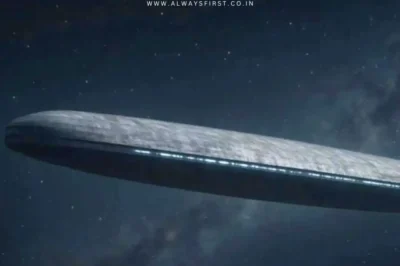
- A viral online theory has suggested the tail was “severed” by advanced alien technology, fueling speculation on social media.
- Scientists firmly attribute the event to a common space weather phenomenon known as a “disconnection event,” caused by intense solar activity.
AlwaysFirst – Space enthusiasts and conspiracy theorists were captivated last week as Comet 31P/ATLAS, after completing its closest pass by the Sun, performed a startling cosmic magic trick: its tail vanished. The bizarre event quickly spiraled into a viral online sensation, with one particular theory suggesting the intervention of an intelligent extraterrestrial hand.
The speculation ran rampant across social media platforms. Some users proposed that an advanced alien civilization might have used powerful technology to “sever” the comet’s tail, either as an experiment, a message, or simply as a demonstration of their capabilities. The idea, while straight out of science fiction, gained traction due to the dramatic and seemingly unnatural appearance of the detachment.
However, astronomers and space weather experts are bringing the discussion back down to Earth—or, more accurately, back to the Sun. The scientific explanation, while less sensational, is no less fascinating. The phenomenon is officially known as a “disconnection event,” and it’s a well-documented, if spectacular, occurrence in the life of a comet.
So, what really happened to Comet 31P/ATLAS?
A comet’s tail is not a solid structure but a vast stream of gas and dust being blown away from the comet’s nucleus by the solar wind—a constant flow of charged particles from the Sun. According to scientists at the National Oceanic and Atmospheric Administration (NOAA), a powerful burst of solar wind, likely from a Coronal Mass Ejection (CME), smashed into the comet. This surge of magnetic energy and particles effectively “pinched off” the tail, pushing it away into space faster than the comet could generate a new one. The comet’s head continued on its journey, temporarily tailless, while the old tail dissipated into the void.
In essence, the Sun itself was the culprit, wielding its immense power in a routine display of cosmic force. While the search for extraterrestrial intelligence continues, in this case, the truth appears to be a stunning reminder of our own star’s incredible influence over the solar system. The fading of Comet 31P/ATLAS after perihelion is a natural part of its cycle, its brief brush with viral fame a testament to humanity’s endless curiosity about the unknown.






































Leave a Reply