
In Shorts
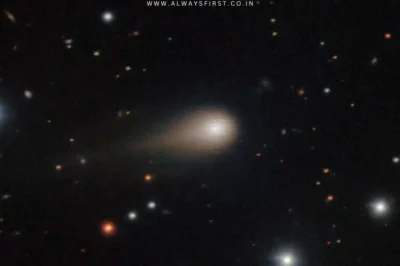
- China’s Tianwen-1 Mars orbiter successfully captured high-resolution images of the interstellar comet 3I/Borisov during its passage through our solar system.
- Analysis of the images is providing scientists with valuable data on the comet’s composition, including the properties of its coma and dust particles.
- This opportunistic observation demonstrates the growing versatility and capability of China’s deep-space exploration fleet to study transient astronomical events.
AlwaysFirst Exclusive – In a stunning display of interplanetary multitasking, China’s Tianwen-1 spacecraft, currently in orbit around Mars, has successfully trained its high-resolution camera on a visitor from the depths of interstellar space. The target: the comet known as 3I/Borisov, a nomadic object journeying through our solar system after being ejected from its own distant star system.
The observation, a sophisticated maneuver for a probe designed to study the Red Planet, provides a fresh and critical dataset for astronomers worldwide. By analyzing the light reflected from the comet’s core and surrounding cloud of gas and dust, scientists are piecing together a clearer picture of what this interstellar traveler is made of.
The data captured by Tianwen-1’s camera is particularly focused on the comet’s coma—the nebulous envelope around its nucleus. Early analysis suggests the coma is rich in carbon monoxide and dust grains, with properties that appear distinct from comets native to our own solar system. This “compositional fingerprint” is vital, as it offers a tangible sample of the building blocks of a planetary system light-years away from our own.
“This was a challenging but highly rewarding observation,” said a mission scientist associated with the Tianwen-1 team, who spoke on the condition of anonymity. “To re-task a Martian orbiter to track a fast-moving comet demonstrates incredible precision and opens up new possibilities for how we can use our existing space assets for broader astrophysical discovery.”
The comet 3I/Borisov was first discovered in 2019 and is only the second interstellar object ever detected passing through our cosmic neighborhood. Unlike its predecessor, the enigmatic ‘Oumuamua, Borisov displayed classic cometary features, making it a prime target for study.
This successful imaging session by Tianwen-1, which occurred over a year ago but is only now being fully analyzed and reported, underscores China’s rapidly advancing capabilities in deep-space exploration. It marks a significant milestone, proving that the country’s interplanetary probes can contribute to fundamental astronomy beyond their primary mission objectives.
As Tianwen-1 continues its study of Mars, this opportunistic glimpse of comet Borisov serves as a powerful reminder that our solar system is not an isolated island, but a dynamic crossroads occasionally visited by debris from the vast galactic ocean beyond.





































Leave a Reply