
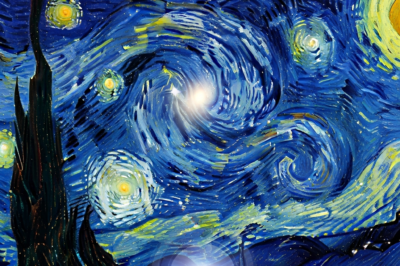
Space has always been a canvas for the human imagination, a vast and swirling expanse that challenges our understanding of physics while simultaneously igniting our artistic sensibilities. Recently, the astronomical community and art enthusiasts alike were captivated by a breathtaking new image captured by the Dark Energy Camera (DECam), mounted on the Victor M. Blanco 4-meter Telescope at the Cerro Tololo Inter-American Observatory in Chile. The image, which showcases the turbulent gas and dust within a distant nebula, bears an uncanny resemblance to Vincent van Gogh’s 1889 masterpiece, ‘The Starry Night.’ This visual synchronicity between a post-impressionist painting and the raw mechanics of the universe is more than just a coincidence; it is a profound testament to the fluid dynamics and chaotic beauty that govern the cosmos. As we peer into the heart of these celestial clouds, we are not just seeing light and heat, but a complex interplay of forces that have shaped the universe over billions of years. This discovery highlights the capabilities of modern imaging technology to bridge the gap between hard science and evocative art, reminding us that the laws of nature often produce patterns that resonate deeply with the human soul.
The Dark Energy Camera: A Masterpiece of Astronomical Engineering
To understand how such a detailed and evocative image was captured, one must first look at the instrument behind the lens. The Dark Energy Camera (DECam) is one of the most powerful wide-field imaging tools currently in operation. Built by the Dark Energy Survey (DES) collaboration, it features an array of 62 charge-coupled devices (CCDs) that together produce a 570-megapixel resolution. Located high in the Chilean Andes, the DECam benefits from some of the clearest skies on Earth, allowing it to capture light that has traveled for thousands, or even millions, of years. Originally designed to study the acceleration of the universe’s expansion and the nature of dark energy, the camera’s sensitivity and wide field of view make it ideal for mapping large-scale structures in the sky. It operates by capturing light across various wavelengths, from the ultraviolet to the near-infrared, which provides scientists with a multi-layered view of the objects they observe. By combining these different data sets, researchers can reconstruct the true colors and physical properties of nebulae, stars, and galaxies with unprecedented clarity. The ‘Starry Night’ effect seen in recent images is a direct result of this high-resolution capability, which can resolve the intricate filaments of gas that would appear as a mere blur to lesser instruments.
Decoding the Cosmic Canvas: Turbulence and Fluid Dynamics
The swirling patterns that evoke Van Gogh’s brushstrokes are not merely aesthetic; they are the physical manifestations of interstellar turbulence. In the vast clouds of gas and dust known as the interstellar medium (ISM), matter is rarely at rest. Instead, it is constantly being pushed, pulled, and heated by various forces. Supernova explosions, the intense radiation from newborn stars, and the rotational forces of the galaxy all contribute to a chaotic environment where gas flows in complex, non-linear ways. These flows are governed by the laws of fluid dynamics, specifically the same principles that describe the movement of water in an ocean or air in the atmosphere. In the DECam images, we see ‘eddies’ and ‘vortices’ of gas that are strikingly similar to the circular motifs used by Van Gogh. Scientifically, these patterns represent the transfer of energy from larger scales to smaller scales, a process known as the energy cascade. By studying these shapes, astronomers can calculate the density of the gas, its temperature, and the strength of the magnetic fields that permeate the region. This helps us understand how the ‘seeds’ of new stars are planted, as these turbulent motions eventually lead to the collapse of gas clouds under their own gravity.
The Science of Star Birth: Inside the Nebula Heart
At the center of these cosmic masterpieces lies the process of star formation. The vibrant blues, reds, and golds seen in the DECam imagery correspond to different elements and physical states. For instance, the reddish hues often indicate the presence of hydrogen gas that has been ionized by the ultraviolet radiation from nearby hot, young stars. As these stars form within the dense knots of the nebula, they act as massive engines, blowing ‘bubbles’ into the surrounding material through powerful stellar winds. These winds carve out cavities and create the sharp, luminous ridges that resemble the thick impasto technique of a painter. Over millions of years, these regions evolve. The stars that are born today will eventually consume the gas around them, or blow it away entirely, leaving behind a cluster of stars that will drift through the galaxy. This lifecycle of birth and destruction is what makes the imagery so dynamic. When we look at the ‘Starry Night’ in space, we are witnessing a snapshot of a violent yet creative process. The image captures the tension between the gravity trying to pull everything together and the radiation pressure trying to push it apart—a cosmic tug-of-war that defines the evolution of our universe.
Dark Energy and the Expanding Universe: The Broader Mission
While the aesthetic beauty of these nebulae is undeniable, the primary mission of the DECam is far more abstract: the hunt for dark energy. Dark energy is the mysterious force that makes up approximately 68% of the universe and is responsible for its accelerating expansion. To study it, DECam doesn’t just look at pretty clouds; it maps hundreds of millions of galaxies across a significant portion of the southern sky. By measuring the distribution of these galaxies and the ‘weak lensing’ effect—where the gravity of foreground matter slightly distorts the light from background objects—scientists can track how the structure of the universe has changed over time. The same precision required to map these subtle gravitational effects is what allows the camera to take such detailed photos of local nebulae. These local observations serve as a calibration tool and a way to understand the ‘foreground’ through which we must look to see the edge of the observable universe. In a sense, the ‘Starry Night’ image is a byproduct of a much larger quest to answer the most fundamental question in physics: what is the universe made of, and how will it end? The synergy between the micro-study of local gas clouds and the macro-study of the cosmic web is what makes modern astrophysics so compelling.
Bridging Art and Science: The Impact of Public Engagement
One of the most significant aspects of this news is its ability to engage the public. In an era where scientific data can often feel cold and inaccessible, images that connect with our cultural history—like the work of Van Gogh—serve as a bridge. When the public sees a photo that looks like a painting, it sparks a curiosity that a spreadsheet of numbers never could. This ‘astrophotography-as-art’ movement has historical roots, from the first black-and-white plates of the 19th century to the iconic ‘Pillars of Creation’ captured by the Hubble Space Telescope. These images remind us that the universe is not just a laboratory, but a place of profound beauty. Educational institutions and planetariums use these visuals to inspire the next generation of scientists and engineers. By highlighting the ‘cosmic Van Gogh,’ NASA and NOIRLab are essentially using a shared human language of art to explain the complex mechanics of the vacuum. This democratization of science through imagery ensures that the wonders of the universe are not just reserved for those with PhDs, but are available for everyone to admire and contemplate.
Technological Horizons: From DECam to the Vera C. Rubin Observatory
The success of the DECam is a precursor to even more ambitious projects. Currently, the Vera C. Rubin Observatory is being constructed in the same region of Chile. Once operational, its Simonyi Survey Telescope will conduct the Legacy Survey of Space and Time (LSST), a ten-year mission to image the entire southern sky every few nights. This will create the first-ever ‘motion picture’ of the universe on a grand scale. The data volume will be staggering—tens of terabytes every night—requiring advanced AI and machine learning to process. If DECam can produce a ‘Starry Night,’ the Rubin Observatory will likely produce an entire gallery’s worth of data, potentially revealing thousands of transient events like supernovae and moving asteroids in real-time. This progression in technology means that our ‘artistic’ view of the cosmos is about to become more vivid and more detailed than ever before. We are moving from snapshots to a cinematic understanding of the heavens, where the swirling gases and bright stars we see today will be tracked as they move and change over a decade. The future of astronomy lies in this intersection of big data, high-resolution optics, and the timeless human desire to see what lies beyond the horizon.
Conclusion: The Universal Language of the Cosmos
In conclusion, the ‘Starry Night’ in space captured by the Dark Energy Camera is more than a viral curiosity. It is a striking reminder that the patterns we perceive as beautiful on Earth are often reflections of universal laws. Whether it is the stroke of a genius painter’s brush or the movement of cold hydrogen in a vacuum, the same mathematics of chaos and order are at play. As we continue to refine our tools—from the 4-meter Blanco telescope to the upcoming Rubin Observatory—we will undoubtedly find more such connections. These images challenge us to look at the sky not as a distant, empty void, but as a dynamic environment teeming with life-giving processes. They remind us that we are made of the same ‘stardust’ we see swirling in these nebulae, and that our artistic impulses are, perhaps, just our way of reflecting the grand design of the universe back onto itself. As we look forward to the next decade of discovery, we can be certain that the cosmos will continue to surprise us with its ability to mimic the finest art ever created by human hands.





































Leave a Reply