
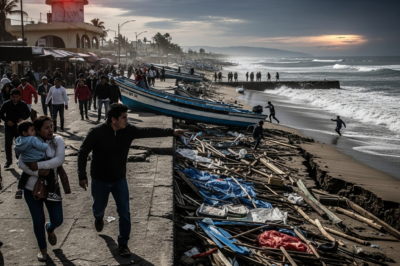
The Immediate Shockwave: A Nation on High Alert
Panic gripped the Pacific coast of Mexico and reached deep into the heart of Mexico City as a powerful 7.4 magnitude earthquake struck with sudden, violent intensity. The seismic event, which originated near the coastal region of Oaxaca, sent ripples of terror through urban centers and rural villages alike, as buildings swayed precariously and the earth roared. This magnitude of earthquake is categorized as ‘major’ on the Richter scale, capable of causing significant damage to even well-constructed buildings and impacting infrastructure hundreds of miles from the epicenter. As the dust began to settle, the immediate concern shifted from the shaking ground to the rising sea, as international agencies issued urgent tsunami warnings for the Pacific coastline. This event serves as a harrowing reminder of Mexico’s precarious position atop some of the world’s most active tectonic boundaries, where the intersection of the Cocos and North American plates creates a persistent threat of geological catastrophe. Residents in the affected areas described a scene of chaos, with many rushing into the streets as the early warning sirens wailed, a sound that has become synonymous with survival in this seismically volatile region. The scale of the event was immediately recognized by the United States Geological Survey (USGS) and Mexico’s National Seismological Service, both of which began a rapid assessment of the potential for loss of life and property.
Understanding the Tsunami Risk: Coastal Communities Under Threat
Within minutes of the initial tremor, the Pacific Tsunami Warning Center (PTWC) issued a critical alert, warning that hazardous tsunami waves were possible for coasts located within 1,000 kilometers of the earthquake epicenter. For Mexico, this meant a vast stretch of the Pacific seaboard was at risk of experiencing sudden sea-level rises that could inundate low-lying coastal towns and tourist resorts. The mechanics of a tsunami triggered by a subduction zone earthquake involve the massive displacement of water as the seabed is thrust upward or downward during the fault rupture. In a 7.4 magnitude event, the energy released is sufficient to move billions of gallons of water, creating waves that, while perhaps not looking like the towering monsters of cinema, possess enough force to sweep away vehicles, destroy docks, and flood interior blocks. Local authorities in states like Oaxaca, Guerrero, and Michoacán acted swiftly, ordering mandatory evacuations for residents living in high-risk zones. The psychological impact of such a warning cannot be overstated, as families were forced to flee their homes with nothing but the clothes on their backs, seeking higher ground while the threat of aftershocks continued to rattle the ground beneath them. This specific warning highlighted the vulnerability of Mexico’s tourism infrastructure, which is heavily concentrated along its beautiful but geologically dangerous Pacific shores.
The Geological Context: Mexico’s Seismic Vulnerability and the Ring of Fire
To understand why Mexico is so frequently the site of major earthquakes, one must look deep beneath the earth’s surface. The country is situated within the ‘Ring of Fire,’ a horseshoe-shaped belt of intense seismic and volcanic activity that circles the Pacific Ocean. Specifically, Mexico sits on the edge of the North American Plate, which is constantly interacting with the Cocos Plate to the south and the Rivera Plate to the west. This interaction is primarily a process of subduction, where the heavier oceanic plates are forced beneath the lighter continental plate. This process is not smooth; the plates frequently get ‘stuck,’ allowing immense amounts of elastic strain energy to build up over decades or even centuries. When the friction is finally overcome, the plates slip suddenly, releasing the energy in the form of seismic waves. The 7.4 magnitude earthquake is a direct manifestation of this subduction process. Geologists have long monitored the ‘Oaxaca Gap’ and other similar seismic gaps where large earthquakes are expected but have not occurred recently. This latest event confirms that the tectonic stresses in the region remain at critical levels. Furthermore, the soft soil composition of areas like the Valley of Mexico, where Mexico City is located, tends to amplify seismic waves, meaning that even distant earthquakes can cause disproportionate damage to the capital city, which is built on the remains of an ancient lakebed.
A History of Devastation: Lessons from 1985 and 2017
History looms large over every earthquake in Mexico. The memory of the 1985 Mexico City earthquake, which claimed thousands of lives and leveled entire neighborhoods, remains a cultural trauma. That disaster, also occurring on the Pacific coast but felt with devastating force in the capital, led to a complete overhaul of building codes and the establishment of one of the world’s most sophisticated early warning systems. More recently, the twin earthquakes of September 2017 served as another wake-up call, striking on the anniversary of the 1985 disaster and causing hundreds of fatalities and widespread structural failure. Each of these events has contributed to a national culture of preparedness, but they also highlight the limitations of human engineering against the raw power of nature. Comparing the current 7.4 magnitude event to these historical precursors reveals a pattern of increasing technical resilience but persistent socio-economic vulnerability. While modern skyscrapers in Mexico City are designed to sway and absorb energy, the informal settlements and older brick structures in rural Oaxaca and Guerrero remain highly susceptible to collapse. The historical context explains the immediate and visceral reaction of the Mexican populace to the first sound of the earthquake alarm; for many, it is not just a warning, but a trigger for memories of loss and survival.
Emergency Response and Infrastructure Impact: The National Strategy
In the wake of the 7.4 magnitude quake, the Mexican government activated the ‘Plan DN-III-E,’ a comprehensive disaster relief program led by the military and federal police. This plan coordinates the distribution of food, water, and medical supplies, while also deploying specialized search and rescue teams to the most affected areas. Reports from the epicenter near Crucecita, Oaxaca, indicated that while the early warning system provided precious seconds for evacuation, the sheer force of the tremor caused significant damage to highways, bridges, and telecommunications infrastructure. Landslides were reported along major coastal routes, cutting off access to remote villages and complicating the delivery of aid. Power outages were also widespread, affecting millions of residents as transformers exploded and transmission lines snapped. In Mexico City, the metro system was temporarily halted for inspections, and thousands of office workers were evacuated from high-rise buildings in the Reforma and Polanco districts. The economic cost of such an event is multi-layered: there is the immediate cost of emergency response, the medium-term cost of rebuilding infrastructure, and the long-term impact on the tourism industry, which may see a decline in bookings as travelers weigh the risks of visiting a seismically active region.
The Role of Technology in Modern Disaster Mitigation: SASMEX and Beyond
One of the few success stories in the face of these disasters is the Seismic Alert System of Mexico (SASMEX). Developed after the 1985 tragedy, SASMEX utilizes a network of sensors along the coast to detect the initial, faster-moving P-waves of an earthquake. Because electronic signals travel much faster than the more destructive S-waves of the tremor, the system can provide Mexico City and other inland areas with up to 60 to 90 seconds of warning before the heavy shaking begins. During this latest 7.4 magnitude quake, the system functioned as designed, allowing schools to be evacuated and hospital procedures to be paused. However, technology is not a panacea. The challenge remains in the ‘blind zone’—areas very close to the epicenter where the warning arrives at the same time as the shaking. Furthermore, the dissemination of these alerts through mobile apps and social media has created a new set of challenges, including the spread of misinformation and the ‘phantom’ alerts that can cause unnecessary panic. Moving forward, the integration of artificial intelligence and more dense sensor networks could further refine the accuracy and speed of these warnings, but the ultimate goal remains the same: buying enough time for people to reach a safe space.
Conclusion: Resilience in the Face of an Unpredictable Earth
As the initial fear subsides and the long process of damage assessment and recovery begins, the 7.4 magnitude earthquake serves as a sobering reminder of the planet’s dynamic nature. Mexico’s response demonstrates a significant evolution in disaster management, yet the threat of a tsunami and the constant possibility of aftershocks keep the nation in a state of hyper-vigilance. The implications of this event extend beyond the immediate geographic area, influencing global discussions on urban planning, the necessity of rigorous building codes, and the vital importance of international cooperation in monitoring oceanic hazards. The resilience of the Mexican people, forged through a history of overcoming seismic adversity, will undoubtedly drive the recovery efforts. However, as the tectonic plates continue their slow, relentless dance beneath the surface, the focus must remain on preparation, education, and the continued development of technology that can mitigate the impact of the next inevitable tremor. This latest event is not just a headline; it is a chapter in an ongoing story of human adaptation to one of the most powerful forces on Earth.




































Leave a Reply