
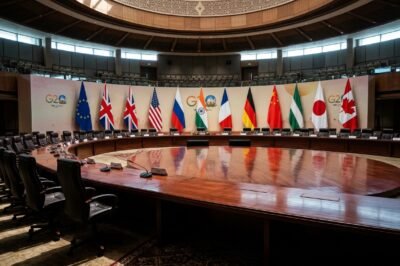
The G20 Foreign Ministers meeting has long been heralded as the premier stage for diplomatic orchestration, where the world’s most influential powers attempt to harmonize their discordant interests. However, the recent gathering served as a stark reminder of the widening chasm in global governance. The traditional family photo—a staple of international summits symbolizing unity and collective resolve—was conspicuously absent. This was not a scheduling conflict or a technical oversight; it was a deliberate, calculated balking by European representatives and their Western allies. The refusal to share a frame with Russian Foreign Minister Sergey Lavrov highlights the visceral tension permeating the forum, where the shadow of the Ukraine conflict has effectively paralyzed the mechanism of consensus. For the host nation, this presented a monumental challenge: how to lead a divided house while advocating for the concerns of the Global South. As we peel back the layers of this diplomatic snub, we find a story not just about a missing photograph, but about the fragmentation of a world order that once prided itself on multilateral cooperation. This analysis explores the intricacies of this standoff and what it portends for the future of international diplomacy, economic stability, and the relevance of the G20 itself in an era of unprecedented polarization.
The Symbolism of the Absent Image: Ritual vs. Reality
In the world of high-stakes international relations, the family photo is far more than a simple souvenir. It is a carefully choreographed performance designed to project a sense of stability and cooperative spirit to the global markets and the public. By standing shoulder-to-shoulder, leaders signal that despite their bilateral disagreements, they remain committed to the collective management of global crises. When this ritual is abandoned, the message is equally powerful: the diplomatic machinery has broken down. The absence of the G20 photo in the latest ministers’ meeting is a loud declaration that the standard rules of engagement have been suspended. The symbolic weight of this omission cannot be overstated, as it marks a transition from a cooperative forum to a confrontational arena where visual association with an adversary is seen as a political liability at home.
European diplomats, particularly those from the G7 nations, have become increasingly wary of the optics surrounding Sergey Lavrov’s presence. For leaders in Berlin, Paris, and London, a photograph with the Russian representative would be interpreted by their domestic electorates as a softening of their stance on the war in Ukraine. In the digital age, where images are stripped of context and weaponized on social media, a single frame can be used as propaganda. Consequently, the decision to forego the photo is a defensive maneuver in the information war, prioritizing domestic political integrity over the traditional requirements of international decorum. This shift reflects a broader trend where domestic politics increasingly dictates the boundaries of international diplomacy, making the G20’s original mandate—global economic stability—secondary to geopolitical positioning.
The European Bloc’s Stance: Red Lines and Moral High Ground
The European refusal to participate in the group photo is rooted in a fundamental shift in their foreign policy doctrine since February 2022. For the European Union and its members, Russia is no longer viewed as a difficult partner but as a fundamental threat to the international order. This perspective makes the traditional pleasantries of a summit not just awkward, but morally untenable. The balking is part of a broader strategy of isolation, where European ministers seek to minimize any engagement that could be construed as a return to business as usual. This principled stand, however, creates significant friction within the G20, which was specifically created to include non-likeminded states to solve global problems.
Furthermore, the European stance is a direct challenge to the concept of neutrality that many other G20 members, particularly those in the Global South, are trying to maintain. By refusing the photo, Europeans are forcing a binary choice on the assembly: either condemn the aggression or accept the breakdown of the forum’s traditions. This puts immense pressure on countries like Brazil, South Africa, and Indonesia, who view the G20 as an economic forum first and a political one second. The European insistence on the moral high ground has effectively created a two-tier system within the G20, where the G7 operates as a cohesive bloc within a larger, increasingly dysfunctional body. This internal fragmentation limits the group’s ability to issue joint communiques, which are the primary output of these meetings.
India’s Balancing Act: The Diplomacy of Decorum
As the host and chair, India faced the unenviable task of managing these deep-seated animosities. Prime Minister Narendra Modi’s government has consistently advocated for a return to the G20’s core focus: the challenges facing developing nations. The Indian presidency sought to pivot the conversation toward food security, fertilizer shortages, and debt distress—issues that disproportionately affect the Global South. However, the shadow of the Ukraine conflict proved impossible to ignore. India’s diplomatic strategy has been one of multi-alignment, maintaining ties with both the West and Russia while positioning itself as the voice of the voiceless. The missing photo was a setback for this agenda, as it signaled that the great power contest was drowning out the developmental narrative.
Despite the lack of a group photo, Indian diplomats worked tirelessly behind the scenes to ensure that the meeting did not end in a total collapse. They focused on achieving consensus on non-controversial topics, such as climate finance and digital public infrastructure. However, the inability to bridge the gap on the Ukraine paragraph in the final summary highlighted the limits of even the most skilled diplomacy. India’s experience serves as a case study for the difficulties faced by middle powers in a multipolar world. When the giants of the international system refuse to even stand in the same room for a photograph, the mediator’s role becomes less about finding solutions and more about damage control. The Indian presidency’s struggle to maintain the G20’s prestige in the face of European-Russian hostility underscores the fragility of the current international architecture.
The Global South Perspective: Collateral Damage
While the headlines focused on the European walkouts and photo snubs, the nations of the Global South watched with increasing frustration. For many countries in Africa, Asia, and Latin America, the G20 is a vital lifeline for addressing the economic shocks caused by the pandemic and the subsequent inflationary crisis. The obsession with the Ukraine conflict and the accompanying diplomatic theatrics are often seen as a European preoccupation that neglects the existential threats of hunger and debt facing the rest of the world. The missing photo is seen by many in the Global South as a sign of Western narcissism, where the inability to manage a regional conflict is allowed to derail global cooperation on systemic issues.
This sentiment is leading to a gradual shift in the perceived legitimacy of the G20. If the forum cannot produce even a symbolic gesture of unity, its ability to reform the IMF or provide debt relief is viewed with skepticism. Nations like South Africa and Brazil are increasingly looking toward other groupings, such as the BRICS, where the agenda is not dominated by the European security architecture. The refusal to take a photo may seem like a minor protocol issue, but it contributes to a narrative of Western obstructionism that the Global South is finding increasingly difficult to tolerate. This creates a vacuum that other powers, particularly China, are more than happy to fill by positioning themselves as the true champions of the developing world’s interests.
Beyond the Photo: Substantive Stalemates on Food and Energy Security
The failure to capture a group photo was reflective of the failure to reach a consensus on the Black Sea Grain Initiative and energy pricing. These are not merely academic debates; they have real-world consequences for millions of people. The G20 was originally formed in the wake of the 1999 financial crisis to prevent a repeat of such systemic failures. Today, however, the weaponization of trade and energy has turned the forum’s agenda into a battlefield. European ministers have argued that there can be no discussion of economic stability without addressing the root cause of the current instability—the war. Russia, conversely, uses the forum to blame Western sanctions for the global economic downturn.
This deadlock means that critical policy initiatives, such as the Common Framework for Debt Treatment, are languishing. As interest rates rise in the West, many developing nations are on the brink of sovereign default. The G20 should be the place where the world’s creditors and debtors come together to find a path forward. Instead, the meetings are increasingly characterized by high-profile snubs and rhetorical flourishes. The cost of this diplomatic paralysis is paid by the world’s poorest, who see no relief from rising food prices or the impacts of climate change. The missing photo is thus a metaphor for a missing consensus on the very survival of the global economic order. When ministers cannot agree on a seating chart or a photo op, the prospect of a coordinated response to a global recession seems remote at best.
Conclusion: The Erosion of the G20’s Existential Purpose
The absence of a group photo at the G20 foreign ministers’ meeting is a watershed moment in contemporary diplomacy. It signals that the era of grand, inclusive multilateralism is giving way to a more fractured, block-based system of international relations. While the European ministers’ decision to balk was based on a specific set of moral and political calculations regarding the Ukraine war, the long-term implications are far-reaching. It suggests that the G20 may no longer be the premier forum for global governance it once was. If the group can no longer function as a space where adversaries meet to solve common problems, it risks becoming a redundant talk shop where each side simply repeats its talking points to a shrinking audience.
Looking ahead, the G20 must find a way to decouple its economic mandate from its members’ geopolitical disputes, or it will continue to fade into irrelevance. The host nations of future summits will need to navigate an even more complex landscape as the rivalry between the U.S. and China intensifies alongside the European-Russian divide. The missing photo in New Delhi was not just a one-off event; it was a symptom of a world that is losing the habit of cooperation. For the G20 to survive, its members must recognize that the challenges of the 21st century—from pandemics to artificial intelligence—require a level of collaboration that transcends their current animosities. Without a return to that basic understanding, the G20 family will continue to be a broken home, unable to even stand together for a single moment in time.




































Leave a Reply