
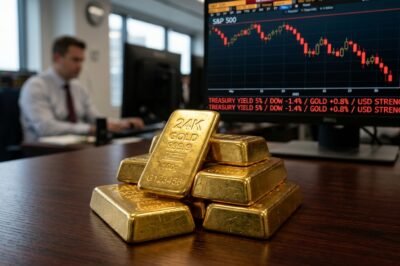
The precious metals market experienced a significant shock today as gold prices tumbled nearly 2%, a move that caught many retail investors off guard despite the growing volatility in global macroeconomics. This decline, highlighted in the latest Kitco AM Report, serves as a stark reminder of gold’s sensitivity to the broader financial environment, specifically the dual pressures of rising energy costs and soaring government bond yields. For months, gold had been attempting to consolidate its position above key psychological levels, but the recent surge in crude oil prices has complicated the inflation narrative. As oil prices climb, the specter of persistent inflation looms larger, leading market participants to recalibrate their expectations regarding the Federal Reserve’s monetary policy path. The immediate reaction has been a sell-off in non-yielding assets like gold, as the opportunity cost of holding the metal rises in tandem with the yield on the U.S. 10-year Treasury note, which is now flirting with the critical 5% threshold. This report delves deep into the mechanics of this price action, examining why the traditional safe-haven appeal of gold is currently being overshadowed by the allure of high-interest-rate environments and the structural shifts in the global energy market. To understand this downturn, one must look at the convergence of geopolitical tension and domestic fiscal realities that are currently dictating the pace of the global economy.
The Economic Squeeze: Understanding the 5% Treasury Yield Milestone
The most immediate catalyst for the gold price drop is the relentless climb of U.S. Treasury yields. When the 10-year Treasury yield approaches the 5% mark, it represents a seismic shift in the financial landscape. This level is not merely a number; it is a psychological and structural barrier that hasn’t been consistently breached in over a decade. For investors, a 5% guaranteed return on a government-backed asset is a formidable competitor to gold. Unlike gold, which provides no dividends or interest, Treasury bonds are now offering a yield that competes with the historical average returns of much riskier assets. This competition creates a massive headwind for bullion, as institutional portfolios shift their allocations toward fixed-income securities to lock in these high rates.
Furthermore, the rise in yields is reflective of a market that is finally taking the Federal Reserve’s ‘higher for longer’ mantra seriously. Earlier in the year, many traders were betting on a pivot or a pause, expecting the central bank to blink in the face of slowing economic data. However, the resilience of the labor market and the stubbornness of core inflation have empowered the Fed to maintain its hawkish stance. As the Kitco AM report suggests, the current sell-off in gold is a direct consequence of the market pricing in at least one more rate hike before the year concludes, or at the very least, the absence of any cuts in the first half of the upcoming year.
Energy Inflation: How Rising Oil Prices Fuel Rate Hike Expectations
Parallel to the bond market turmoil is the significant surge in crude oil prices. As energy costs rise, they permeate every sector of the economy, from manufacturing to transportation and consumer goods. This ‘cost-push’ inflation is particularly difficult for the Federal Reserve to manage because it is driven by supply-side factors, such as OPEC+ production cuts and geopolitical instability in the Middle East. When oil prices surge, it almost guarantees that the Consumer Price Index (CPI) will remain elevated, preventing inflation from returning to the Fed’s 2% target. For gold, this creates a paradoxical situation. Traditionally, gold is an inflation hedge; however, when inflation is driven by energy, it reinforces the need for higher interest rates, which in turn strengthens the U.S. dollar and weakens gold.
The current correlation between oil and gold has turned sharply negative. As investors see oil prices heading toward the $100 per barrel mark, the immediate fear is not the inflation itself, but the central bank’s reaction to it. The expectation that the Fed will have to keep the ‘monetary brakes’ on for a longer period to counteract energy-driven inflation is what is currently depressing the price of gold. In the eyes of the market, the threat of more rate hikes is more potent than the protective qualities of gold against rising prices, leading to the nearly 2% drop seen in today’s trading session.
Technical Breakdown: The Breach of Key Support Levels
From a technical analysis perspective, the 2% drop in gold is particularly concerning because it represents a breach of several key support levels. Traders had been watching the $1,950 and $1,920 levels closely, hoping that these areas would provide a floor for the metal. However, the momentum of the yield surge was too great, and once these levels were broken, a wave of automated sell orders was triggered. This ‘cascading’ effect is common in the gold market, where high-frequency trading algorithms respond to price triggers, accelerating the downward trend. The Kitco AM report highlights that the next major support level sits near the psychological $1,900 mark, and a failure to hold this could lead to a deeper correction toward the 200-day moving average.
Additionally, the Relative Strength Index (RSI) for gold had been showing signs of bearish divergence even before the plunge. This indicator suggested that the previous rallies were losing steam and that a correction was overdue. When combined with the fundamental news of the day, the technical setup was primed for a significant move. Analysts are now looking at the ‘death cross’ potential on the daily charts, where the 50-day moving average crosses below the 200-day moving average, a signal that often precedes a prolonged bearish phase. While gold has shown resilience in the past, the current technical environment suggests that the path of least resistance is currently to the downside.
Investor Sentiment: Safe Haven Status Challenged by a Strong Dollar
The U.S. dollar’s role in this equation cannot be overstated. As the primary reserve currency, the dollar typically has an inverse relationship with gold. Today, as Treasury yields rose, the dollar index (DXY) also saw a significant boost. A stronger dollar makes gold more expensive for holders of other currencies, effectively dampening international demand. This currency pressure, combined with the lack of immediate geopolitical ‘black swan’ events that would typically drive safe-haven buying, has left gold vulnerable. While there are ongoing tensions globally, they have not yet reached a boiling point that outweighs the influence of the Fed and the U.S. economy’s performance.
Moreover, the sentiment among retail investors, often tracked through ETFs like GLD, has turned increasingly cautious. We have seen consistent outflows from gold-backed exchange-traded funds over the last few weeks, indicating that even long-term bulls are taking profits or moving to the sidelines. The narrative has shifted from ‘gold as a necessary hedge’ to ‘cash as a viable alternative.’ With high-yield savings accounts and money market funds offering attractive returns, the urgency to hold gold has dissipated for many. This shift in sentiment is a major headwind that the gold market must overcome if it hopes to see a price recovery in the near term.
The Federal Reserve’s Role: Aggressive Stance vs. Market Reality
The Federal Reserve finds itself in a precarious position, and its communications are the primary driver of market volatility. Recent speeches by Fed officials have leaned toward the hawkish side, emphasizing that the mission to cool the economy is far from over. This rhetoric has bolstered rate-hike expectations, which the Kitco report identifies as a primary cause for the gold sell-off. The central bank’s focus on the ‘dot plot’—the chart showing where officials expect rates to be in the future—suggests that interest rates will remain restrictive well into the next year. This stance is designed to curb demand and lower inflation, but it also creates a difficult environment for non-interest-bearing assets.
The market is now closely watching every piece of economic data, from retail sales to unemployment claims, for signs of how the Fed will act. Any data point that suggests a strong economy is ironically bad for gold, as it provides the Fed with the ‘green light’ to keep rates high. Conversely, only a significant economic slowdown or a financial crisis would likely force the Fed to pivot and provide the spark needed for a gold rally. Until such a shift occurs, the Federal Reserve’s policy remains the single most important factor capping gold’s upside potential and driving the current volatility seen in the Kitco AM reports.
Future Outlook: Strategic Implications for Gold and Global Markets
Looking ahead, the implications of this 2% fall are profound for both short-term traders and long-term investors. In the short term, the market will likely remain volatile as it digests further inflation data and energy price movements. If oil continues its ascent and Treasury yields solidify above 5%, gold could see further liquidations. However, some analysts argue that this correction is a healthy part of a larger cycle. They suggest that once the Fed finally reaches its terminal rate—the point where it stops hiking—gold will find a solid bottom and begin its next leg up. The key will be whether the economy can withstand these high rates without entering a severe recession.
Ultimately, the story of gold in the coming months will be a story of the U.S. dollar and the Federal Reserve’s credibility. If the Fed successfully engineers a ‘soft landing,’ gold might languish as the dollar stays strong. But if the high interest rates trigger a ‘hard landing’ or a systemic banking issue, gold’s safe-haven status will likely be restored with a vengeance. For now, the Kitco AM report serves as a warning: the road to $2,000 gold is paved with significant obstacles, and the current macro-economic environment favors the dollar and the bond market over precious metals. Investors should remain disciplined, keeping a close eye on the 10-year yield and energy prices as the primary indicators of gold’s next major move.






































Leave a Reply