
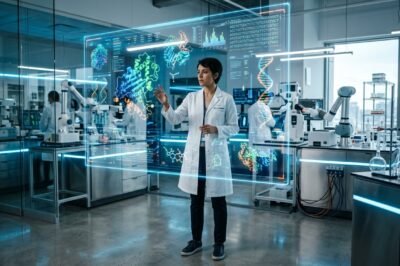
The pharmaceutical landscape is currently navigating one of the most transformative eras in its history, driven by an urgent need to escape the stagnating returns of traditional drug discovery. For decades, the industry has grappled with ‘Eroom’s Law’—the observation that drug discovery is becoming slower and more expensive over time, despite improvements in technology. In this high-stakes environment, scientists are no longer looking at artificial intelligence as a futuristic novelty but as an essential toolkit to solve the most complex puzzles of human biology. The quest for the next generation of therapeutics is being redefined by a demand for precision, speed, and predictive accuracy that human cognition alone cannot achieve. Researchers are calling for AI systems that can sift through billions of molecular combinations, predict toxicological outcomes before a single petri dish is touched, and identify patient subpopulations that will respond best to experimental treatments. This analysis explores the deep-seated desires of the scientific community as they seek to harness the power of machine learning to transition from a serendipity-based discovery model to one of intentional, data-driven design.
Accelerating the Path from Molecule to Medicine
One of the primary desires scientists harbor for AI is the drastic reduction of the drug discovery timeline. Traditionally, the journey from identifying a biological target to launching a Phase I clinical trial can take upwards of five to seven years. Scientists are looking for generative AI models that can function as ‘molecular architects,’ designing de novo ligands with optimized pharmacological properties. By utilizing deep learning algorithms, researchers can simulate how a potential drug interacts with a target protein in a virtual environment, filtering out thousands of unviable candidates in seconds. This ‘in silico’ screening process allows laboratories to focus their resources on the most promising molecules, effectively shortening the lead optimization phase by years. The goal is to move beyond mere pattern recognition and into the realm of predictive synthesis, where AI can suggest the most efficient chemical routes to manufacture a complex molecule, thereby reducing waste and cost.
Furthermore, the integration of AI into high-throughput screening (HTS) is revolutionizing how scientists interpret massive datasets. Modern labs generate terabytes of data daily, often more than a human team can analyze in a lifetime. Scientists want AI that can autonomously identify subtle phenotypic changes in cell cultures that might indicate a drug’s efficacy or toxicity—changes that are often too nuanced for the human eye to detect. This level of automated, high-fidelity analysis is crucial for managing the ‘data deluge’ that characterizes contemporary biopharma. By offloading the burden of manual data processing to intelligent systems, scientists can dedicate more time to experimental design and high-level strategy, fostering a more creative and productive research environment.
The Protein Folding Revolution and Structural Biology
For decades, the ‘protein folding problem’ was considered one of the greatest challenges in biology. Scientists have long sought to understand how a protein’s linear sequence of amino acids folds into a three-dimensional shape, as this structure determines its function and its role in disease. With the advent of tools like AlphaFold, the scientific community has seen a glimpse of what AI can achieve. However, what scientists want now is a deeper, more dynamic understanding of these structures. They are looking for AI that doesn’t just provide a static snapshot of a protein but predicts its conformational changes in real-time as it interacts with other molecules within the cellular environment. This level of ‘4D’ biological modeling would allow for the design of drugs that are much more specific, reducing the likelihood of off-target effects that lead to clinical trial failures.
Moreover, researchers are seeking AI platforms that can bridge the gap between structural biology and genomics. By combining structural data with genetic variants found in diverse populations, scientists can begin to understand why certain drugs work for some individuals but not for others. This requires AI models capable of processing ‘multi-omics’ data—integrating genomics, proteomics, and metabolomics into a unified biological map. The desire is for a holistic digital twin of human physiology that can be used to test hypotheses before moving into animal or human subjects, thereby increasing the ethical and scientific rigor of the entire discovery process.
Revolutionizing Clinical Trial Design and Patient Stratification
The failure rate of clinical trials remains a significant bottleneck in the pharmaceutical industry, with nearly 90% of drug candidates failing during human testing. Scientists are looking to AI to mitigate this risk through better patient stratification and trial design. By analyzing electronic health records (EHRs), genomic data, and real-world evidence, AI can identify patients who are most likely to benefit from a specific intervention. This allows for smaller, more targeted clinical trials that are more likely to reach statistical significance. Scientists want AI to help them move away from the ‘one-size-fits-all’ approach to medicine, enabling the era of truly personalized therapeutics where the right drug is delivered to the right patient at the right time.
In addition to patient selection, there is a growing demand for AI-driven ‘synthetic control arms.’ By using historical trial data and real-world data, scientists can create digital representations of control groups, potentially reducing the number of human participants who need to receive a placebo. This not only speeds up the trial process but also addresses ethical concerns in trials for life-threatening diseases where denying a patient a potentially life-saving treatment is problematic. Scientists want these AI systems to be transparent and validated by regulatory bodies, ensuring that the data produced is as reliable as traditional clinical methods. The integration of AI into the clinical phase promises to make drug development more humane, efficient, and scientifically robust.
Solving the Data Quality and Interoperability Challenge
Despite the potential of AI, scientists are often hindered by the quality and accessibility of data. The pharmaceutical industry is notorious for its ‘data silos,’ where valuable information is trapped within specific departments or legacy systems. Scientists are calling for AI-driven data management solutions that can automatically clean, standardize, and integrate disparate datasets. For an AI model to be effective, it must be trained on high-quality, diverse data. Researchers want tools that can handle ‘dark data’—the results of failed experiments that are rarely published but contain vital information on what does not work. By unlocking this hidden knowledge, AI can prevent scientists from repeating past mistakes and accelerate the collective learning of the industry.
Furthermore, the demand for ‘explainable AI’ (XAI) is paramount in the scientific community. While a ‘black box’ algorithm might accurately predict a drug’s success, scientists need to know *why* it made that prediction to gain regulatory approval and scientific confidence. They want AI systems that provide a clear rationale for their outputs, allowing human experts to verify the biological plausibility of the results. This collaboration between human intuition and machine calculation is essential for building trust in AI-generated hypotheses. The goal is to create a symbiotic relationship where AI enhances human expertise rather than replacing it, ensuring that scientific discovery remains a grounded and verifiable pursuit.
Future Implications: The Dawn of the AI-Native Laboratory
Looking ahead, the ultimate desire of scientists is the creation of an ‘AI-native’ laboratory environment where artificial intelligence is woven into the very fabric of the research process. This future involves autonomous labs where AI systems design experiments, direct robotic platforms to execute them, and analyze the results in a continuous feedback loop. Such a system would be capable of ‘closed-loop’ discovery, operating 24/7 to solve biological challenges at a pace previously thought impossible. As these technologies mature, we can expect a shift from reactive medicine to proactive, preventive care. The implications for global health are profound, with the potential to develop treatments for rare diseases that were previously ignored due to the high cost of traditional research.
However, the realization of this vision will require significant shifts in regulatory frameworks and ethical considerations. Scientists, ethicists, and policymakers must work together to ensure that AI-driven discovery is conducted transparently and equitably. As we stand on the threshold of this new era, the focus remains on the synergy between technological innovation and biological insight. The medicine maker of the future is not just a chemist or a biologist, but a data-savvy scientist who leverages AI to push the boundaries of what is possible, ultimately leading to a world where disease is understood with unprecedented clarity and treated with surgical precision.






































Leave a Reply