
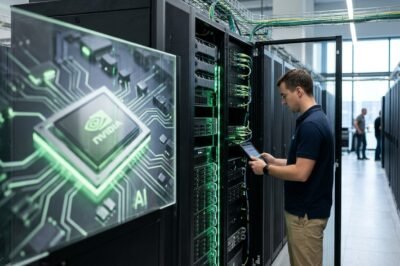
In the high-stakes arena of global finance and semiconductor innovation, Nvidia Corporation continues to stand as the undisputed titan, a fact reinforced by its latest quarterly performance which saw its stock price surge by a remarkable 6 percent. This jump comes on the back of a fiscal forecast that did more than just meet expectations; it shattered them, signaling to the world that the artificial intelligence gold rush is far from reaching its peak. As the primary architect of the hardware powering the generative AI revolution, Nvidia’s financial health has become a bellwether for the entire technology sector and the broader economy. The company’s ability to consistently outpace the most optimistic projections from Wall Street analysts has created a narrative of unstoppable growth, fueled by an insatiable global appetite for high-performance computing power. This latest rally reflects not just confidence in a single company, but a fundamental belief in the transformative potential of AI as the defining industrial shift of the twenty-first century. Investors, analysts, and tech enthusiasts alike watched with bated breath as the results were unveiled, confirming that the demand for the company’s specialized silicon remains at historic levels, regardless of macroeconomic headwinds elsewhere.
Shattering Financial Barriers: A Deep Dive into the Quarterly Figures
The core of Nvidia’s recent success lies in a set of financial figures that would have seemed impossible just a few years ago. During the latest fiscal quarter, the company reported revenue that significantly exceeded the consensus estimates provided by institutional analysts. This performance was driven primarily by the Data Center division, which has become the crown jewel of the organization. As major cloud service providers and enterprise giants scramble to build out their AI infrastructures, the sale of H100 and the newer H200 chips has reached unprecedented levels. The sheer scale of the revenue growth—frequently doubling or tripling year-over-year—highlights a shift in corporate spending priorities where AI investment is prioritized above almost all other capital expenditures.
Furthermore, Nvidia’s gross margins have remained remarkably resilient, hovering around the 75 percent mark. This indicates that despite the complexities of manufacturing some of the most advanced pieces of technology on earth, Nvidia maintains significant pricing power. In the world of semiconductors, where cycles of boom and bust are common, Nvidia has managed to create a unique position where it controls the supply of a commodity that is currently more valuable than gold to the tech industry. The earnings per share (EPS) also saw a significant beat, providing concrete evidence that the company is effectively translating its massive top-line growth into bottom-line profits for its shareholders.
The Blackwell Factor: Anticipating the Next Generation of AI Sovereignty
Much of the forward-looking excitement that drove the 6 percent share jump revolves around the upcoming ‘Blackwell’ architecture. Named after the mathematician David Blackwell, this new platform represents a generational leap in computing performance and energy efficiency. CEO Jensen Huang has described Blackwell as the engine of a new industrial revolution. During the earnings call, management provided crucial updates on the production timeline and the expected revenue contributions from this new line of GPUs. The market reacted positively to the news that Blackwell is currently in full production and that customer demand is vastly outstripping current supply capacity.
The transition from the Hopper architecture to Blackwell is not just a hardware upgrade; it is a total system redesign aimed at reducing the cost and energy footprint of training and deploying massive large language models (LLMs). As companies like OpenAI, Meta, and Google move toward models with trillions of parameters, the efficiency gains promised by Blackwell become essential. Nvidia’s ability to manage this transition without a significant lull in revenue from the outgoing Hopper chips is a testament to its operational excellence and the desperate need for compute power across the industry. The forecast for the coming quarters explicitly incorporates the ramp-up of Blackwell, suggesting that the current growth trajectory has a long runway ahead.
Market-Wide Implications and the Ripple Effect on the Tech Ecosystem
When Nvidia moves, the entire market feels the impact. The 6 percent jump added billions of dollars to Nvidia’s market capitalization, solidifying its position as one of the most valuable companies in the world. However, the impact extends far beyond its own stock ticker. The positive forecast acted as a catalyst for a broader rally in the technology sector, lifting shares of other semiconductor firms, server manufacturers, and software companies that are pivoting toward AI integration. This phenomenon, often referred to as the ‘Nvidia Lift,’ underscores how the company has become an index-moving force, often dictating the direction of the S&P 500 and the Nasdaq 100 on the days it reports earnings.
The broader market implications also touch upon the supply chain. Companies like TSMC, which manufactures Nvidia’s chips, and SK Hynix, which provides the high-bandwidth memory (HBM) required for AI GPUs, are also seeing increased valuation as a direct result of Nvidia’s bullish forecast. Analysts are now looking at the ‘AI ecosystem’ as a whole, noting that Nvidia’s success is a lead indicator for the future profitability of any firm involved in the AI value chain. The fact that Nvidia continues to forecast revenue above estimates suggests that the capital expenditure budgets of ‘Hyperscalers’ like Microsoft, Amazon, and Meta remain robust, easing fears of a near-term bubble in AI spending.
Strategic Dominance in the Data Center and Enterprise Segments
Nvidia’s dominance is most visible in its Data Center segment, which now accounts for the vast majority of its total revenue. This shift from a gaming-centric company to an enterprise powerhouse is one of the most successful corporate pivots in history. The company isn’t just selling chips anymore; it is selling entire AI factories. This includes the InfiniBand and Ethernet networking solutions that allow thousands of GPUs to work in unison, as well as the CUDA software platform that has become the industry standard for AI development. By creating a ‘moat’ through integrated hardware and software, Nvidia has made it incredibly difficult for competitors like AMD or Intel to displace its market share.
Moreover, the enterprise segment is beginning to see a wider adoption of AI beyond just the large tech firms. Industries ranging from healthcare and pharmaceuticals, which use AI for drug discovery, to the automotive sector, which utilizes it for autonomous driving training, are all becoming significant contributors to Nvidia’s order books. This diversification of the customer base is a key reason why the company can forecast such high revenue. It is no longer dependent on a handful of buyers; instead, it is providing the foundational infrastructure for the next era of global productivity. The recent earnings report highlighted this expansion, showing that sovereign AI—countries building their own domestic AI capacity—is also becoming a multi-billion dollar business for the company.
Addressing Potential Risks: Geopolitics and Supply Chain Constraints
Despite the overwhelming positivity, Nvidia’s path is not without its hurdles. One of the most significant risks discussed by analysts in relation to the forecast is the ongoing geopolitical tension, particularly between the United States and China. U.S. export controls on advanced AI chips have limited Nvidia’s ability to sell its most powerful hardware into the Chinese market, which was historically a significant portion of its revenue. While the company has developed modified chips to comply with regulations, the threat of further restrictions remains a constant shadow over its long-term growth prospects. The management’s ability to find new markets to offset potential losses in China has been impressive, but the geopolitical landscape remains a volatile variable.
Supply chain constraints also remain a critical talking point. While Nvidia designs the chips, it relies on partners for manufacturing and packaging. The complexity of ‘CoWoS’ (Chip-on-Wafer-on-Substrate) packaging has been a bottleneck in the past. To meet the aggressive revenue forecasts provided, Nvidia must ensure that its partners can scale their production capacity at an equivalent pace. Any hiccup in the global supply chain, whether due to logistics, raw material shortages, or manufacturing yields, could prevent Nvidia from delivering on its promises. However, the company’s proactive management of its supply partners and its significant cash reserves provide a buffer against these operational risks, giving investors the confidence to push the stock higher.
Conclusion: The Future of Nvidia and the AI-Driven Economy
As we look toward the future, Nvidia’s recent performance and its optimistic revenue forecast suggest that the world is only in the early stages of a massive technological shift. The 6 percent jump in share price is a recognition of the company’s current execution excellence and its strategic positioning for the years to come. With the Blackwell platform set to become the new standard and the expansion of AI into every sector of the economy, Nvidia is well-positioned to remain at the center of the global tech narrative. The company has successfully transitioned from being a component provider to being the architect of the modern AI platform, encompassing hardware, software, and networking.
While challenges such as regulatory scrutiny and intense competition will undoubtedly arise, the momentum behind Nvidia is currently unmatched. The financial world will continue to look at Nvidia as the primary barometer for the health of the tech industry. As long as the company can continue to innovate at its current breakneck pace and the demand for AI remains high, Nvidia’s trajectory appears set to redefine what is possible in the corporate and technological landscape. The latest forecast is not just a set of numbers; it is a bold statement that the AI era is here to stay, and Nvidia is leading the charge.





































Leave a Reply