
Introduction: A Morning of Chaos in Bangkok
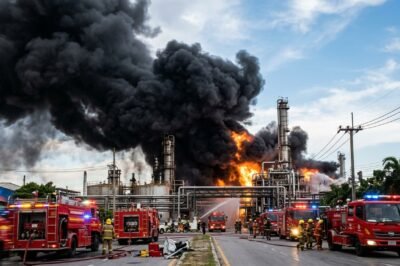
The morning sky over Bangkok was transformed into a canvas of dark, ominous gray as a massive explosion ripped through one of the city’s primary oil facilities, sending shockwaves across the metropolitan area and the global energy sector alike. Witnesses described a deafening roar followed by a visible wall of flame that climbed hundreds of feet into the air, a stark reminder of the volatile nature of urban industrial zones. As emergency sirens wailed across the Phra Khanong district, the immediate priority became the containment of a blaze that threatened not just the facility itself, but the delicate balance of the regional fuel supply chain. This incident, occurring at a critical juncture for the Thai economy, serves as a harrowing wake-up call for industrial safety standards in rapidly developing Southeast Asian nations. Beyond the immediate chaos, the explosion has triggered an instantaneous reaction in the financial markets, where energy futures spiked in anticipation of supply disruptions. As news crews and first responders swarmed the site, the world watched with bated breath, questioning how such a significant failure could occur in a facility long touted for its modern safety protocols and strategic importance to the kingdom’s energy security.
The scale of the disaster is difficult to overstate, as the facility in question serves as a central hub for refining and distribution within the heart of Thailand. Initial reports suggest that the blast occurred near a storage tank farm, a location that houses millions of liters of highly flammable petroleum products. The resulting inferno required the mobilization of over fifty fire engines and specialized hazardous material units from across the city. As smoke plumes became visible from as far away as the Suvarnabhumi Airport, the social and economic impact began to ripple through the city, leading to massive traffic congestion and the temporary closure of nearby transit lines. This detailed analysis explores the multifaceted consequences of the Bangkok explosion, ranging from the immediate humanitarian response to the long-term shifts in global energy policy and market stability.
Initial Reports and Immediate Emergency Response
The explosion occurred at approximately 10:30 AM local time, a period when the facility was at full operational capacity. Early accounts from workers on-site indicate that a pressure malfunction may have preceded the ignition, though official confirmation remains pending. Within minutes of the primary blast, secondary explosions were heard, complicating the efforts of first responders who were forced to maintain a safe distance due to the intense radiant heat. The Bangkok Metropolitan Administration immediately activated its highest level of emergency protocols, establishing a two-kilometer exclusion zone around the perimeter of the facility to protect residents from potential toxic fumes and further debris.
Firefighting efforts were significantly hampered by the nature of the fuel involved. Standard water-based suppression was insufficient, requiring the deployment of thousands of gallons of specialized aqueous film-forming foam (AFFF) to blanket the burning tanks and cut off the oxygen supply. The logistics of transporting such vast quantities of foam through Bangkok’s notoriously congested streets posed a significant challenge, highlighting the need for localized emergency caches in industrial zones. Local hospitals were placed on high alert, preparing for a potential influx of casualties suffering from burn injuries and smoke inhalation, while evacuation centers were rapidly established in nearby schools and community centers.
Despite the ferocity of the fire, the bravery of the initial response teams prevented a total catastrophe. By creating firebreaks and cooling adjacent storage tanks with continuous water curtains, emergency crews managed to isolate the blaze to a specific sector of the refinery. However, the complexity of the operation meant that the fire continued to burn for several hours, with thick black smoke casting a shadow over the city’s skyline. This incident underscores the critical importance of rapid-response training and the integration of high-tech monitoring systems that can alert authorities to anomalies before they escalate into full-scale disasters.
Impact on Regional and Global Energy Markets
The energy markets reacted with characteristic volatility as news of the Bangkok explosion hit the wires. Thailand, being a significant consumer and refiner of petroleum in Southeast Asia, plays a pivotal role in the regional supply chain. The sudden loss of capacity at a major facility immediately raised concerns regarding fuel shortages and price hikes. In the hours following the blast, Brent crude futures saw a notable uptick as traders assessed the potential for prolonged downtime at the refinery. This facility provides a substantial portion of the jet fuel and diesel used by the country’s transport and aviation sectors, meaning any significant disruption could have a cascading effect on regional commerce.
Financial analysts are particularly concerned about the refinery’s role in the production of high-value petrochemicals. If the damage to the distillation units is as extensive as early aerial footage suggests, the facility could be offline for months, forcing Thailand to increase its reliance on refined product imports from neighboring Singapore and India. This shift would not only increase the cost of energy for local consumers but also strain the regional tanker market, potentially leading to higher shipping rates. For investors, the explosion serves as a reminder of the ‘tail risk’ inherent in energy infrastructure, where a single localized event can disrupt global pricing mechanisms.
Furthermore, the explosion has prompted a sell-off in the stocks of major Thai energy conglomerates. Market participants are wary of the potential for massive insurance claims and the heavy capital expenditure required for reconstruction. There is also the matter of regulatory fines and the cost of implementing new, more stringent safety mandates that are likely to follow in the wake of such a public disaster. As the situation evolves, the focus will shift from immediate price spikes to the long-term structural impact on Thailand’s energy independence and its standing as a regional industrial powerhouse.
Environmental Concerns and Public Health Advisory
One of the most pressing issues in the aftermath of the explosion is the environmental degradation caused by the massive release of combustion byproducts. The thick black smoke billowing from the refinery is rich in particulate matter (PM2.5), sulfur dioxide, and nitrogen oxides, all of which pose severe health risks to the millions of people living in the Bangkok metropolitan area. The Thai Ministry of Public Health issued an urgent advisory, urging residents to stay indoors, seal their windows, and wear N95 masks if they must go outside. The long-term health implications of inhaling such concentrated industrial pollutants are a major concern for local health officials.
Beyond air quality, there is the significant threat of water contamination. The millions of gallons of water and chemical foam used to combat the fire eventually drain into the city’s complex canal system and, potentially, the Chao Phraya River. These runoff fluids are often contaminated with hydrocarbons and toxic firefighting chemicals, which can devastate local aquatic ecosystems and contaminate the water supply for downstream communities. Environmental agencies are currently scrambling to deploy booms and filtration systems to contain the runoff, but the sheer volume of water used makes total containment an uphill battle.
The explosion also raises questions about the long-term viability of housing such large-scale industrial operations in close proximity to residential areas. Bangkok’s rapid urbanization has seen residential developments creep closer to industrial zones that were once on the outskirts of the city. This ‘encroachment’ increases the human cost of industrial accidents and complicates emergency evacuation procedures. Moving forward, there will likely be intense pressure on the government to relocate hazardous facilities or at least establish much larger buffer zones to protect the public from the inevitable risks associated with oil and gas processing.
Investigative Focus: Determining the Root Cause
As the smoke clears, the focus of the international community and local authorities is shifting toward a comprehensive investigation into the root cause of the explosion. Speculation has ranged from mechanical failure of a high-pressure valve to a potential breach in safety protocols during a maintenance cycle. Forensic engineering teams are expected to begin their work as soon as the site is declared cool enough for entry. Their investigation will involve a meticulous review of the facility’s SCADA (Supervisory Control and Data Acquisition) logs, which record every pressure change, temperature fluctuation, and valve movement leading up to the event.
Key to this investigation will be the facility’s maintenance records. In many industrial accidents, it is later discovered that minor warnings or ‘near-misses’ were overlooked in the pursuit of operational efficiency. Investigators will be looking for signs of metal fatigue, corrosion in the piping, or failures in the emergency shutdown systems (ESD) that were designed to prevent exactly this type of catastrophe. There is also the human element to consider; interviews with control room operators and field technicians will be crucial in understanding whether there were any manual errors or if the automated systems failed to provide adequate warning.
The findings of this investigation will have implications far beyond Thailand. International safety bodies, such as the American Petroleum Institute (API) and the International Association of Oil & Gas Producers (IOGP), will be watching closely. Any new insights into equipment failure or procedural gaps will likely be incorporated into global safety standards. For the operators of the Bangkok facility, the investigation represents a moment of extreme legal and reputational risk, as any proof of negligence could lead to massive lawsuits and the permanent revocation of their operating licenses.
Broader Economic Consequences for Thailand’s Industry
The explosion at the Bangkok oil facility is not just an energy crisis; it is an economic challenge for the entire nation. Thailand has spent decades positioning itself as the ‘Detroit of the East’ and a hub for high-tech manufacturing. These industries rely heavily on a stable and affordable energy supply. A disruption of this magnitude could lead to increased operational costs for manufacturers, potentially making Thai exports less competitive on the global stage. Furthermore, the volatility in the energy sector can lead to fluctuations in the Thai Baht, adding another layer of complexity for businesses involved in international trade.
Tourism, a cornerstone of the Thai economy, could also feel the pinch. While the explosion was localized, the imagery of a burning capital city can deter international travelers, particularly those sensitive to environmental and safety concerns. If fuel prices for domestic flights and transport increase, the cost of travel within the kingdom will rise, potentially slowing the recovery of a sector that is still finding its feet after years of pandemic-related disruptions. The government’s response to this crisis will be a litmus test for its ability to manage large-scale industrial disasters without compromising the broader economic health of the nation.
Investors are also looking at the ‘Environmental, Social, and Governance’ (ESG) implications of this event. In an era where institutional investors are increasingly focused on sustainability and safety, a major industrial disaster can lead to a downgrade in a company’s or even a country’s ESG rating. This, in turn, can lead to higher borrowing costs and a reduction in foreign direct investment. To mitigate this, the Thai government and the energy sector must demonstrate a transparent and aggressive approach to safety reform, proving that they can balance industrial growth with the safety of their citizens and the environment.
Conclusion: Future Implications and Safety Policy Reforms
In conclusion, the explosion at the Bangkok oil facility is a watershed moment for the energy industry in Southeast Asia. While the immediate focus remains on fire suppression and public safety, the long-term implications will reshape the regulatory landscape for years to come. We can expect to see a significant push for more stringent safety inspections, the mandatory adoption of advanced leak detection technologies, and a complete re-evaluation of the zoning laws that allow industrial facilities to operate near high-density urban centers. The ‘business as usual’ approach to industrial safety is no longer tenable in a world where the social and economic costs of failure are so high.
The road to recovery for the Bangkok facility will be long and arduous, involving not just physical reconstruction but the rebuilding of public trust. For the global community, this incident serves as a stark reminder of the fragile nature of our energy infrastructure and the constant vigilance required to maintain it. As we move toward a more complex and interconnected energy future, the lessons learned from the smoke-filled skies of Bangkok will be essential in preventing the next disaster. The integration of artificial intelligence in monitoring, the transition to safer energy storage solutions, and the strengthening of international safety partnerships are no longer optional; they are the necessary foundations of a resilient global energy system.





































Leave a Reply