
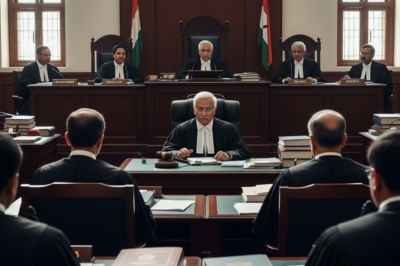
The legal landscape of India stands at a critical juncture as the Supreme Court continues its deliberations on the landmark Sabarimala reference case. This case, which has captivated the nation’s attention, transcends the mere entry of women into a temple; it probes the very heart of the Indian Constitution, questioning the balance between individual fundamental rights and the collective rights of religious denominations. As a 9-judge Constitution Bench led by the Chief Justice of India hears arguments, the outcome promises to redefine the boundaries of judicial intervention in “essential religious practices.”
The Evolution of the Reference: From 2018 to the 9-Judge Bench
The origins of the current proceedings date back to the historic 2018 judgment, where a 5-judge bench, in a 4:1 majority, struck down the traditional prohibition on women of menstruating age entering the Lord Ayyappa temple at Sabarimala. However, the subsequent flood of review petitions led to a unique legal turn. Instead of simply reviewing the 2018 order, the Supreme Court decided to refer certain overarching “questions of law” to a larger bench.
The 9-judge bench is now tasked with interpreting the interplay between Article 25 (Freedom of conscience and free profession, practice, and propagation of religion) and Article 26 (Freedom to manage religious affairs). The core of the debate rests on whether the “morality” mentioned in these articles refers to constitutional morality or individual/religious morality. This distinction is vital because it determines if a court can override long-standing religious traditions in favor of modern egalitarian principles.
Key Legal Questions: Judicial Intervention and Essential Practices
One of the most contentious points being debated in the Supreme Court is the “Essential Religious Practices” (ERP) doctrine. For decades, Indian courts have taken it upon themselves to determine what constitutes an “essential” part of a religion. The Sabarimala reference seeks to clarify if the judiciary should have the authority to decide such matters or if the religious community should have the final word.
Furthermore, the bench is examining the scope of “religious denominations.” If the Ayyappa devotees are considered a separate denomination under Article 26, they may claim greater autonomy in managing their internal affairs, including the preservation of ancient customs. The court’s decision will not only affect Sabarimala but will also set a precedent for other pending cases, including:
- The entry of women into mosques.
- The rights of Parsi women who marry outside their community to enter the Fire Temple.
- The legality of Female Genital Mutilation (FGM) in the Dawoodi Bohra community.
The Broader Impact: Shaping India’s Secular Fabric
As the legal arguments unfold, the proceedings highlight a profound tension in Indian secularism. On one side are advocates for gender equality and constitutional supremacy, arguing that no tradition should survive if it violates the dignity of individuals. On the other side are traditionalists who argue that religious diversity requires the state to maintain a hands-off approach to sacred rituals that do not harm public order, health, or morality.
The final verdict from this 9-judge bench will likely become one of the most cited authorities in Indian constitutional history. It will dictate how the state engages with faith for decades to come. For now, the legal community and the public at large remain tuned into the live updates from the Supreme Court, awaiting a decision that will bridge the gap between ancient faith and modern law.
Stay tuned to AlwaysFirst.co.in for more in-depth analysis and the latest updates on the Supreme Court’s most critical judgments.




































Leave a Reply