
The Loneliest Traveler: A Prelude to the Final Frontier
In the vast, silent expanse of interstellar space, over 15 billion miles from Earth, a small, aging pioneer continues its journey. Voyager 1, launched in 1977, is the furthest man-made object in existence. It has traveled beyond the protective bubble of our sun—the heliosphere—and is now exploring the mysterious realm between the stars. However, as the spacecraft enters its 47th year of operation, its survival is becoming an increasingly complex engineering challenge. Recently, NASA engineers had to make a heartbreaking but necessary decision: to turn off one of the spacecraft’s remaining science instruments. This move is part of a desperate, high-stakes effort to manage a dwindling power supply and keep the mission operational for as long as possible. The news, originally highlighted by outlets like The Verge, underscores the reality that Voyager 1 is on borrowed time, yet its contributions to science remain as vital as ever.
The Dwindling Heart: Understanding Voyager’s Nuclear Power Supply
To understand why NASA is shutting down instruments, one must first understand how Voyager 1 generates power. Unlike satellites closer to home that rely on solar panels, Voyager 1 is far too distant from the sun to use solar energy. Instead, it relies on three Radioisotope Thermoelectric Generators (RTGs). These devices convert the heat generated by the natural decay of plutonium-238 into electricity. When Voyager 1 launched, these RTGs provided about 470 watts of power. However, plutonium-238 has a half-life of about 87.7 years, and the thermocouples that convert the heat into electricity also degrade over time. Today, the power output is decreasing by about 4 watts every year. NASA engineers have already turned off all non-essential systems, including heaters that keep the instruments warm in the sub-zero temperatures of space. Now, they are forced to choose between the science instruments themselves. The goal is to extend the mission’s life until at least 2027—the 50th anniversary of its launch—and hopefully into the 2030s.
The Latest Sacrifice: The Plasma Science (PLS) Instrument
The most recent instrument to be powered down is the Plasma Science (PLS) instrument. For decades, the PLS played a crucial role in the mission, particularly in determining when Voyager 1 officially crossed the heliopause and entered interstellar space in 2012. The PLS measures the speed, density, temperature, and pressure of the plasma (ionized gas) flowing from the sun, known as the solar wind. While the instrument was instrumental in defining the boundaries of our solar system, its utility has decreased in recent years. Because of the spacecraft’s orientation and the nature of the interstellar medium, the PLS was only able to collect useful data at specific intervals. After a careful assessment, the mission team decided that the power saved by turning off the PLS was more valuable than the limited data it was still providing. By shutting it down, engineers can ensure that the remaining four instruments—which measure magnetic fields, cosmic rays, and charged particles—can continue to function for several more years.
Overcoming the ‘Age Gap’: Engineering Feats from 15 Billion Miles Away
Maintaining Voyager 1 is not just a matter of power management; it is a battle against aging hardware and obsolete technology. Earlier in 2024, Voyager 1 experienced a significant technical glitch that nearly ended the mission. The Flight Data Subsystem (FDS), which packages science and engineering data before it is sent to Earth, began sending back a garbled, repetitive pattern of ones and zeros. For months, the mission seemed lost. However, through sheer brilliance and persistence, the team at NASA’s Jet Propulsion Laboratory (JPL) discovered that a single chip responsible for storing a portion of the FDS memory had failed. Because they couldn’t physically replace the chip, they had to rewrite the spacecraft’s code and distribute it across other parts of the system—a task complicated by the fact that the computer systems on Voyager 1 use assembly language and have less memory than a modern car key. This recovery was hailed as one of the greatest engineering saves in space history, proving that even with 1970s technology, human ingenuity can bridge the gap across the solar system.
The Communication Delay: A 45-Hour Conversation
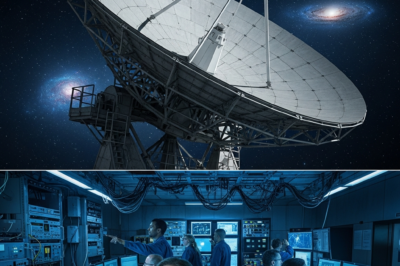
One of the most mind-bending aspects of managing Voyager 1 is the communication lag. Because the spacecraft is so far away, radio signals traveling at the speed of light take approximately 22.5 to 23 hours to reach the probe. This means that if an engineer sends a command on a Monday morning, they won’t know if it worked until Wednesday morning. This 45-hour round-trip delay makes every adjustment a high-stakes gamble. Engineers must be incredibly precise, as a single error could inadvertently shut down the spacecraft permanently. To maintain this connection, NASA utilizes the Deep Space Network (DSN), a global array of massive radio antennas. The DSN is the only infrastructure on Earth capable of picking up the incredibly faint signals from Voyager’s 20-watt transmitter—roughly the same power as a refrigerator light bulb—which have been weakened by the vast distance of space.
The Scientific Legacy of the Interstellar Frontier
Why do we keep fighting for Voyager 1? The answer lies in the uniqueness of the data it provides. Voyager 1 and its twin, Voyager 2, are the only spacecraft currently operating in interstellar space. Every bit of data they send back is a ‘first’ for humanity. They are teaching us about the ‘breath’ of the sun—how the solar wind interacts with the interstellar medium. They are measuring the intensity of cosmic rays that never reach Earth because of our magnetic field. They are helping us understand the shape and nature of the heliosphere, which acts as a shield for our entire solar system. Without Voyager 1, our understanding of the environment outside our solar bubble would be based entirely on models and distant observations rather than direct, in-situ measurements. The loss of any instrument is a blow to science, but the preservation of the core mission ensures that we continue to peer into the dark unknown for as long as possible.
The Long Goodbye: What Happens When the Power Runs Out?
Eventually, the laws of physics will win. By the early 2030s, it is likely that Voyager 1 will no longer have enough power to run even a single science instrument. At that point, the mission will transition into a final phase where only engineering data is transmitted, and eventually, even that will cease. However, the end of communication does not mean the end of the mission. Voyager 1 will continue its silent journey through the Milky Way. On its side, it carries the famous Golden Record—a copper phonograph record containing sounds and images selected to portray the diversity of life and culture on Earth. It is a time capsule intended for any intelligent extraterrestrial life that might find it in the distant future. Even when the lights go out on Earth’s end, Voyager 1 will remain a silent ambassador, traveling for millions of years, carrying the story of a small blue planet and the people who dared to reach for the stars. The recent instrument shutdown is merely a tactical retreat in a grander strategy to keep our furthest scout alive as long as humanly possible.







































Leave a Reply