
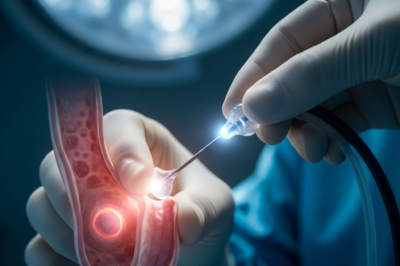
The landscape of modern oncology is witnessing a monumental shift, driven by the convergence of material science and biomedical engineering. At the forefront of this transformation is the Indian Institute of Technology Gandhinagar (IITGN), where a team of researchers has recently unveiled a groundbreaking innovation that promises to redefine the standards of colon tumour surgery. The development of a novel, self-healing hydrogel marks a significant leap forward in addressing the complexities of Endoscopic Mucosal Resection (EMR), a common but technically demanding procedure used to remove pre-cancerous and early-stage cancerous growths in the colon. As colorectal cancer rates continue to rise globally, particularly among younger demographics, the need for safer, more efficient surgical tools has never been more urgent. This breakthrough from IIT Gandhinagar not only simplifies a high-stakes medical procedure but also embodies the potential of indigenous Indian research to solve global healthcare challenges. By providing a stable, long-lasting cushion for surgeons to work with, this hydrogel reduces the risks of complications such as internal bleeding and intestinal perforation, effectively paving the way for better patient outcomes and more streamlined hospital workflows.
Understanding the Challenges of Traditional Colon Tumour Surgery
To appreciate the significance of the IIT Gandhinagar breakthrough, one must first understand the intricacies of Endoscopic Mucosal Resection (EMR). Colorectal cancer often begins as small growths known as polyps. If detected early, these polyps can be removed endoscopically, avoiding the need for invasive open surgery. During EMR, a liquid is injected into the submucosal layer of the colon wall, directly beneath the tumour. This injection creates a ‘cushion’ or a ‘fluid lift,’ which separates the diseased tissue from the underlying muscular layer. This separation is crucial; it allows the surgeon to snare and remove the tumour without damaging the delicate muscle wall of the colon. However, the traditional lifting agents used in this process, such as saline solutions, come with significant limitations. Saline is absorbed by the body very quickly, often within minutes. This rapid dissipation causes the cushion to collapse prematurely, forcing the surgeon to re-inject fluid multiple times throughout the procedure. Not only does this prolong the surgery, but it also increases the risk of ‘flat’ resections, where the lack of a proper lift makes it difficult to distinguish between healthy and cancerous tissue, leading to incomplete tumour removal or accidental perforation of the colon wall.
The Science Behind the Breakthrough: What is this Hydrogel?
The research team at IIT Gandhinagar, led by Professor Sivapriya Kirubakaran and her dedicated colleagues, sought to overcome these limitations by engineering a substance that could maintain its structure for an extended duration. The result is a peptide-based, self-healing hydrogel. At its molecular level, the hydrogel is composed of short chains of amino acids that are designed to self-assemble into a complex three-dimensional network. One of the most remarkable properties of this material is its ‘shear-thinning’ capability. This means that under the pressure of being pushed through a fine surgical needle, the gel behaves like a liquid, flowing easily into the submucosal space. However, once the pressure is released and the gel settles under the tumour, it instantly regains its gel-like consistency. This ‘self-healing’ nature allows the material to reform its internal structure after being disturbed, ensuring that the cushion remains firm and localized. Unlike saline, which is watery and transient, this hydrogel provides a stable, high-viscosity elevation that can last for hours, giving surgeons an unprecedented window of time to perform precise excisions without the constant pressure of a receding cushion.
Comparative Analysis: Existing Solutions vs. IIT Gandhinagar’s Innovation
In the current medical market, there are other viscous agents used for EMR, such as hyaluronic acid or hydroxypropyl methylcellulose. While these are superior to saline, they are often prohibitively expensive or difficult to prepare in a clinical setting. Furthermore, some existing synthetic polymers can trigger inflammatory responses or are not easily biodegraded by the body after the surgery is complete. The IIT Gandhinagar hydrogel addresses these gaps through its inherent biocompatibility. Since it is based on natural peptides, the body can break it down safely and naturally once its purpose is served. In comparative studies, the hydrogel demonstrated a significantly higher ‘lift’ duration than conventional agents. While saline might provide a lift for 5 to 10 minutes, the IITGN hydrogel can maintain the elevation for a duration that comfortably covers the entirety of a complex resection. This stability is a game-changer for surgeons, as it provides a clear, consistent view of the surgical field, minimizing the guesswork and the physical fatigue associated with repetitive re-injections.
Methodological Excellence and Rigorous Testing
The development of this hydrogel was not an overnight success but the result of years of interdisciplinary research. The researchers conducted extensive testing to ensure the material’s efficacy and safety. The study involved analyzing the rheological properties of the gel—studying how it deforms and flows under various conditions—to perfect the shear-thinning and self-healing mechanisms. Biocompatibility tests were a cornerstone of the research, ensuring that the hydrogel does not cause toxicity or adverse immune reactions when in contact with human tissue. Furthermore, the team performed ‘ex vivo’ testing, using animal tissue models to simulate the conditions of a human colon. These tests confirmed that the hydrogel could effectively lift mucosal tissue and withstand the manipulations of surgical tools. The precision with which the gel can be placed and the reliability of the lift it provides were consistently validated across multiple trials, establishing a robust scientific foundation for its eventual transition into clinical practice.
The Impact on Global Oncology and Surgical Procedures
The implications of this breakthrough extend far beyond the laboratory. On a global scale, colorectal cancer is the third most common cancer and the second leading cause of cancer-related deaths. In India, the incidence is rising due to changing dietary habits and lifestyle factors. By simplifying the EMR procedure, the IIT Gandhinagar hydrogel has the potential to make early-stage cancer treatment more accessible. When a surgery is simplified, it becomes faster; when it is faster, hospitals can treat more patients in a single day. Moreover, reducing the complexity of the procedure lowers the barrier for less experienced surgeons to perform these resections with a higher degree of safety. The reduction in complications like perforation is perhaps the most significant benefit. Intestinal perforation during an endoscopy is a life-threatening emergency that requires immediate open surgery and long-term hospitalization. By virtually eliminating the ‘sinking’ cushion problem, this hydrogel provides a safety buffer that protects patients from such catastrophic outcomes, thereby reducing the overall cost of healthcare and improving recovery times.
Bridging the Gap Between Engineering and Medicine at IIT Gandhinagar
This achievement highlights the critical role of the Indian Institutes of Technology (IITs) in the nation’s healthcare ecosystem. Traditionally known for engineering and technology, institutions like IIT Gandhinagar are increasingly focusing on ‘MedTech’—the intersection of technology and medicine. This project was a collaborative effort that required expertise in organic chemistry, molecular biology, and mechanical engineering. It underscores the importance of interdisciplinary research environments where scientists can look at a medical problem through the lens of material science. The success of the hydrogel project also aligns with the ‘Make in India’ initiative, demonstrating that high-end medical innovations can be conceptualized and developed domestically. By reducing reliance on expensive imported medical supplies, such indigenous breakthroughs can make advanced healthcare more affordable for the Indian population while also positioning India as a hub for global medical innovation.
Future Prospects: From Lab to Bedside
While the initial results are incredibly promising, the journey from a laboratory breakthrough to a standard hospital procedure involves several more steps. The next phase for the IIT Gandhinagar team involves large-scale clinical trials to satisfy regulatory requirements and confirm the gel’s performance in human patients. There is also the potential to adapt this hydrogel technology for other medical applications. For instance, the same self-healing and injectable properties could be used for drug delivery systems, where the gel acts as a reservoir, releasing medication slowly over time at a specific site in the body. It could also find uses in wound healing or tissue engineering. As the team moves toward commercialization, partnerships with pharmaceutical companies and medical device manufacturers will be essential to scale up production and distribute this technology to hospitals worldwide. The horizon looks bright for this innovation, and it stands as a testament to the power of scientific curiosity and its ability to save lives.
Conclusion
The development of the self-healing hydrogel by IIT Gandhinagar is more than just a scientific curiosity; it is a vital tool in the fight against colon cancer. By addressing the fundamental physical limitations of traditional surgical lifting agents, the researchers have created a solution that is elegant, effective, and inherently safe. As we move into an era where minimally invasive procedures are the preferred choice for both patients and doctors, innovations like this will be the cornerstones of modern medicine. This breakthrough not only promises to make colon tumour surgeries safer and more efficient but also serves as an inspiring example of how dedicated research can lead to tangible improvements in human health. The world will be watching closely as this technology moves toward clinical adoption, hopeful for a future where cancer surgery is less daunting and more successful for everyone.






































Leave a Reply