
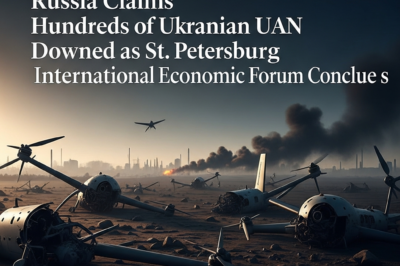
The geopolitical landscape of Eastern Europe continues to shift with tectonic intensity as the Russian Ministry of Defense recently announced a staggering success in neutralizing a massive wave of Ukrainian unmanned aerial vehicles (UAVs). This surge in aerial activity coincided precisely with the conclusion of the 27th St. Petersburg International Economic Forum (SPIEF), an event designed to showcase Russia’s economic resilience and pivot toward global partners in the Global South and East. As high-ranking officials and international business leaders gathered in Russia’s secondary capital, the skies above the border regions and deep within Russian territory became a chaotic theater of modern electronic warfare and kinetic interception. According to official Kremlin statements, hundreds of Ukrainian drones were intercepted or brought down through a combination of sophisticated air defense systems and advanced electronic jamming techniques. This escalation underscores a significant shift in the conflict’s methodology, moving away from traditional frontline trench warfare toward high-tech attrition that seeks to destabilize the home front and cripple vital economic infrastructure. The timing of the attack—aligned with a major diplomatic and economic summit—suggests a calculated attempt by Kyiv to signal the vulnerability of the Russian state even as Moscow attempts to project an image of internal stability and growth. This article delves into the technical, political, and strategic ramifications of this massive drone engagement and what it portends for the future of the ongoing war.
The Scale of the Aerial Assault: Numbers and Tactics
The reported scale of the drone wave is among the largest seen since the inception of the full-scale conflict in 2022. Russian military sources have indicated that over the course of a 48-hour window, air defense units engaged targets across several regions, including Belgorod, Kursk, Voronezh, and even areas closer to the Leningrad region surrounding St. Petersburg. The diversity of the drones utilized in this operation highlights Ukraine’s rapidly maturing UAV industry. Analysts suggest that the swarm consisted of a mixture of small, agile First Person View (FPV) drones designed for tactical strikes against localized military targets, and larger, fixed-wing long-range loitering munitions capable of traveling hundreds of kilometers. These long-range assets are increasingly being used to target critical infrastructure, such as oil refineries, ammunition depots, and transportation hubs. By launching these drones in massive clusters, the Ukrainian forces aim to overwhelm the capacity of Russian surface-to-air missile (SAM) systems. In a classic saturation attack strategy, cheaper decoys are often used to draw fire and deplete expensive interceptor missiles, allowing more capable strike drones to penetrate the defensive perimeter. The Russian Defense Ministry’s claim of hundreds of successful downings suggests a high level of alert for the duration of the SPIEF, likely involving the deployment of additional Pantsir-S1 and S-400 units to protect the St. Petersburg periphery and the transit routes of international dignitaries.
St. Petersburg International Economic Forum: Business as Usual Amidst Conflict?
The St. Petersburg International Economic Forum has long been dubbed the ‘Russian Davos,’ serving as the premier platform for the Kremlin to attract foreign investment and articulate its economic vision. This year’s forum was particularly symbolic, as President Vladimir Putin sought to demonstrate that Western sanctions have failed to isolate the Russian economy. With delegations from China, India, the Middle East, and various African nations in attendance, the forum focused on ‘sovereign development’ and the creation of a multipolar financial system. However, the shadow of the drone campaign loomed large over the proceedings. While the forum halls were filled with discussions on AI, digital currencies, and Eurasian logistics, the military reality was just a few hundred miles away. The juxtaposition of luxury gala dinners and the high-tech defense of the Russian airspace highlights the duality of modern Russia: a nation attempting to maintain a facade of normalcy and prosperity while being fully mobilized for a protracted conflict. The drones were not just military tools; they were psychological instruments intended to disrupt the narrative of Russian invincibility that the SPIEF aims to project. Despite the reported interceptions, the mere fact that such a large-scale attempt was made during the forum sends a message to the international community about the ongoing risks associated with the Russian market and the volatility of the region’s security architecture.
The Evolution of Ukrainian Drone Capabilities and Indigenous Production
Ukraine’s ability to launch hundreds of drones in a single operation is a testament to the radical transformation of its defense industry. Early in the war, Ukraine relied heavily on imported platforms like the Turkish Bayraktar TB2. Today, the landscape is dominated by domestic production, fueled by a decentralized network of hundreds of private companies and volunteer groups working in tandem with the Ministry of Strategic Industries. This ‘Army of Drones’ initiative has successfully developed long-range platforms such as the ‘Bober’ (Beaver) and the ‘Lyutyi,’ which have demonstrated the range to strike deep into the Russian heartland. The technical sophistication of these drones has also increased, with many now incorporating AI-driven terminal guidance systems that allow them to strike targets with high precision even in the face of intense electronic jamming. Furthermore, Ukraine has adapted its tactics to include the use of ‘mothership’ drones—larger UAVs that carry smaller FPV drones closer to the target before releasing them, effectively extending the range of tactical strikes. This indigenous innovation is a critical component of Ukraine’s strategy of asymmetric warfare, allowing it to strike back at a numerically superior enemy by targeting the economic engines that fund the Russian military machine. The recent surge indicates that the production pipelines are now capable of generating the volume required for sustained, high-intensity aerial campaigns.
Russian Defense Systems: Electronic Warfare and the Electronic Umbrella
In response to the growing drone threat, Russia has significantly reinforced its Electronic Warfare (EW) capabilities, which are widely considered some of the most advanced in the world. The Russian military utilizes a tiered defense system that begins with long-range radar detection and moves to electronic disruption before concluding with kinetic interception. Systems like the Krasukha-4 and the Pole-21 are designed to jam GPS signals and disrupt the communication links between the drone and its operator, often causing the UAV to lose its way or crash. In the recent engagements, the Russian Defense Ministry highlighted the role of these ‘electronic umbrellas’ in neutralizing a significant portion of the Ukrainian swarm without firing a single missile. However, the effectiveness of EW is a constant cat-and-mouse game. As Ukrainian drones become more autonomous and less reliant on external signals, the Russian military must constantly update its software and deployment patterns. Beyond EW, the kinetic layer—comprising Pantsir-S1 point defense systems—has been working overtime. These systems, which combine rapid-fire cannons with short-range missiles, are specifically designed to counter low-flying, slow-moving targets like drones. The reported success in downing hundreds of drones suggests that Russia has learned from previous lapses in security and has established a more robust, multi-layered defense network around high-value targets and urban centers.
Geopolitical Implications and the Changing Face of Attrition
The escalation of drone warfare has profound geopolitical implications. For the West, the continued success and scale of Ukrainian drone operations provide a justification for further investment in high-tech military aid, even as the debate over long-range missile strikes continues. For Russia, the ability to successfully defend against such a large-scale attack is used as propaganda to reassure the domestic population and foreign investors that the state remains in control. However, the persistence of these attacks forces Russia to divert significant resources away from the front lines to protect its interior. This ‘dilution’ of air defense assets is a key goal for Ukraine, as it creates gaps in the front-line coverage that can be exploited by other military means. Moreover, the targeting of economic assets like refineries during a major economic forum highlights the fragility of global energy markets. Any successful strike that leads to a significant disruption in Russian oil exports could trigger a spike in global prices, impacting the economies of the very ‘friendly’ nations Russia is trying to court at the SPIEF. The international community is watching closely, as the norms of aerial warfare are being rewritten in real-time, with drones becoming the primary tool for both power projection and strategic deterrence in the 21st century.
The Future of the Conflict: A War of Attrition in the Skies
As the St. Petersburg International Economic Forum concludes and the smoke clears from the latest drone engagements, it is evident that the war has entered a new phase of technological attrition. The reliance on drones will only increase as both sides seek to minimize human casualties while maximizing damage to the opponent’s infrastructure. We are likely to see the deployment of even larger swarms, potentially numbering in the thousands, utilizing coordinated ‘swarm intelligence’ to navigate and strike. For Russia, the challenge remains maintaining the integrity of its vast borders and protecting its economic heartland from an increasingly capable and desperate adversary. For Ukraine, the goal is to keep the pressure on Moscow, ensuring that the cost of the war is felt not just on the battlefield but in the boardrooms and streets of Russia’s major cities. The conclusion of the SPIEF marks a moment of transition; while Russia looks to build a new economic order, the reality of the drone-filled skies serves as a stark reminder that the conflict is far from over and that the battle for technological and aerial supremacy will be the defining feature of the months to come. The world must brace for a protracted period of volatility where the ‘front line’ is no longer a geographical coordinate, but any point within range of a pre-programmed flight path.





































Leave a Reply