
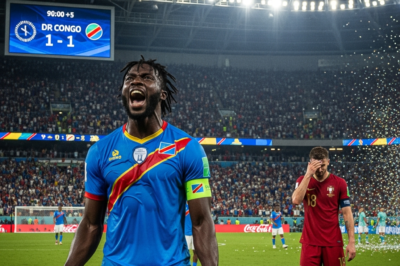
In a tournament historically defined by its ability to humble giants and elevate the underdogs, the latest chapter of the FIFA World Cup has provided a narrative that few pundits could have predicted. The Lusail Stadium witnessed an extraordinary display of resilience and tactical discipline as the Democratic Republic of Congo (DR Congo) held a star-studded, yet ultimately listless, Portugal side to a 1-1 draw. This result sends shockwaves through the group standings and serves as a poignant reminder that reputations alone do not win matches on the world’s grandest stage. Portugal, led by their talismanic veterans and a galaxy of young European stars, found themselves stifled by a Congolese side that played with a level of cohesion and bravery that transcended their FIFA ranking. For the Portuguese, it was a night of missed opportunities and tactical lethargy; for the Leopards of DR Congo, it was a historic statement of intent.
Tactical Stagnation vs. Relentless Defensive Spirit
From the opening whistle, it was evident that Roberto Martínez’s Portugal intended to dominate proceedings through sustained possession. However, the fluidity that usually defines the Portuguese midfield was noticeably absent. The likes of Bernardo Silva and Vitinha struggled to find pockets of space between the lines, as DR Congo manager Sébastien Desabre organized his team into a compact 4-5-1 mid-block that rarely wavered. The Leopards did not simply park the bus; they engaged in a sophisticated defensive dance, pressing triggers in the middle third and forcing Portugal into harmless sideways passes. The Portuguese wingers, Rafael Leão and João Félix, were frequently doubled-teamed, preventing them from utilizing their explosive pace. This tactical stagnation allowed DR Congo to grow in confidence, as they realized that the European heavyweights lacked the creative spark to unlock a well-drilled African defense. The frustration on the Portuguese bench was palpable as early as the 30th minute, with Martínez seen gesturing frantically for more verticality in their play.
The Goal That Silenced a Nation
The turning point of the match arrived in the 42nd minute, sending the Congolese supporters into a frenzy and the rest of the stadium into a stunned silence. Following a rare lapse in concentration from the Portuguese midfield, Samuel Moutoussamy intercepted a loose ball and immediately launched a counter-attack. The speed of transition was breathtaking. Yoane Wissa, playing with an intensity that the Portuguese defenders couldn’t match, found space on the left flank before cutting inside and unleashing a curling effort that took a slight deflection off Rúben Dias. The ball looped over the outstretched arms of Diogo Costa and nestled into the far corner. It was a goal born of pure opportunism and clinical execution. For the remainder of the first half, DR Congo didn’t just hold their lead; they looked like the more dangerous side, exploiting the gaps left by a Portugal team that had committed too many bodies forward in a desperate attempt to rectify their lack of rhythm.
Portugal’s Struggle for Identity and Ronaldo’s Frustration
The second half saw the introduction of several Portuguese substitutes, including a desperate search for an equalizer that eventually came, but the overall performance remained disjointed. Cristiano Ronaldo, the veteran captain, found himself isolated for long periods. Every time he dropped deep to get involved in the build-up, he was swarmed by Congolese defenders like Chancel Mbemba and Henoc Inonga, who produced masterclass performances in central defense. The statistics tell a story of dominance without direction: Portugal enjoyed 68 percent of the ball and registered 18 shots, but only three of those were on target. This lack of clinical finishing and creative vision highlighted a deeper issue within the squad—a potential over-reliance on individual brilliance over collective tactical cohesion. While Portugal eventually found an equalizer in the 78th minute through a scrambled effort from a corner, the goal felt more like a relief than a triumph. The Leopards refused to buckle under the late pressure, with goalkeeper Lionel Mpasi making two world-class saves in stoppage time to preserve the point.
The Historical Context: A New Era for the Leopards
To understand the significance of this result, one must look at the history of DR Congo in the FIFA World Cup. Formerly known as Zaire during their 1974 appearance, the nation has long struggled to replicate its continental success on the global stage. This 1-1 draw against a team ranked in the world’s top ten is not just a fluke; it is the culmination of years of structural reform and the integration of diaspora talent. Under Desabre, the Leopards have developed a tactical identity that prioritizes defensive solidity without sacrificing the flair associated with Congolese football. This result mirrors the rising quality of African football seen throughout recent tournaments, where the gap between the traditional elite and the rest of the world continues to shrink. For DR Congo, this point is a massive step toward potential qualification for the knockout rounds, a feat that would be celebrated as a national milestone.
Statistical Breakdown: Numbers That Tell the Tale
A deep dive into the match statistics reveals why Portugal failed to secure the win. Beyond the possession metrics, the ‘Expected Goals’ (xG) for Portugal was surprisingly low at 1.12, considering their talent. This suggests that despite having the ball, they failed to create high-quality scoring chances. DR Congo, on the other hand, made their few entries into the final third count, recording an xG of 0.85 despite having significantly less possession. The defensive work rate of the Congolese midfield was staggering; Charles Pickel and Samuel Moutoussamy combined for 12 successful tackles and 9 interceptions, effectively neutralizing the Portuguese engine room. Furthermore, the distance covered by the DR Congo players was nearly 5 kilometers more than their Portuguese counterparts, illustrating the physical commitment required to pull off such an upset. In modern football, the data often highlights that work rate and tactical discipline can overcome pure technical superiority.
Group Implications and the Path Ahead
As the smoke clears from this encounter, the Group F standings have become a complex puzzle. Portugal, who were widely expected to cruise through to the Round of 16 with maximum points, now face a high-stakes final group match. They cannot afford another slip-up, especially with goal difference potentially coming into play. For DR Congo, the path to the knockout stages is now clear: a win in their next match would almost certainly guarantee them a spot in history. The psychological boost from holding a team of Portugal’s caliber cannot be overstated. The Leopards have proven they can go toe-to-toe with the best, and they will enter their final fixtures with no fear. Conversely, the Portuguese camp must engage in some serious soul-searching. If they are to live up to their status as contenders for the trophy, they must find a way to break down low blocks and inject more urgency into their play.
Conclusion: The Beautiful Game’s Great Leveler
The 1-1 draw between DR Congo and Portugal will be remembered as one of the defining moments of this World Cup’s group stage. It serves as a reminder that football is played on grass, not on paper, and that heart, organization, and tactical discipline can level the playing field against even the most expensive squads. Portugal’s listless performance should be a wake-up call for the European elite, while DR Congo’s plucky display is a beacon of hope for underdog nations everywhere. As the tournament progresses, the repercussions of this match will continue to be felt, proving once again that in the FIFA World Cup, anything is possible, and no giant is ever truly safe from the grit of an inspired opponent.































Leave a Reply