
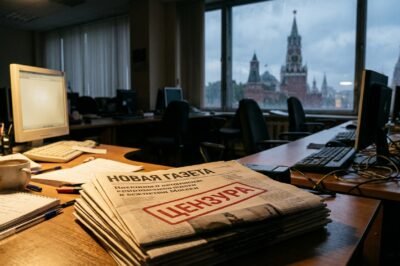
The echoes of the printing press have finally gone silent in one of Russia’s last bastions of independent journalism, marking a definitive end to an era of post-Soviet transparency. For decades, Novaya Gazeta served as the conscience of a nation, a platform where the most uncomfortable truths were brought to light under the steely gaze of the Kremlin. However, following a series of calculated legal maneuvers by the state media regulator Roskomnadzor, the newspaper has been stripped of its print license, effectively forcing its closure within Russian borders. This move is not merely a bureaucratic technicality; it represents the culmination of a years-long campaign to dismantle any narrative that deviates from the official state line. As the international community watches with growing alarm, the silencing of Nobel Peace Prize laureate Dmitry Muratov’s publication signals a total pivot toward information isolationism. The closure comes at a time when the world desperately seeks objective reporting from within Russia, yet the domestic space for such discourse has been systematically constricted until it reached a breaking point. This analysis explores the legal, political, and social ramifications of a decision that permanently alters the landscape of global media and Russian civil society.
The Regulatory Squeeze: Roskomnadzor’s Legal Maneuvers
The technical justification for the closure of Novaya Gazeta rests on what many legal experts describe as a thin veneer of administrative compliance. Roskomnadzor, Russia’s federal communications watchdog, argued that the publication failed to provide the necessary documents related to a change in ownership that occurred over a decade ago. In a court of law that has become increasingly aligned with executive interests, these decade-old clerical issues were deemed sufficient to revoke a license that had sustained the paper since 1993. This strategy of ‘lawfare’—the use of legal systems to harass or silence opponents—has become the standard operating procedure for the Kremlin in its dealings with independent entities. By focusing on administrative minutiae, the state avoids the optics of direct censorship while achieving the same result: the total cessation of a critical voice.
Furthermore, the pressure on Novaya Gazeta intensified significantly following the implementation of new laws regarding the ‘discrediting’ of the Russian armed forces. Under these draconian regulations, any reporting that uses the word ‘war’ instead of ‘special military operation,’ or that investigates allegations of human rights abuses, can result in heavy fines or imprisonment. Novaya Gazeta had initially attempted to navigate these waters by self-censoring certain topics, but the regulatory body continued to issue warnings for failing to label ‘foreign agents’ correctly in their archives. After receiving two such warnings within a year, the paper was legally vulnerable to license revocation, a trap that the state was more than willing to spring. This systematic dismantling of a media outlet through legal attrition serves as a chilling warning to any remaining independent bloggers or local news outlets within the federation.
A Legacy of Investigative Bravery and Blood
To understand the gravity of Novaya Gazeta’s closure, one must look back at its storied and often tragic history. Founded in 1993 with the help of Nobel Peace Prize winner Mikhail Gorbachev, who used his prize money to buy the paper’s first computers, Novaya Gazeta was born from the hope of a free and democratic Russia. Over the years, it became famous for its fearless investigations into corruption at the highest levels of government, human rights abuses in Chechnya, and the mysterious deaths of political dissidents. However, this bravery came at a staggering cost. Since its inception, six of its journalists and contributors have been murdered in connection with their work, including the world-renowned Anna Politkovskaya, who was gunned down in her apartment building in 2006.
These sacrifices cemented the paper’s reputation as a vital, if endangered, pillar of Russian society. The staff, led by Dmitry Muratov, operated under constant threat of violence and prosecution. When Muratov was awarded the Nobel Peace Prize in 2021, it was seen as a shield of sorts—a global recognition that might protect the publication from the escalating crackdown. Yet, the events of 2022 and 2023 have proven that even the highest international honors offer little protection against a state determined to achieve domestic ideological homogeneity. The closure of the paper is not just a loss of a news source; it is an insult to the memory of those who gave their lives to keep it running. It signals that the era where international prestige could provide a ‘safety net’ for Russian liberals has officially ended.
The Economic and Market Fallout of Censorship
From a financial and market perspective, the forced closure of independent media outlets like Novaya Gazeta creates a ripple effect of instability. For international investors and multinational corporations still monitoring the Russian market, the death of independent media is a primary indicator of ‘sovereign risk.’ Without a free press to investigate corporate governance, state corruption, or the true state of the economy, data coming out of Russia becomes increasingly unreliable. This lack of transparency leads to what economists call ‘information asymmetry,’ where the state controls all economic indicators, making it nearly impossible for external actors to conduct accurate risk assessments. This inevitably leads to further capital flight and the total isolation of the Russian financial system from global standards.
Moreover, the media sector itself in Russia has been hollowed out. What was once a burgeoning industry of diverse voices has been replaced by state-funded conglomerates that prioritize propaganda over profitability. For the journalists who worked at Novaya Gazeta, the closure represents a professional dead end within their home country. Many have been forced to flee to Europe or the Baltics to continue their work under the ‘Novaya Gazeta Europe’ banner, a separate entity that remains inaccessible to most Russians without a VPN. This ‘brain drain’ of the country’s most talented investigative minds further weakens the domestic intellectual economy, leaving behind a media landscape that is monolithic, uncompetitive, and divorced from the realities of the global information market.
Comparative Analysis: The Extinction of Independent Outlets
Novaya Gazeta is not an isolated case; it is the final piece of a puzzle that has seen the near-total extinction of independent Russian media. In the months following February 2022, outlets such as Echo Moskvy (a staple of liberal radio) and TV Rain (Dozhd) were also forced to shutter their domestic operations. These outlets provided a necessary counterweight to the state-run Rossiya-1 and Channel One. By analyzing these closures together, a clear pattern emerges: the state is moving toward a Chinese-style ‘Great Firewall’ model, where the internet and traditional media are scrubbed of any dissenting views. While Novaya Gazeta held out longer than most, its eventual fate was sealed by the same logic that dismantled its peers.
This trend has profound implications for the Russian public’s perception of reality. Statistics suggest that while younger, tech-savvy Russians use VPNs to access banned content, a significant portion of the older population relies solely on state-controlled television and newspapers. The removal of Novaya Gazeta from newsstands removes one of the last physical reminders that an alternative viewpoint even exists. This creates a feedback loop where the state’s narrative is never challenged, leading to a consolidation of social support for policies that might otherwise be questioned. The extinction of these outlets means that the ‘marketplace of ideas’ in Russia has been replaced by a state monopoly on truth, with dire consequences for the long-term social health of the nation.
Future Implications: The Era of Information Isolation
Looking forward, the forced closure of Novaya Gazeta suggests a future where Russia becomes an ‘information black hole.’ As the state moves to control not just the output of news but the very infrastructure of the internet within its borders, the ability for the outside world to understand internal Russian dynamics will diminish. We are likely to see a rise in ‘underground’ journalism, reminiscent of the Soviet-era Samizdat, where information is passed through encrypted channels and clandestine networks. However, these methods lack the reach and institutional weight of a major newspaper, making it harder for truth to penetrate the mainstream consciousness.
Internationally, this closure will likely trigger a new wave of sanctions and diplomatic condemnations. Organizations like the United Nations and the OSCE have already voiced their concerns, but with Russia increasingly pivoting away from Western institutions, these protests may fall on deaf ears. The primary concern for the future is the total radicalization of the domestic information space. Without a moderate, fact-based voice like Novaya Gazeta to bridge the gap between the state and the people, the potential for internal social fracturing increases. The closure of the paper is a symptom of a much larger shift: a nation closing its doors to the world and, in doing so, losing its ability to see itself clearly.
Conclusion: The Death of Dialogue
In conclusion, the forced closure of Novaya Gazeta by Russian authorities is a watershed moment in the history of global press freedom. It represents the final victory of state censorship over the remnants of the independent media landscape established after the fall of the Soviet Union. By utilizing a combination of bureaucratic harassment, draconian legislation, and physical intimidation, the Russian state has succeeded in silencing a voice that stood for three decades as a beacon of integrity. The implications for the Russian people are profound, as they are now left with a singular, state-mandated version of reality. For the rest of the world, this serves as a somber reminder that the freedom of the press is a fragile entity, easily dismantled when the rule of law is subverted by political ambition. As Novaya Gazeta fades from the Russian newsstands, the light of transparency in the region grows significantly dimmer, ushering in a period of unprecedented information isolation that will likely last for generations.





































Leave a Reply