
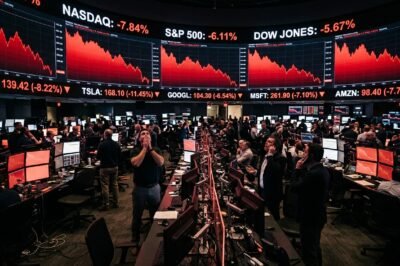
The financial world witnessed a seismic shift in sentiment today as the tech-heavy Nasdaq and the broader S&P 500 plummeted, marking what is shaping up to be Wall Street’s most harrowing trading session since early June. For months, the narrative of an unstoppable artificial intelligence revolution had propelled equity markets to record highs, creating an atmosphere of near-invincibility among growth-oriented investors. However, the tide has turned with surprising ferocity, as a combination of overstretched valuations, shifting interest rate expectations, and a cooling labor market has triggered a massive de-risking event. This downturn represents more than just a momentary correction; it is a fundamental reassessment of the risk-reward profile of the world’s largest companies. As the primary engines of the market’s year-to-date gains faltered, the ripple effects were felt across every sector, leaving traders to grapple with the reality that the low-volatility environment of the spring has officially vanished. The decline today underscores the fragility of a market heavily concentrated in mega-cap technology firms, where any sign of weakness can lead to a cascading effect that drags down indices globally, forcing a recalibration of portfolios for the second half of the year.
The Valuation Conundrum: When Growth Hits a Ceiling
At the heart of the current sell-off is a growing concern over the sustainability of current price-to-earnings ratios within the tech sector. For the better part of the year, investors have been willing to pay a premium for companies like Nvidia, Microsoft, and Alphabet, betting that the integration of generative AI would lead to an immediate and massive boost in productivity and revenue. However, recent earnings reports and forward-looking guidance have suggested that while the AI transition is real, the timeline for monetization might be longer than the market initially priced in. This discrepancy has created a ‘valuation gap’ that makes these stocks vulnerable to even minor disappointments in macroeconomic data.
Furthermore, the ‘Magnificent Seven’ stocks, which have dominated the market’s performance, are now facing the challenge of high expectations. Analysts have noted that for these companies to justify their current market caps, they must not only beat earnings estimates but also provide flawless guidance. When a company like Apple or Amazon shows even a slight deceleration in specific growth metrics, the market’s reaction is swift and punitive. Today’s price action is a textbook example of ‘multiple compression,’ where investors decide that they are no longer willing to pay 30 or 40 times earnings for growth that may be slowing down in the face of broader economic headwinds.
Macroeconomic Catalysts: The Fed and the Yield Curve
While tech valuations are the internal trigger, the external pressure is coming from a complex macroeconomic landscape. Recent data releases have painted a conflicting picture of the U.S. economy, leading to increased volatility in the bond market. The 10-year Treasury yield has seen significant movement as investors digest the possibility that the Federal Reserve may remain ‘higher for longer’ even as recessionary signals begin to flicker in the manufacturing sector. This ‘sticky’ inflation coupled with a cooling jobs market puts the Fed in a precarious position, and the uncertainty is toxic for high-growth tech stocks that rely on low discount rates for their long-term valuation models.
Statistics from the latest labor department reports indicate a slight uptick in unemployment claims, which usually would signal a need for rate cuts. However, with service-sector inflation remaining stubborn, the central bank remains hesitant. This ‘hawkish pause’ is draining liquidity from the speculative corners of the market. Investors are realizing that the ‘Fed Put’—the idea that the central bank will step in to save the market—might not be as robust as it was in previous cycles. As a result, the cost of capital is staying elevated, squeezing the margins of tech firms that have relied on cheap debt to fund aggressive research and development programs.
Sector Rotation: The Rise of the Underdogs
One of the most notable features of this sell-off is the visible rotation of capital out of growth and into value and small-cap sectors. While the Nasdaq is suffering its worst day in months, indices like the Russell 2000 have shown relative resilience or even modest gains in specific pockets. This suggests that the ‘Great Rotation’ is finally underway, as investors hunt for yield in neglected areas of the market such as regional banks, utilities, and traditional industrial firms. These sectors typically benefit from a broader economic base and are less sensitive to the specific volatility of the semiconductor and software industries.
This shift is also driven by a desire for diversification. Professional money managers, who were heavily overweight in tech to keep up with benchmark indices, are now taking profits and reallocating to ‘defensive’ positions. The logic is simple: if the tech bubble is indeed deflating, the safest place to be is in companies with strong cash flows, high dividend yields, and low debt-to-equity ratios. We are seeing a move toward ‘old economy’ stocks that were largely ignored during the AI frenzy, providing a silver lining for those with balanced portfolios but creating a painful environment for those who chased the tech rally at its peak.
Technical Analysis: Breaking Through the Floor
From a technical perspective, the damage to the charts is significant. The Nasdaq 100 has broken below its 50-day moving average for the first time in several months, a move that often triggers algorithmic selling and further downward pressure. Technical analysts point to the ‘head and shoulders’ patterns forming on several major tech stocks, suggesting that the path of least resistance is currently down. The suddenness of the drop has also pushed the Relative Strength Index (RSI) into oversold territory, but in a momentum-driven sell-off, ‘oversold’ can often stay that way for longer than traders expect.
Support levels that previously held firm are now being tested. For instance, the 18,000 level on the Nasdaq was seen as a psychological bastion for bulls, but its breach today has opened the door for a potential test of the 200-day moving average. The increase in the VIX, often referred to as the ‘fear gauge,’ confirms that market participants are rushing to buy protection via put options. This spike in volatility usually precedes a period of choppy trading as the market attempts to find a new equilibrium. Until we see a ‘capitulation’ event where selling volume peaks, many analysts remain cautious about calling a bottom.
Global Implications and the Semiconductor Supply Chain
The sell-off in New York is not an isolated incident; it has profound implications for global markets, particularly in Asia and Europe. The semiconductor industry, which is highly interconnected, has seen stocks like TSMC and ASML retreat in sympathy with their American counterparts. Because these companies are the backbone of the global tech infrastructure, their decline signals a potential slowdown in the capital expenditure cycle of major cloud providers. If the big players in Silicon Valley pull back on their AI infrastructure spending, the entire global supply chain will feel the pinch, from equipment manufacturers in the Netherlands to assembly plants in Southeast Asia.
Geopolitical tensions are also playing a role in this global retreat. Potential new trade restrictions on chip exports and the ongoing ‘tech war’ between the U.S. and China add layers of risk that are now being priced back into the market. Investors are weighing the possibility that the era of global tech cooperation is giving way to a more fragmented and expensive landscape. This uncertainty is leading international investors to pull capital back to safe-haven assets, such as the U.S. Dollar or gold, further complicating the liquidity picture for equity markets.
Conclusion: Future Implications for Investors
As Wall Street stares down its worst day since June, the road ahead appears fraught with challenges. The immediate focus will remain on the upcoming quarterly earnings reports, which must provide more than just optimism; they must provide concrete evidence that the AI investment cycle is translating into bottom-line growth. If the corporate world fails to deliver these results, the current correction could deepen into a more prolonged bear market for the technology sector. However, for the long-term investor, this volatility may eventually provide an attractive entry point into high-quality companies that were previously too expensive to touch.
The key for the coming months will be monitoring the Federal Reserve’s next moves and the stability of the consumer. If inflation continues to moderate and the Fed begins a cutting cycle, the pressure on tech valuations may ease. Conversely, if economic growth stalls while inflation remains high—the dreaded stagflation scenario—then the current sell-off may be just the beginning of a larger structural shift in the global financial markets. Investors are advised to remain disciplined, focus on fundamental value, and prepare for a period where volatility, rather than steady growth, is the new market norm.





































Leave a Reply