
The study of paleontology has long been a source of wonder, bridging the gap between our modern world and a primordial past that feels more like science fiction than history. For decades, the public imagination was dominated by a few central figures such as the Tyrannosaurus Rex or the Triceratops, but as our scientific techniques evolve, a new roster of prehistoric giants is stepping into the spotlight. The letter ‘S’ in the dinosaurian alphabet offers a particularly diverse array of specimens, ranging from the semi-aquatic Spinosaurus to the heavily armored Saltasaurus. This resurgence in interest, highlighted by recent features in major publications like The Times of India, underscores a broader cultural and scientific shift. We are no longer satisfied with the ‘greatest hits’ of the Jurassic Period; instead, there is a growing appetite for the nuanced, the strange, and the lesser-known creatures that once dominated every niche of our planet. This detailed analysis explores ten such creatures, examining their biological marvels, their place in the evolutionary timeline, and the significant impact they have on today’s scientific and economic landscape.
The Significance of Taxonomy and the ‘S’ Species
In the world of biology, nomenclature is far more than a naming convention; it is a map of evolutionary relationships. The dinosaurs beginning with ‘S’ represent some of the most critical branches of the dinosaurian family tree. Taxonomists and paleontologists use these names to categorize creatures that often represent major leaps in adaptation. For instance, the transition from land-dwelling carnivores to river-dwelling apex predators is best exemplified by the Spinosaurus, while the development of complex armor plating is seen in the Scelidosaurus. The diversity within this single letter category is a microcosm of the Mesozoic Era itself, showcasing how life adapted to shifting continents and changing climates.
Understanding these creatures requires a deep dive into the strata of the earth where their fossils are found. From the dusty plains of North America to the lush, ancient riverbeds of North Africa, ‘S’ dinosaurs have been found on nearly every continent. This global distribution tells a story of a world that was once interconnected, a Pangean landscape where these beasts could roam across vast distances before the tectonic plates drifted apart. The scientific community relies on these specific names to communicate findings that impact our understanding of modern biology, climate change, and even biomechanics.
Spinosaurus and Suchomimus: The River Kings
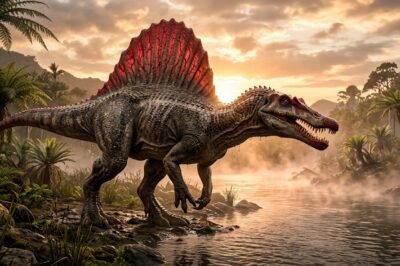
When discussing dinosaurs beginning with ‘S’, the Spinosaurus stands out as a true titan. Recent research suggests it was perhaps the largest carnivorous dinosaur to ever walk—or swim—the earth. With its massive dorsal sail and elongated, crocodile-like snout, the Spinosaurus was a master of the Cretaceous waterways. This creature fundamentally changed our understanding of dinosaur behavior, proving that some theropods were perfectly adapted for an aquatic lifestyle. Its dense bones and paddle-like tail are key pieces of evidence that point toward a life spent hunting large fish in the prehistoric river systems of what is now the Sahara Desert.
Sharing this specialized niche was the Suchomimus, a name that literally means ‘crocodile mimic.’ While not as large as its cousin the Spinosaurus, Suchomimus possessed a long, narrow snout filled with over 100 teeth, many of which were curved and serrated to grip slippery prey. The discovery of Suchomimus in the Tenere Desert of Niger provided crucial insights into the distribution of spinosaurids across the southern supercontinent of Gondwana. These two predators represent a fascinating evolutionary experiment in specialized hunting, moving away from the brute-force crushing power of the tyrannosaurs toward a more surgical, water-based approach.
Armored Sentinels: Stegosaurus and Saltasaurus
The Stegosaurus is perhaps the most famous ‘S’ dinosaur, recognizable by the double row of kite-shaped plates along its back and the four-spiked ‘thagomizer’ on its tail. Despite its fame, modern science is still uncovering secrets about its physiology. We now know that the plates were likely used for thermoregulation or display rather than just physical defense. The Stegosaurus represents the height of the thyreophoran line during the Late Jurassic, a group of dinosaurs that prioritized defense through structural adaptation. Its small brain and massive body have often led to the misconception that it was a slow, dim-witted herbivore, but its survival for millions of years suggests a highly successful evolutionary strategy.
Moving forward in time to the Late Cretaceous, we encounter the Saltasaurus, a sauropod that broke the traditional mold. Unlike the massive, smooth-skinned long-necks like Brachiosaurus, the Saltasaurus was covered in thousands of small, bony plates called osteoderms. This ‘armored sauropod’ demonstrates how even the largest animals on earth had to adapt to the presence of increasingly dangerous predators. The Saltasaurus was relatively small for a titanisaur, but its built-in chainmail made it a formidable target. This evolutionary path highlights the constant arms race between herbivores and carnivores that drove the diversification of life during the Mesozoic.
The Ostrich Mimics and the Feathered Revolution
One of the most fascinating groups of ‘S’ dinosaurs is the Struthiomimus, or ‘ostrich mimic.’ These dinosaurs were built for speed, with long legs, a light frame, and a toothless beak. Living in the shadow of giants like Edmontosaurus and Triceratops, the Struthiomimus relied on its agility to survive. It is a perfect example of convergent evolution, where a dinosaur from the Cretaceous Period independently evolved a body plan strikingly similar to modern flightless birds. This group provides vital clues into the transition of dinosaurs into the ancestors of modern birds, showcasing that the avian blueprint was already being tested millions of years ago.
Furthering the bird connection is the Sinornithosaurus, a small, feathered dromaeosaur from the Early Cretaceous of China. This ‘Chinese bird-lizard’ was one of the first dinosaurs to provide definitive evidence of feathers, changing the way we visualize these animals forever. Some theories even suggest that Sinornithosaurus may have been venomous, based on the structure of its teeth and skull, which would make it one of the few known toxic dinosaurs. The discovery of such creatures in the Jehol Biota has revolutionized paleontology, moving the field away from scaly, reptilian depictions toward a more colorful, feathered reality.
Economic Impacts and the ‘Paleo-Economy’
The fascination with dinosaurs is not just a scientific pursuit; it is a massive economic driver. The ‘Paleo-Economy’ encompasses museum tourism, media franchises like Jurassic Park, and the high-stakes world of fossil auctions. Dinosaurs starting with ‘S’, particularly the Spinosaurus and Stegosaurus, are major draws for institutions like the Smithsonian or the Natural History Museum in London. A single well-preserved skeleton can generate millions of dollars in tourism revenue and merchandising. Furthermore, the private market for fossils has seen prices skyrocket, with specimens often selling for tens of millions at auction houses like Sotheby’s and Christie’s, raising important ethical questions about the private ownership of scientific heritage.
Market implications extend to the entertainment and educational sectors as well. Brands that leverage dinosaur imagery—whether in toys, video games, or documentaries—see consistent returns on investment. The ‘S’ dinosaurs provide a rich catalog of unique silhouettes and behaviors that creators use to keep the ‘dino-craze’ alive in every new generation. From a financial perspective, paleontology is a bridge between the academic world and a multi-billion dollar global industry, proving that these ancient creatures are still very much ‘alive’ in the modern economy.
Conclusion: The Future of Prehistoric Discovery
As we look toward the future, the study of dinosaurs beginning with ‘S’ will undoubtedly benefit from advancements in digital reconstruction and genetic analysis. Techniques such as CT scanning and finite element analysis allow scientists to ‘flesh out’ these skeletons with unprecedented accuracy, determining how they moved, ate, and interacted with their environments. We are entering an era of ‘Digital Paleontology,’ where fossils can be shared and studied globally without ever leaving their host institutions. This democratization of data is leading to a faster pace of discovery, with new species being named almost every week.
The enduring popularity of these creatures, as seen in the recent coverage by The Times of India, ensures that funding and public interest will continue to support the next generation of paleontologists. Whether it is a new sauropod from the heart of Argentina or a feathered theropod from the forests of China, the story of the ‘S’ dinosaurs is far from over. They remain a testament to the resilience of life and the infinite curiosity of the human mind, reminding us that even the most powerful empires—whether of flesh or of bone—are part of a much larger, ever-changing cosmic narrative.




































Leave a Reply