
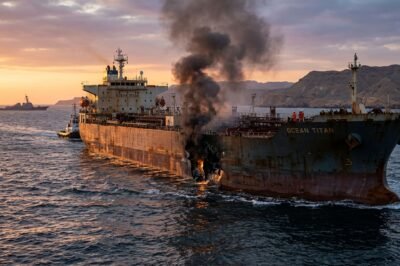
The Strait of Hormuz, a narrow waterway separating the Persian Gulf from the Gulf of Oman, has once again become the epicenter of global maritime tension following a sophisticated attack on a commercial tanker carrying 27 Indian nationals. Reports indicating the use of limpet mines—specialized magnetic explosives designed to be attached to the hull of a ship—have sent shockwaves through the international shipping community and energy markets. This incident represents a significant escalation in the regional shadow war that threatens the stability of one of the world’s most vital energy transit corridors. For the 27 Indian seafarers on board, the attack turned a routine transit into a life-threatening ordeal, highlighting the increasing vulnerability of merchant mariners in geopolitical flashpoints. As news of the explosion broke, global crude prices reacted with immediate volatility, reflecting the market’s deep-seated anxiety over supply disruptions. This analysis delves into the technical, political, and economic ramifications of the attack, examining why the Strait of Hormuz remains the world’s most dangerous maritime choke point and what this means for India’s strategic interests in the Middle East.
The Anatomy of the Attack: Understanding Limpet Mines
Limpet mines are a specific type of naval mine that attaches to the target by magnets. They are typically placed by divers or small boats, making them a weapon of choice for actors seeking to maintain a level of plausible deniability. In this latest incident, the mines were reportedly placed near the waterline, a tactical decision intended to disable the vessel rather than sink it. This method of ‘calibrated escalation’ suggests a state or state-sponsored actor with sophisticated underwater sabotage capabilities. The use of such weapons in the Strait of Hormuz is not unprecedented, yet the precision of this attack underscores an evolving threat landscape where commercial vessels are increasingly used as pawns in larger diplomatic disputes.
Technical experts suggest that the damage caused by a limpet mine is localized but structurally significant. It creates a breach in the outer hull that can lead to flooding in ballast tanks or engine rooms. For a tanker carrying volatile cargo, the risk of fire or environmental disaster is immense. The 27 Indian crew members were forced to implement emergency damage control protocols, a testament to the rigorous training of Indian seafarers who dominate the global maritime workforce. The psychological impact of such an attack cannot be overstated, as crews now face the reality that their workplace has become a front line in a conflict they have no part in.
Human Stakes: The 27 Indian Mariners at the Center of the Crisis
India is one of the largest providers of seafarers to the global shipping industry, accounting for approximately 10% of the world’s maritime workforce. The safety of the 27 Indians on board the attacked tanker is a matter of grave national concern for New Delhi. This incident puts the Indian government in a complex diplomatic position, as it must balance its strategic ties with regional powers in the Middle East while ensuring the protection of its citizens abroad. The Ministry of External Affairs (MEA) has been in constant communication with maritime authorities to ensure the safe evacuation or stabilization of the crew, emphasizing that the safety of Indian nationals is paramount.
The vulnerability of Indian sailors in the Persian Gulf is a recurring theme in India’s maritime security discourse. Over the past decade, Indian crews have been caught in the crossfire of regional rivalries, piracy, and state-led seizures. The current attack highlights the need for more robust international protection for merchant mariners. Families of the 27 crew members have called for greater transparency and faster intervention, prompting the Indian Navy to increase its surveillance presence in the region. The incident serves as a reminder that the human cost of geopolitical instability is often borne by those far removed from the halls of power.
Economic Shockwaves: Oil Markets and Shipping Premiums
The Strait of Hormuz is the world’s most important oil transit choke point, with nearly 21 million barrels of crude oil passing through it daily. Any disruption, or even the threat of disruption, sends immediate ripples through the global economy. Following the news of the limpet mine attack, Brent crude and West Texas Intermediate (WTI) prices saw a sharp uptick as traders factored in the ‘risk premium’ associated with potential supply chain failures. If the strait were to be closed or become too dangerous for transit, the global energy market would face a catastrophic supply deficit, leading to hyperinflation in energy costs across Europe and Asia.
Furthermore, the insurance industry is reacting with alarm. ‘War risk’ premiums for vessels transiting the Persian Gulf and the Gulf of Oman have surged. For shipping companies, this means a significant increase in operational costs, which are ultimately passed down to the consumer. Lloyd’s of London and other major maritime insurers have categorized the region as high-risk, requiring tankers to pay exorbitant fees for coverage. This economic pressure acts as a form of secondary warfare, slowing down trade and increasing the cost of living globally, showcasing how a localized explosion can have a macro-economic fallout.
Geopolitical Fingerprints and the ‘Shadow War’
While no group has immediately claimed responsibility for the attack, the geopolitical context points toward the ongoing friction between regional rivals and their international backers. The Strait of Hormuz is frequently used as a lever by regional actors to pressure the West, particularly in response to sanctions or diplomatic isolation. The use of limpet mines is a hallmark of ‘gray zone’ warfare—hostile actions that fall below the threshold of conventional war but are designed to achieve strategic objectives through intimidation and disruption.
India’s role in this theater is particularly delicate. As a major importer of crude oil from the Middle East, India maintains a policy of ‘strategic autonomy,’ avoiding taking sides in the regional rivalry between Iran and its neighbors. However, when Indian lives and energy security are threatened, this neutrality is tested. The international community, led by the United States and its allies, has frequently blamed regional proxies for such attacks, leading to a cycle of accusations and counter-accusations that leave the maritime industry in a state of perpetual anxiety. This incident will likely lead to calls for an international maritime task force to provide armed escorts for tankers, a move that could further militarize the waterway.
India’s Maritime Response: Operation Sankalp
In response to previous attacks in the region, the Indian Navy launched ‘Operation Sankalp’ in 2019 to ensure the safe passage of Indian-flagged vessels. The current incident will likely see an expansion of this operation. The Indian Navy has deployed stealth destroyers and frigates to the Gulf of Oman to provide a sense of security to the merchant fleet. These vessels utilize advanced electronic warfare suites and P-8I long-range maritime patrol aircraft to monitor suspicious activities near the shipping lanes. The attack on the tanker carrying 27 Indians proves that despite these measures, the threat remains potent and unpredictable.
India’s maritime strategy is now shifting toward a more proactive stance. New Delhi is not only focusing on military protection but also on diplomatic engagement through the Indian Ocean Rim Association (IORA) and other multilateral forums. The goal is to establish a ‘rules-based order’ at sea where commercial shipping is off-limits to political conflict. However, as long as the underlying tensions in the Middle East remain unresolved, the Indian Navy will find itself stretched thin, acting as the primary shield for the nation’s energy interests and its citizens’ lives in the volatile waters of the North Arabian Sea.
Conclusion: Future Implications for Maritime Trade
The attack on the tanker in the Strait of Hormuz is a grim reminder of the fragility of the global trade network. As 27 Indian nationals recover from the shock of the explosion, the international community must grapple with the reality that maritime security can no longer be taken for granted. The incident is likely to trigger a re-evaluation of shipping routes and a push for alternative pipelines that bypass the strait altogether, though such projects are years away from completion. In the short term, we can expect increased militarization of the Persian Gulf, higher oil prices, and a more assertive Indian maritime presence.
Ultimately, the use of limpet mines marks a dangerous return to the ‘Tanker War’ tactics of the 1980s, adapted for the 21st century’s digital and geopolitical landscape. For India, the incident is a wake-up call to further diversify its energy sources and strengthen its naval capabilities. As the investigation into the specific perpetrators continues, the world watches the Strait of Hormuz with bated breath, knowing that the next spark in this narrow waterway could ignite a global crisis of unprecedented proportions.



































Leave a Reply