
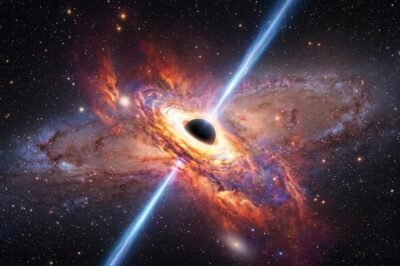
In the vast, silent theater of the cosmos, supermassive black holes have long been characterized as the ultimate scavengers, consuming everything that crosses their event horizons. However, recent scientific breakthroughs, including reports from DD India, are painting a much more complex and dynamic portrait of these gravitational titans. At the center of almost every massive galaxy lies a black hole with a mass millions or even billions of times that of our Sun. While their gravity is inescapable, it is what they expel that is currently captivating the astronomical community. Powerful jets of ionized plasma, traveling at relativistic speeds, are ejected from the regions immediately surrounding these black holes. These jets are not just celestial fireworks; they are fundamental regulators of galactic growth. By injecting immense amounts of energy into the surrounding circumgalactic medium, these jets act as a cosmic thermostat, heating the gas to temperatures so high that it can no longer collapse to form new stars. This process, known as feedback, is the primary mechanism that dictates the lifecycle, shape, and eventual fate of entire galaxies across the universe.
The Mechanics of Relativistic Jets and AGN Feedback
To understand how a black hole can influence a galaxy hundreds of thousands of light-years across, one must first look at the process of accretion. As matter—gas, dust, and the occasional star—spirals toward a supermassive black hole, it forms an accretion disk. This disk is a cauldron of extreme friction and magnetic forces, heating the material to millions of degrees. While much of this material is destined to be swallowed, a fraction is diverted by intense magnetic fields and accelerated outward from the poles of the black hole. These are the relativistic jets. They consist of electrons, protons, and potentially heavier ions moving at nearly the speed of light, carrying kinetic energy that rivals the total radiative output of the galaxy itself.
This phenomenon is part of what astronomers call an Active Galactic Nucleus (AGN). When an AGN is “on,” its jets can extend far beyond the visible boundaries of the galaxy, piercing into the intergalactic medium. The interaction between these jets and the surrounding gas is violent and transformative. Scientists have observed that these jets create massive bubbles or cavities in the hot gas that surrounds galaxy clusters. As these bubbles expand, they generate shock waves and turbulence, effectively transferring the black hole’s kinetic energy into thermal energy within the gas. This thermal injection is the cornerstone of the feedback loop that governs how galaxies mature over billions of years.
Heating the Galactic Atmosphere: Preventing the Big Chill
In a typical galaxy, the gas residing in the halo—the circumgalactic medium—is expected to cool down over time. As this gas loses energy through radiation, it should theoretically sink toward the center of the galaxy, increasing the density of the interstellar medium and triggering massive bursts of star formation. This is known as the “cooling flow” problem. For decades, astronomers were puzzled because they observed far less cold gas and far fewer young stars in massive galaxies than their models predicted. The missing piece of the puzzle was the heat supplied by black hole jets. By continuously reheating this gas, the jets prevent it from cooling and falling inward, effectively quenching the galaxy’s ability to produce new generations of stars.
Statistical analyses of galaxy clusters have shown a remarkable correlation between the power of a central black hole’s jets and the temperature of the surrounding gas. In clusters where the jets are most active, the gas remains in a state of high-temperature plasma, often reaching tens of millions of degrees Kelvin. This state of perpetual heat creates a pressure balance that supports the gas against the pull of gravity. Without this constant source of energy, galaxies would likely grow much larger and more chaotic, filled with an abundance of short-lived, massive stars that would fundamentally alter the chemical evolution of the universe. The jets, therefore, act as a stabilizing force, maintaining a delicate equilibrium between gas supply and stellar consumption.
Quenching Star Formation: A Galactic Crisis
The cessation of star formation, often referred to as “quenching,” is a pivotal moment in the life of a galaxy. When a galaxy stops forming stars, it begins to transition from a vibrant, blue, spiral-shaped entity into a “red and dead” elliptical galaxy. Red galaxies are composed primarily of older, cooler stars, with very little gas left to fuel new births. Black hole jets are the primary culprits behind this transition. By heating the gas reservoirs, the jets ensure that the “fuel” for star formation remains in a gaseous, ionized state rather than the cold, molecular state required for gravitational collapse. This process is particularly evident in massive elliptical galaxies at the centers of galaxy clusters, which are often home to the most powerful radio-loud AGNs.
Recent high-resolution simulations and observations have provided a more granular look at this quenching process. It is not a sudden event but a protracted struggle between the cooling of gas and the heating from the jets. Statistics suggest that galaxies with supermassive black holes exceeding 100 million solar masses are significantly more likely to be quenched. This implies a threshold where the feedback from the black hole becomes dominant enough to overcome the natural cooling rates of the galactic gas. The implications are profound: the very presence of a sufficiently large black hole can essentially seal the reproductive fate of its host galaxy, ensuring it remains a stellar graveyard rather than a nursery.
Observation Techniques: Mapping the Invisible Influence
Detecting the influence of black hole jets requires a multi-wavelength approach to astronomy. While the jets themselves are often most visible in radio waves—due to synchrotron radiation from electrons spiraling in magnetic fields—their impact on the surrounding gas is best seen in X-rays. Observatories like NASA’s Chandra X-ray Observatory and the ESA’s XMM-Newton have been instrumental in mapping the hot gas in and around galaxies. These X-ray images reveal the “holes” or cavities carved out by the jets, allowing scientists to calculate exactly how much energy is being pumped into the environment. By measuring the pressure and volume of these cavities, researchers can estimate the jet power with surprising precision.
Furthermore, the advent of the James Webb Space Telescope (JWST) has opened a new window into the early universe. JWST allows astronomers to see the first generations of AGNs and their jets, providing data on how this feedback mechanism operated when the universe was only a few billion years old. Early data suggests that black hole feedback was even more intense in the past, suggesting that the “heating” phase of galactic evolution began much earlier than previously thought. Coupled with ground-based arrays like the Atacama Large Millimeter/submillimeter Array (ALMA), which tracks the colder molecular gas, scientists are now able to see the full cycle of gas being heated, pushed away, and prevented from forming stars in real-time across cosmic history.
The Role of Turbulence and Sound Waves in Heat Distribution
One of the more fascinating aspects of black hole feedback is how the heat is distributed throughout the galaxy. It is not enough for the jets to heat the gas only in their immediate path; they must heat the entire volume of the circumgalactic medium to prevent cooling flows. Research indicates that this is achieved through turbulence and, surprisingly, sound waves. As the jets plow into the surrounding medium, they create ripples of pressure—cosmic sound waves—that travel through the gas. These waves carry energy far from the central black hole, dissipating it as heat as they move through the thinning atmosphere of the galaxy.
In the Perseus Cluster, for example, astronomers have detected ripples in the X-ray gas that correspond to a “note” 57 octaves below middle C. This ultra-low-frequency sound represents a massive transfer of energy.
- Turbulence: Chaotic gas motions induced by jet passage stir the galactic medium.
- Viscosity: The “thickness” of the gas helps convert kinetic motion into heat.
- Conduction: Thermal energy moves from the hot jet-struck regions to cooler outer layers.
These mechanisms ensure that the black hole’s influence is felt globally, preventing localized pockets of gas from cooling and starting the star-formation process prematurely. This holistic heating is what allows the black hole to act as a singular governor for the entire galactic system.
Conclusion: The Future of Galactic Morphology and Discovery
The realization that black hole jets shape the fate of galaxies represents a paradigm shift in cosmology. We no longer view galaxies as isolated islands of stars evolving in a vacuum; instead, they are complex, feedback-regulated systems where the smallest central point—the black hole—controls the largest scales of structure. As we look to the future, the next generation of telescopes, such as the Square Kilometre Array (SKA) and the Extremely Large Telescope (ELT), will provide even deeper insights into the nuances of this relationship. We will be able to observe the fine filaments of gas being pushed by jets and measure the magnetic field strengths that launch these cosmic blowtorches. Ultimately, understanding black hole jets is not just about studying extreme physics; it is about understanding our own origins. The Milky Way’s central black hole, Sagittarius A*, is currently quiet, but its past activity—and future potential—plays a role in why our galaxy looks the way it does today. As we continue to probe the depths of space, the interplay between the darkness of black holes and the light of the stars will remain one of the most compelling stories in the history of science.





































Leave a Reply