
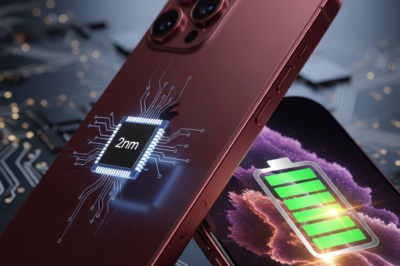
The smartphone industry is no stranger to the relentless cycle of innovation, but every few years, a technological leap occurs that promises to redefine the very fabric of mobile computing. According to recent high-profile leaks surfaced by Indian Television Dot Com and various supply chain insiders, the iPhone 18 Pro is positioning itself to be that very catalyst. While the tech world is currently fixated on the immediate future of the iPhone 16 and 17 series, the early blueprints for the 2026 flagship suggest a monumental shift in hardware architecture, energy management, and aesthetic identity. At the heart of these rumors is the transition to a 2nm fabrication process, a milestone that has been the ‘holy grail’ for semiconductor giants like TSMC and Apple. Coupled with a significant overhaul of battery density and a sophisticated new ‘Dark Cherry’ colorway, the iPhone 18 Pro is shaping up to be more than just an incremental update; it is a vision of the next decade of personal electronics.
The Silicon Frontier: Understanding the 2nm TSMC Breakthrough
The most profound leak regarding the iPhone 18 Pro revolves around its brain: the A20 Pro chip. Apple has long maintained a dominant lead in mobile silicon, but the jump to a 2-nanometer (2nm) process marks a departure from the traditional FinFET (Fin Field-Effect Transistor) architecture that has governed chips for years. Industry experts suggest that TSMC is on track to begin mass production of 2nm wafers by late 2025, perfectly timing the release of the iPhone 18 Pro. The 2nm node is expected to utilize Gate-All-Around (GAA) transistor technology, which allows for better control over the current flow and significantly reduces power leakage. For the end user, this translates to a projected 15% increase in processing speed and a staggering 25% to 30% reduction in power consumption compared to the 3nm chips found in the iPhone 15 Pro series. This efficiency isn’t just about speed; it is the foundation required to run advanced, on-device generative AI models—branded as Apple Intelligence—without overheating the device or draining the battery in mere hours.
A Paradigm Shift in Battery Technology and Energy Density
For years, the physical footprint of lithium-ion batteries has limited how much power Apple could pack into its sleek frames. However, the iPhone 18 Pro leaks suggest a major pivot in battery design. Rumors indicate that Apple is experimenting with new materials, potentially involving a stainless steel battery casing. While this might sound counterintuitive due to weight concerns, a steel shell allows for a thinner casing, which in turn permits a higher density of active battery chemicals within the same volume. Furthermore, this move is likely a strategic response to evolving European Union regulations regarding battery replaceability and durability. By moving toward a more robust, high-density cell structure, Apple aims to provide the iPhone 18 Pro with its largest battery life jump in the history of the Pro line. Imagine a device that can comfortably last two full days on a single charge while powering a 120Hz ProMotion display and a suite of background AI processes. This enhancement is crucial as 5G Advanced (5G-A) and satellite connectivity features continue to place higher demands on mobile power sources.
The ‘Dark Cherry’ Aesthetic: A New Era of Pro Design
Apple has mastered the art of color psychology, using exclusive ‘hero’ colors to drive upgrades and establish a visual hierarchy for its Pro models. Following the success of Deep Purple, Natural Titanium, and the rumored Bronze hues of the near future, the iPhone 18 Pro is said to debut a ‘Dark Cherry’ finish. This color is described as a deep, moody burgundy with metallic undertones that shift depending on the lighting. From a design perspective, the Dark Cherry finish signals a move toward a more ‘luxe’ and sophisticated palette, catering to the professional demographic that prefers elegance over flashy gradients. This new hue is expected to be achieved through a refined physical vapor deposition (PVD) process on the grade 5 titanium frame, ensuring that the color is not just a surface coating but is deeply integrated into the metal’s finish, offering superior scratch resistance and a premium tactile feel that remains fingerprint-resistant.
Camera Innovations: Beyond the Megapixel Myth
While the 2nm chip and battery are the headlines, the optics of the iPhone 18 Pro are not being ignored. Leaks point toward a triple-lens system where all three sensors—wide, ultra-wide, and telephoto—will finally move to 48-megapixel resolutions or higher. This uniformity is essential for professional videographers who use the iPhone for spatial video capture for the Vision Pro headset. By having consistent sensor resolutions across all focal lengths, the iPhone 18 Pro will be able to transition between lenses during 4K or 8K recording without any perceptible shift in detail or color science. Additionally, there are whispers of a new ‘periscope’ lens assembly that utilizes specialized hybrid glass-plastic elements to reduce the thickness of the camera bump while extending optical zoom capabilities to 10x or beyond. The integration of the 2nm ISP (Image Signal Processor) will also allow for real-time, frame-by-frame AI retouching, virtually eliminating noise in low-light environments and providing cinematic-grade dynamic range.
Market Competition and the 2nm Arms Race
Apple is not alone in the pursuit of 2nm dominance. Competitors like Samsung and Intel are racing to perfect their own 2nm nodes, but Apple’s long-standing partnership and preferential ‘first-access’ status with TSMC give them a significant time advantage. The iPhone 18 Pro will likely be the first consumer device in the world to hit the market with this technology. This puts tremendous pressure on the Android ecosystem, particularly Qualcomm’s Snapdragon series, to keep pace without sacrificing thermal efficiency. In the Indian market, where premium smartphone growth is outpacing the mid-range segment, the iPhone 18 Pro’s advanced features could further solidify Apple’s dominance in the luxury tier. As consumers hold onto their devices for longer periods—often three to five years—the promise of a 2nm chip offers a level of ‘future-proofing’ that makes the high entry price of the Pro models more justifiable to the savvy buyer.
Conclusion: The Future of the Pro Experience
The leaks surrounding the iPhone 18 Pro paint a picture of a device that is reaching the zenith of smartphone engineering. By combining the unprecedented efficiency of a 2nm chip, the longevity of a high-density battery, and the undeniable allure of the Dark Cherry finish, Apple is addressing the three most critical pillars of user satisfaction: performance, endurance, and style. While 2026 may seem distant, the groundwork being laid today suggests that the iPhone 18 Pro will not merely be a tool, but a sophisticated AI-driven companion capable of handling workloads that were once reserved for desktop workstations. As we look toward this horizon, it becomes clear that the smartphone’s evolution is far from over; it is simply entering a more powerful, more efficient, and more beautiful chapter.




































Leave a Reply