
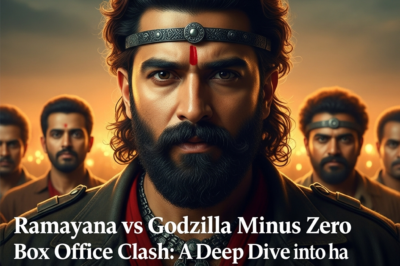
The cinematic landscape is bracing for a seismic shift as two of the most anticipated films of the decade prepare for a head-on collision at the global box office. On November 6, the Indian mythological epic ‘Ramayana,’ directed by the visionary Nitesh Tiwari, is set to clash with the critically acclaimed and Academy Award-winning ‘Godzilla Minus Zero.’ This is not merely a battle of ticket sales; it is a profound cultural crossroads where ancient Eastern spirituality meets the modern resurgence of the kaiju genre. For film enthusiasts and industry analysts alike, this date marks a pivotal moment in distribution strategy, particularly as both films vie for the coveted IMAX and PLF (Premium Large Format) screens across the globe. As the buzz intensifies, the stakes have never been higher for the producers, who are looking to capitalize on a post-festival window that promises high footfall but limited premium screen real estate.
The Vision Behind Nitesh Tiwari’s Ramayana: A Cultural Phenomenon
Nitesh Tiwari, known for his masterful storytelling in ‘Dangal’ and ‘Chhichhore,’ has taken on his most ambitious project yet: a multi-part retelling of the Ramayana. This isn’t just another adaptation; it is being touted as the most expensive Indian film ever made. Starring Ranbir Kapoor as Lord Ram, Sai Pallavi as Sita, and Yash as Ravana, the film represents a massive investment in visual effects and historical research. The production has reportedly collaborated with DNEG, a world-class VFX house, to ensure that the divine landscapes of Treta Yuga are rendered with unparalleled realism. The film aims to transcend domestic boundaries, targeting a global audience hungry for authentic Indian narratives presented with international production standards. The release on November 6 is strategically timed to follow the Diwali festive season in India, aiming to sustain the momentum of the holiday spirit while capturing the attention of the international diaspora. The narrative focuses on the internal and external journeys of its protagonists, promising a grounded yet spectacular experience that differentiates itself from previous television or cinematic versions of the epic.
Godzilla Minus Zero: The Resurgence of the King of Monsters
On the other side of the ring stands ‘Godzilla Minus Zero,’ a film that has already redefined what a monster movie can achieve both narratively and technically. Directed by Takashi Yamazaki, this Toho production became a global sensation, eventually securing the Academy Award for Best Visual Effects—a historic first for a Godzilla film. The film’s arrival in various markets on November 6 represents its continued global expansion and re-release strategy in regions where it previously had limited windows. Unlike the high-budget monster-mashups seen in Hollywood, ‘Godzilla Minus Zero’ is celebrated for its deep emotional core, focusing on post-war trauma and the human condition in 1940s Japan. Its portrayal of Godzilla as a terrifying, destructive force of nature rather than a misunderstood anti-hero has resonated deeply with critics and audiences. The clash with ‘Ramayana’ highlights a unique competition: the spectacle of divinity versus the spectacle of destruction. For cinema-goers, the choice on November 6 will be between the spiritual heroism of Lord Ram and the primal, metaphoric power of Godzilla.
The IMAX Dilemma: Why Screen Real Estate Matters
The core of the conflict between these two giants lies in the limited number of IMAX and high-end projection screens. For big-budget spectacles, IMAX is the gold standard of viewing, offering higher ticket prices and a prestige factor that drives opening weekend numbers. ‘Ramayana,’ with its sweeping vistas and intricate battle sequences, was filmed specifically with large-format screens in mind. Similarly, the detailed CGI and sound design of ‘Godzilla Minus Zero’ are best experienced in an immersive environment. In markets like India, Southeast Asia, and parts of North America, the struggle for screen count will be fierce. Theater owners often find themselves in a bind, forced to allocate time slots between a domestic cultural juggernaut and a globally recognized franchise. Industry experts suggest that the performance of both films in their first three days will dictate how screens are redistributed for the following week. This “IMAX War” underscores the growing importance of premium formats in an era where audiences require a unique incentive to leave their home streaming setups.
Comparative Box Office Analysis: Myth vs. Monster
Analyzing the potential box office trajectory of both films requires looking at diverse demographics. ‘Ramayana’ has a massive built-in audience in India and the Middle East, as well as significant interest from the Indian diaspora in the UK and USA. Its success is almost guaranteed domestically, but its goal is to break records on the level of ‘Baahubali’ or ‘RRR.’ Conversely, ‘Godzilla Minus Zero’ has a cult following that has grown into a mainstream powerhouse. It appeals to a global demographic that values storytelling and technical perfection over star power. While ‘Ramayana’ relies on the charismatic pull of Ranbir Kapoor and Yash, ‘Godzilla’ relies on its legacy brand and critical acclaim. The November 6 clash will likely see ‘Ramayana’ dominating the Asian markets while ‘Godzilla Minus Zero’ holds its ground in Western territories and Japan. However, the overlap in urban centers will be the true test of which film has the stronger “must-see” factor. Analysts predict that ‘Ramayana’ could potentially open to a staggering 100 crore-plus global day-one tally, while Godzilla aims for long-term legs and high occupancy rates in premium theaters.
The Impact of Visual Effects and Storytelling Mastery
Technological prowess is the common thread between these two contenders. ‘Godzilla Minus Zero’ shocked the industry by producing Oscar-quality effects on a fraction of a Hollywood budget, proving that vision and craft can outweigh sheer financial muscle. Nitesh Tiwari’s ‘Ramayana’ is attempting the opposite: spending heavily to bring Indian cinema on par with the highest global benchmarks. The use of Virtual Production (VP) and advanced motion capture for characters like Hanuman and Ravana’s army is expected to be a game-changer for the Indian industry. This clash is essentially a showcase of how two different filmmaking cultures approach the concept of “spectacle.” One uses a monster as a metaphor for societal guilt and recovery, while the other uses a divine epic to explore dharma, morality, and the victory of light over darkness. The visual language of both films is designed to be epic, meaning the battle on November 6 is as much about the artists behind the scenes as it is about the characters on screen.
Future Outlook: A New Era for Global Cinema
The simultaneous release of ‘Ramayana’ and ‘Godzilla Minus Zero’ signals a new era where regional stories are no longer confined to their home markets. We are seeing a blurring of lines between “foreign” cinema and mainstream blockbusters. As India continues to produce films with global appeal and Japan revitalizes its most iconic IP with renewed artistic vigor, the global box office is becoming more pluralistic. The November 6 clash is a healthy sign for the industry, indicating a robust demand for high-quality, high-concept theatrical experiences. Regardless of which film earns more in the first week, the ultimate winner is the audience, which now has access to diverse, top-tier content that challenges the traditional dominance of Western superhero narratives. This showdown will likely be remembered as the moment when the ‘Epic’ and the ‘Kaiju’ redefined the standards for 21st-century blockbuster filmmaking.
Conclusion: The Dawn of a Cinematic Super-Sunday
In conclusion, the November 6 box office battle between ‘Ramayana’ and ‘Godzilla Minus Zero’ is more than just a scheduling coincidence; it is a testament to the power of high-stakes filmmaking. As both films vie for IMAX dominance, they represent the peak of their respective industries. Nitesh Tiwari’s ‘Ramayana’ carries the weight of a nation’s heritage and expectations, while ‘Godzilla Minus Zero’ carries the prestige of an Oscar-winning legacy. For the film industry, this clash will provide invaluable data on audience preferences and the viability of releasing two massive spectacles simultaneously. As the countdown to November 6 begins, the world watches to see if the divine arrow of Ram or the atomic breath of Godzilla will claim the throne of the box office. One thing is certain: cinema history is about to be made, and the results will resonate through the halls of theaters worldwide for years to come.





































Leave a Reply