
For decades, the field of organ transplantation has been locked in a desperate race against the clock. When a donor organ becomes available, a frantic logistical chain begins, as kidneys, hearts, and livers begin to degrade the moment they are removed from the body. Currently, a human kidney can only survive outside the body for about 24 to 36 hours before it becomes non-viable. This narrow window results in thousands of potentially life-saving organs being discarded every year simply because they could not reach a matching recipient in time. However, a groundbreaking study led by researchers at the University of Minnesota has just shattered these biological boundaries. By successfully reviving pig kidneys that had been vitrified and frozen for an entire year, and then transplanting them into living recipients, scientists have proven that the concept of ‘organ banking’ is no longer a science fiction trope but a looming reality. This breakthrough does more than just save time; it promises to fundamentally rewrite the economics of healthcare and the logistics of global surgery.
The implications of this achievement are staggering. In the United States alone, over 100,000 people are currently on the national transplant waiting list, with the vast majority requiring a kidney. Every day, approximately 17 people die while waiting for an organ that never arrives. The ability to store organs for months or even years would allow for perfect immunological matching, global distribution, and the elimination of the ’emergency’ nature of transplant surgery. This analysis explores the technical marvel of ‘nanowarming,’ the economic disruption of the multi-billion dollar dialysis industry, and the ethical landscape of a world where organs are as readily available as shelf-stable pharmaceuticals.
The Crisis of the Clock: Why Current Organ Preservation Fails
To understand the magnitude of this discovery, one must first understand the failure of traditional organ storage. Currently, organs are kept in ‘static cold storage,’ essentially placed on ice. While this slows down metabolic decay, it does not stop it. Even more problematic is the fact that freezing an organ using conventional methods is fatal to the tissue. When water inside cells freezes, it forms jagged ice crystals that pierce cell membranes and destroy the delicate internal architecture of the organ. This is why we cannot simply ‘freeze’ a human heart and thaw it later; the thawing process itself typically causes the organ to shatter or suffer irreversible vascular damage.
The University of Minnesota team bypassed this ‘crystal’ problem through a process called vitrification. Instead of allowing ice to form, the researchers used high concentrations of cryoprotectant chemicals—essentially biological antifreeze—to turn the liquid inside the organ into a glass-like state. This allows the organ to be cooled to temperatures as low as -150 degrees Celsius without the formation of damaging ice. However, vitrification has historically faced a second, even more difficult hurdle: how do you warm the organ back up quickly and evenly enough to prevent it from cracking or being poisoned by the very chemicals used to protect it?
The Nanowarming Revolution: Solving the Re-thawing Dilemma
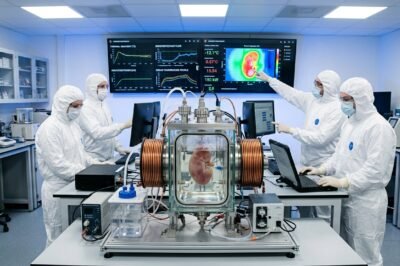
The true genius of this latest experiment lies in a technology called ‘nanowarming.’ Traditional warming methods, such as placing an organ in a warm bath, work from the outside in. This creates thermal gradients where the outside of the organ thaws while the inside remains frozen, leading to structural failure. To solve this, the researchers infused the pig kidneys with iron oxide nanoparticles. When the organ was ready to be revived, it was placed inside an electromagnetic coil that generated a rapidly oscillating magnetic field. This field interacted with the iron nanoparticles, causing them to generate heat uniformly throughout the entire organ simultaneously.
Key technical highlights of the nanowarming process include:
- Uniform Heating: The organ warmed at a rate of several hundred degrees per minute, preventing the formation of ice crystals during the transition phase.
- Nanoparticle Removal: After warming, the iron oxide particles were successfully flushed out of the organ’s vascular system, ensuring no toxic metallic residue remained.
- Full Functional Recovery: Upon transplantation back into the pigs, the kidneys resumed full metabolic function within minutes, filtering waste and producing urine just as a healthy kidney would.
This successful revival after a full year of storage is a world-first. It proves that the biological ‘pause button’ can be hit for extended periods without degrading the complex vascular and cellular networks required for a life-sustaining organ.
Economic and Market Implications for the Healthcare Sector
From a financial perspective, the ability to store organs long-term is a disruptive force of massive proportions. The global dialysis market, dominated by giants like DaVita and Fresenius Medical Care, is valued at nearly $100 billion annually. In the U.S., Medicare spends over $50 billion every year on patients with end-stage renal disease (ESRD). A single kidney transplant, while expensive upfront, saves the healthcare system hundreds of thousands of dollars over the lifetime of the patient compared to the ongoing costs of dialysis. By increasing the supply and availability of viable kidneys, this technology could lead to a significant shift in healthcare spending away from chronic maintenance and toward curative surgical intervention.
Furthermore, the biotech sector is likely to see a surge in investment toward ‘organ banking’ infrastructure. Companies specializing in cryoprotectants, induction heating technologies, and specialized logistics will become central to the medical supply chain. We are looking at the birth of a new industry dedicated to the long-term preservation of complex biological assets. This also synergizes with the burgeoning field of xenotransplantation—using genetically modified pig organs for human use. If we can grow human-compatible organs in pigs and then store them in ‘banks’ using nanowarming, the organ shortage could be solved entirely within the next decade.
The Future of ‘Organ Banking’ and Global Logistics
If organs can be stored for years, the geographical barriers to transplantation vanish. Currently, an organ recovered in New York rarely makes it to a patient in California due to travel time. With vitrification and nanowarming, a kidney could be harvested in one part of the world, stored in a centralized bank, and shipped via standard cold-chain logistics to a matching patient anywhere on the globe. This would allow for much higher ‘HLA matching’ precision, which is the gold standard for preventing organ rejection. Currently, doctors often settle for ‘good enough’ matches because the clock is ticking; organ banking allows them to wait for the ‘perfect’ match.
Moreover, this technology has applications beyond kidneys. Researchers are already looking at how nanowarming could be applied to hearts, livers, and even complex tissues like limbs or skin grafts. The ability to ‘pause’ life at the cellular level has profound implications for emergency medicine, allowing surgeons to stabilize patients or preserve damaged tissues that would otherwise be lost. The ‘organ bank’ of the future will likely look less like a hospital and more like a high-tech fulfillment center, where perfectly preserved biological units are dispatched on demand.
Conclusion: Rewriting the Bioethical Script for the 21st Century
The revival of pig kidneys after a year in deep freeze marks the beginning of the end for the organ donor crisis. While the transition from porcine models to human trials will require rigorous FDA oversight and years of safety testing, the fundamental physics and biology have now been proven. We are moving from a world of scarcity, where life and death are determined by a ticking clock, to a world of abundance, where life-saving organs are treated as a manageable medical resource. However, this transition will also bring new ethical challenges, such as ensuring equitable access to these ‘banked’ organs and managing the costs of this high-tech preservation. Ultimately, the work at the University of Minnesota has done more than just save a pig’s kidney; it has offered a glimpse into a future where no one has to die while waiting for a second chance at life.






































Leave a Reply