
Introduction: A New Era in Oncology
For decades, the standard protocol for treating prostate cancer involved a grueling schedule of daily radiotherapy sessions, often stretching over seven to eight weeks. Patients were forced to reorganize their lives, traveling to hospitals for up to 40 individual appointments, which created significant physical, emotional, and financial burdens. However, a revolutionary shift is occurring in the medical landscape. Recent clinical findings, highlighted by prestigious institutions and reported by outlets like The Week, suggest that the future of prostate cancer treatment may lie in just two high-intensity radiation sessions. This breakthrough, driven by the advancement of ultra-hypofractionated radiotherapy, promises to maintain the same level of curative success while drastically reducing the time patients spend in the clinic. As we stand on the precipice of this medical evolution, it is essential to understand the science, the trial results, and the profound implications this has for millions of men worldwide.
The Evolution of Radiation: From Weeks to Days
To appreciate the significance of a two-session treatment, one must look at the history of radiation oncology. Traditionally, radiation was delivered in small, daily doses (fractions) to minimize damage to the healthy tissue surrounding the prostate, such as the rectum and bladder. This ‘conventional fractionation’ was the gold standard because it was believed that prostate cancer cells were best eradicated through consistent, lower-intensity exposure over a long period. In the early 2000s, ‘moderate hypofractionation’ emerged, reducing treatment to roughly 20 sessions over four weeks. This was a major step forward, but the ultimate goal remained ‘ultra-hypofractionation’—delivering the entire therapeutic dose in five or fewer sessions. The move toward two sessions is the logical, albeit daring, conclusion of this trend, made possible only by modern imaging and robotic precision that can target tumors with sub-millimeter accuracy.
Analyzing the PACE-B Trial: The Catalyst for Change
The core of this breakthrough is the PACE-B (Prostate Fractionated Irradiation of Neoplasia and Conditioning) trial, led by researchers at the Royal Marsden NHS Foundation Trust and the Institute of Cancer Research in London. This large-scale, international study aimed to determine if ultra-hypofractionated Stereotactic Body Radiotherapy (SBRT) was as effective and safe as conventional treatment. The results have been nothing short of transformative. Data indicated that patients receiving the concentrated, short-course treatment showed no significant difference in side effects or cancer recurrence rates compared to those on the traditional eight-week schedule. Building on this, researchers have explored even further compression of the schedule, moving from five sessions down to just two. The success of these trials suggests that the biological response of prostate cancer to high-dose radiation is more favorable than previously thought, allowing for a ‘blitz’ approach that destroys the DNA of cancer cells while sparing the patient months of therapy.
The Technology Behind the Precision: SBRT and Robotic Arms
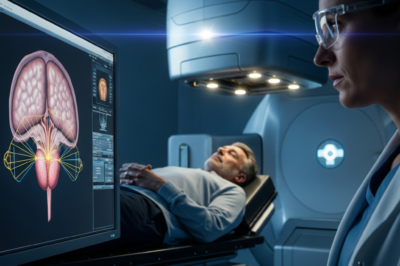
Treating cancer in just two sessions requires a level of precision that was historically impossible. Conventional machines often struggle with the fact that the prostate is not a fixed target; it can move slightly due to breathing or the filling of the bladder. To solve this, ultra-hypofractionated treatment utilizes Stereotactic Body Radiotherapy (SBRT) delivered via systems like the CyberKnife or highly advanced Linear Accelerators (Linacs). These machines use real-time image guidance and sophisticated software to track the prostate’s movement during the procedure. If the target shifts even a fraction of a millimeter, the robotic arm adjusts the beam instantly or pauses the treatment. This ‘pinpoint’ accuracy is what allows oncologists to deliver a massive dose of radiation in just two sessions. By concentrating the energy so precisely, the dose fall-off is incredibly sharp, ensuring that the rectum and bladder receive minimal exposure, which is critical when using such high-potency radiation.
Patient Quality of Life and Psychological Impact
The benefits of a two-day treatment plan extend far beyond the clinical outcomes. For many men, a diagnosis of prostate cancer is accompanied by ‘treatment fatigue’—the dread of the long road ahead. Reducing the treatment window from two months to two days has an immeasurable impact on mental health. It allows patients to return to their normal lives, hobbies, and families almost immediately. Furthermore, for patients living in rural areas or developing nations, where access to specialized oncology centers is limited, the two-session model is a game-changer. It reduces the need for long-term accommodation near hospitals and lowers the overall cost of care. From a psychological perspective, finishing a cancer journey in a single week rather than a whole season provides a sense of closure and empowerment that the traditional model simply cannot offer.
Economic Implications for Global Healthcare Systems
Healthcare systems worldwide are under immense pressure to handle rising cancer rates with limited resources. In the UK, the NHS could potentially save millions of pounds by adopting ultra-hypofractionated protocols as the standard of care. Fewer sessions per patient mean that radiation machines (which are incredibly expensive) are freed up to treat a higher volume of people. This reduces waiting lists and ensures that more patients receive timely care. Moreover, the reduction in administrative costs, staff hours, and facility usage makes the two-session model an economically superior option. As insurance companies and national health boards analyze the cost-benefit ratio, the push for shorter, more intense radiation cycles is likely to become the preferred recommendation for low-to-intermediate risk prostate cancer cases globally.
Potential Risks and the Importance of Patient Selection
While the prospect of two-session treatment is exciting, medical experts urge a balanced view. Not every patient is a candidate for ultra-hypofractionation. Currently, the most successful outcomes are seen in men with low-to-intermediate risk prostate cancer where the tumor is localized and hasn’t spread to distant lymph nodes. There are also concerns regarding late-term toxicity; while five-year data is very promising, oncologists continue to monitor patients for long-term effects on bowel and urinary function. Delivering a high dose in a short time leaves less room for error. If the radiation is slightly off-target, the damage to healthy tissue could be more severe than in a low-dose, long-term approach. Therefore, the expertise of the radiation oncology team and the quality of the imaging equipment are paramount. Patients must undergo rigorous screening to ensure their anatomy and tumor profile are suited for this aggressive schedule.
Future Outlook: Is This the End of Conventional Radiation?
As research continues, we are likely to see the two-session model become increasingly common in high-tier cancer centers. We are also seeing similar ‘hypofractionation’ trends in breast and lung cancer treatments, suggesting a broader shift in the philosophy of radiation oncology. The next decade will likely focus on refining these two sessions even further, perhaps integrating artificial intelligence to predict exactly how a tumor will respond to specific doses. The goal is moving toward ‘personalized radiotherapy’ where the number of sessions is tailored perfectly to the individual’s genetic and biological markers. While conventional radiation may still have a role for complex, high-risk cases, its days as the universal standard for prostate cancer appear to be numbered.
Conclusion: A Triumph of Medical Innovation
The possibility of treating prostate cancer in just two radiation sessions is more than just a scientific curiosity; it is a triumph of engineering and biological understanding. It represents a shift from a ‘one size fits all’ approach to a highly targeted, efficient, and patient-centric model of care. For the thousands of men diagnosed with this disease every year, the news from trials like PACE-B offers a vision of the future where cancer treatment is a brief interruption rather than a life-altering ordeal. As technology continues to sharpen our focus and trials continue to validate these shorter protocols, the two-session treatment is set to redefine the oncology landscape, making the fight against prostate cancer faster, safer, and more accessible than ever before.







































Leave a Reply