
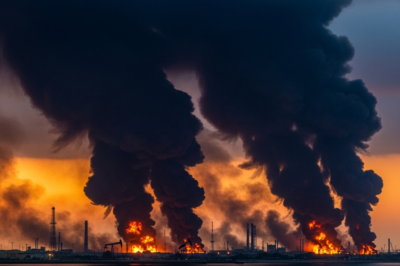
The geopolitical landscape of West Asia has been thrust into a state of heightened alarm following reports of significant fire outbreaks in Kuwait, allegedly triggered by an Iranian-led or proxy-driven offensive. As the regional conflict spreads its shadow across the Gulf, the once-stable enclave of Kuwait finds itself caught in the crossfire of a rapidly deteriorating security situation. This latest incident, which resulted in injuries to several first responders and sparked two massive fires at industrial and residential sectors, marks a terrifying expansion of the conflict that has already decimated parts of Gaza and Lebanon. The international community is now looking toward the Kuwaiti government and the Iranian leadership to see if this represents a direct escalation or a tragic consequence of the stray-missile syndrome that has plagued the region since the outbreak of hostiles between major regional powers. For years, the fragile peace in the Middle East has relied on a complex web of deterrents, but as smoke rises over Kuwait City and the surrounding oil-rich districts, those deterrents appear to be crumbling. The implications of this event are staggering, threatening not only regional stability but also the global energy market and the safety of millions of expatriate workers residing in the Gulf Cooperation Council (GCC) nations.
The Immediate Aftermath: Fires, Casualties, and Emergency Response
The emergency services in Kuwait were mobilized in the early hours of the morning following reports of loud explosions followed by plumes of thick, black smoke visible for miles. According to local reports and international news agencies, the fires broke out in two distinct locations. The first was reported at a logistics hub near the Shuaiba industrial area, a critical node for Kuwait’s economic infrastructure. The second blaze occurred in a residential-commercial district, leading to a frantic evacuation of civilians. Firefighters, who have been praised for their bravery, faced immense challenges as the blazes were fueled by flammable materials and exacerbated by high winds. At least five firefighters were reported injured, with some suffering from severe smoke inhalation and others from thermal burns sustained during the initial blast suppression efforts. Medical facilities in Kuwait City have been placed on high alert, and the Ministry of Interior has cordoned off the affected areas, citing the potential for unexploded ordnance or secondary devices. The psychological impact on the population cannot be overstated; Kuwait has long prided itself on being a haven of neutrality and safety amidst the tumultuous politics of West Asia. Seeing its own soil under fire has sent shockwaves through the local community and the massive foreign workforce that keeps the nation’s economy running.
The Geopolitical Chessboard: Why Kuwait is Now in the Crosshairs
To understand why an attack on Kuwait is so significant, one must look at the broader map of the West Asian conflict. Traditionally, Kuwait has maintained a delicate balancing act, maintaining strong ties with the United States and its GCC neighbors while attempting to keep diplomatic channels open with Tehran. However, as the shadow war between Iran and Israel comes into the light, and as the U.S. strengthens its military posture in the region, neutral ground is becoming increasingly scarce. Analysts suggest that the attack may have been intended as a warning shot to the GCC states, signaling that no nation is truly safe if a full-scale regional war erupts. Iran’s military strategy has frequently utilized ‘grey zone’ warfare—using proxies like the Houthis in Yemen or militias in Iraq to conduct strikes that allow for plausible deniability. Whether these fires were caused by a direct Iranian missile, a drone launched by a regional proxy, or debris from an intercepted projectile remains the subject of intense investigation. The strategic location of Kuwait, situated between Iraq, Saudi Arabia, and the Persian Gulf, makes it an unfortunate geographical casualty in the trajectory of missiles launched from northern or eastern sites toward southern targets.
Iranian Missile Capabilities and the ‘Axis of Resistance’
Iran possesses the largest and most diverse missile arsenal in the Middle East, with thousands of ballistic and cruise missiles, as well as a sophisticated drone program. The ‘Axis of Resistance’—a network of allied groups including Hezbollah, Hamas, and various PMF groups in Iraq—serves as a force multiplier for Tehran. In recent months, these groups have increased their coordination, aiming to overwhelm the air defense systems of their adversaries. The incident in Kuwait highlights the limitations of regional missile defense. While systems like the Patriot batteries and the Aegis-equipped ships in the Gulf are highly capable, the sheer volume of low-flying drones and high-velocity missiles can occasionally penetrate the defensive umbrella. Military experts point out that the drones used in these types of attacks, such as the Shahed-series loitering munitions, are difficult to detect on traditional radar because of their low altitude and small RCS (Radar Cross Section). This technological evolution in warfare means that industrial assets, like Kuwaiti oil refineries and power plants, are more vulnerable than ever before. The international community is now debating whether a more integrated regional air defense system, often referred to as a ‘Middle East NATO,’ is necessary to prevent further incidents of this nature.
Economic Ripples: Oil Markets and Global Supply Chains
Kuwait is a cornerstone of the global energy market, holding approximately 7% of the world’s proven oil reserves. Any instability within its borders immediately resonates through the commodity pits in London and New York. Following the reports of the fires, Brent Crude prices saw a sharp uptick as traders factored in the ‘geopolitical risk premium.’ The Shuaiba area, where one of the fires occurred, is vital for the export of petroleum products. If Kuwaiti infrastructure is targeted or even incidentally damaged, the ripple effects would be felt globally, particularly in energy-dependent economies in Asia, including India and China. Furthermore, the insurance rates for maritime shipping in the Persian Gulf and the Strait of Hormuz are expected to skyrocket. We have seen this pattern before during the ‘Tanker War’ of the 1980s, but the modern global economy is far more interconnected and less resilient to sudden shocks. A prolonged conflict that involves Kuwait could lead to a global energy crisis, potentially triggering inflationary pressures that would hamper the post-pandemic recovery of many nations. Investors are currently watching for a statement from OPEC regarding production quotas and security measures for energy infrastructure across the Gulf.
Humanitarian and Diplomatic Consequences
The injuries to firefighters in Kuwait are a grim reminder of the human cost of these political machinations. These first responders are often the unsung heroes of regional conflicts, risking their lives to contain disasters they did nothing to create. Beyond the physical injuries, the threat of war creates a humanitarian crisis of displacement and fear. Kuwait hosts a vast population of expatriates from India, Egypt, Pakistan, and the Philippines. A major escalation would necessitate a massive evacuation effort, the likes of which have not been seen since 1990. On the diplomatic front, the UN Security Council has been called upon to convene an emergency session. Kuwaiti diplomats are reportedly working around the clock to garner international support and to demand a formal investigation into the origin of the strikes. The tension is palpable in the halls of power in Geneva and New York, where the fear is that this incident could be the ‘Archduke Franz Ferdinand moment’ for a wider Middle Eastern war. Diplomats are urging for a ‘maximum restraint’ policy, but with blood on the ground and fire in the sky, the appetite for restraint is thinning among regional leaders who feel their sovereignty is being violated.
The Path Forward: De-escalation or Total War?
The situation in West Asia is at a crossroads. One path leads toward a diplomatic off-ramp, involving high-level negotiations facilitated by neutral parties like Oman or Qatar. This would require Iran to pull back its regional proxies and for the U.S. and its allies to provide security guarantees that address the underlying grievances of the various factions. The other path, which feels increasingly likely after the Kuwait incident, is one of total regional war. In this scenario, the conflict would no longer be confined to specific borders but would engulf the entire Persian Gulf, leading to a catastrophe that could last for decades. The coming days will be critical. The world is watching to see if Kuwait retaliates, if the GCC issues a collective military response, or if the fires in Kuwait serve as a final warning that forces all parties to the table. For now, the smoke rising over the desert is a somber testament to the fragility of peace and the terrifying reality of modern warfare where no one, not even a neutral neighbor, is truly safe from the flames of conflict.



































Leave a Reply